Meet the Legend: Masterpiece of Tensile Design
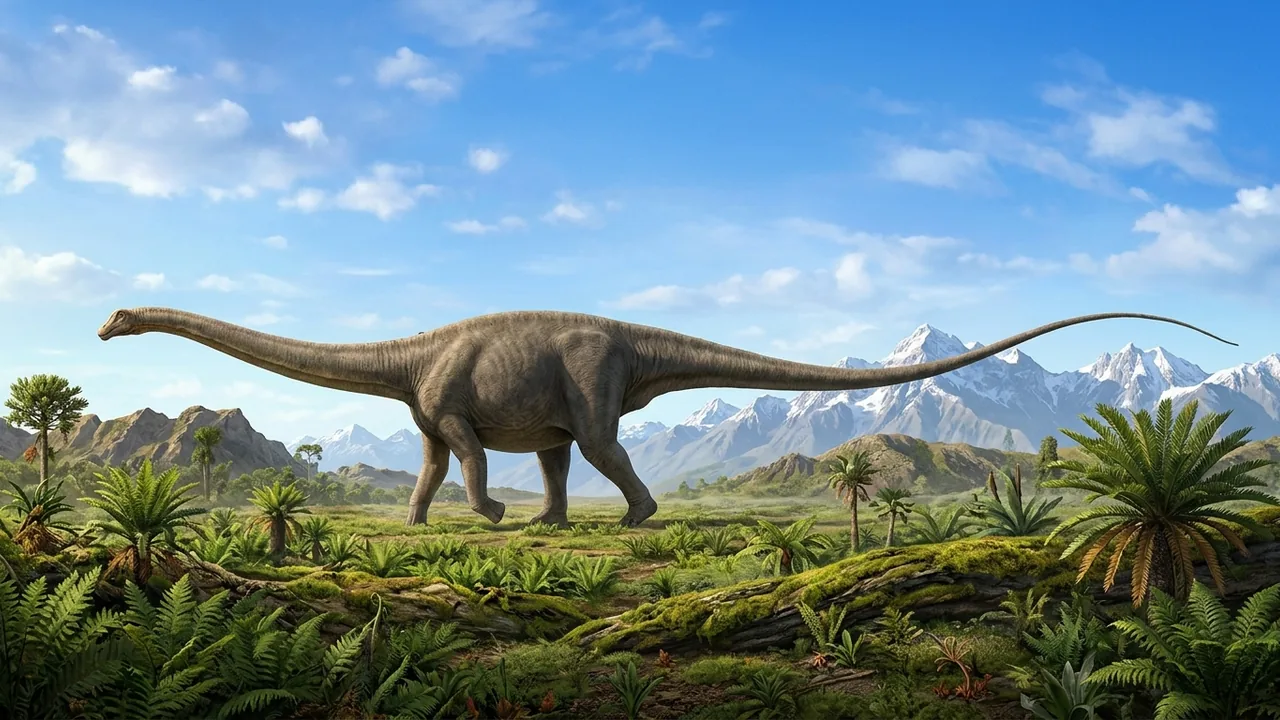
Within the sauropod radiation of the Late Jurassic, Diplodocus exemplifies extreme axial elongation paired with remarkable skeletal economy. Whereas macronarians such as Brachiosaurus invested mass into elevated shoulders and deep thoraces, Diplodocus carnegii stretched twenty-six to twenty-seven meters from premaxilla to tail tip while maintaining an estimated body mass of just twelve to fifteen metric tons—roughly one-third the weight of a comparably long titanosaur.
Othniel Charles Marsh erected the genus in 1878 from Morrison Formation fossils collected near Cañon City, Colorado, naming it 'double beam' in reference to the distinctive anteriorly and posteriorly elongated haemal arches (chevrons) beneath its mid- vertebrae. Those twin-beamed chevrons shielded the caudal artery and vein while stiffening the mid-tail into a load-bearing lever.
Viewed laterally, the entire skeleton operated as a balanced double-cantilever suspension bridge anchored over robust pelvic girdles and taller hind limbs. Fifteen elongate cervical vertebrae projected six meters forward, counterweighted cleanly by roughly eighty caudal segments stretching nearly fourteen meters astern.
Extensive postcranial skeletal hollowed out the vertebral centra into thin-walled bony honeycombs, allowing Diplodocus to sweep vast horizontal foraging envelopes without bogging down in seasonal floodplain sediments.
Even its elongated skull—barely sixty centimeters long with retracted external nares positioned high ahead of the orbits—minimized terminal weight at the end of its slender cervical beam, optimizing agility across open Jurassic savannas while preserving keen olfactory and visual awareness along the horizon. Every vertebra, rib, and limb bone reflected natural selection's blueprint for maximum linear reach at minimum structural weight.
Lost World Habitat: Morrison Fern Savannas
Precision argon-argon radiometric dating and basin-wide within the Brushy Basin Member of the Morrison Formation place Diplodocus between 154 and 152 million years ago across the Western Interior of Laurentia. During the Kimmeridgian stage, uplift to the west cast a rain shadow over sprawling alluvial plains crisscrossed by seasonal braided streams, oxbow lakes, and alkaline wetlands.
Because true angiosperm grasses would not diversify until the Late Cretaceous, open Morrison interfluves supported vast herbaceous savannas dominated by pteridophyte ferns, lycopods, Equisetum horsetails, and low bennettitalean cycadophytes, bordered by taller conifer-ginkgo gallery woods along perennial channels.
Isotopic carbon signatures and quarry taphonomy show Diplodocus thrived across these open lowland meadows by exploiting a low-to-medium horizontal browsing horizon distinct from high-canopy Brachiosaurus and tough-shrub specialist Camarasaurus. Trackway assemblages preserve parallel multi-individual trails lacking any medial drag furrow, confirming gregarious herds cruised briskly with necks and tails suspended clear of the substrate.
Even juvenile cohorts left size-segregated trackways near wooded lake margins, illustrating how age classes partitioned microhabitats across the heterogeneous Morrison landscape as seasonal rains shifted green forage patches across hundreds of kilometers.
Sharing these sunlit fern savannas were plated Stegosaurus stenops, nimble ornithopods like Dryosaurus, burrowing lungfish aestivating inside dry-season mud cocoons, and patrolling theropods whose tooth-marked bones appear alongside sauropod skeletons in drought-concentrated quarry bonebeds from Wyoming to Utah. Together these fossil clues reveal a dynamic, sun-drenched floodplain ecosystem sculpted continuously by migrating long-necked herbivores across thousands of Late Jurassic seasons.
What's on the Prehistoric Menu?
Cranial biomechanics in Diplodocus diverged sharply from broad-snouted macronarians. Its elongate, horse-sized skull terminated in a subrectangular, squared-off rostrum housing slender, cylindrical, peg teeth restricted entirely to the anterior premaxilla, maxilla, and dentary. No grinding cheek dentition existed posteriorly, and the jaw articulation permitted slight propalinal fore-and-aft sliding.
Three-dimensional finite-element stress simulations conducted by Mark Young, Emily Rayfield, and Paul Barrett tested competing foraging hypotheses on digital CT skull reconstructions. Their models demonstrated that unilateral branch stripping—clamping frond stems gently and drawing the head laterally or posteriorly to comb away pinnae—generated low, safely distributed cranial stresses, supplemented by direct ground-level cropping of soft ferns and Equisetum shoots.
Dental microwear scratches on labial and lingual enamel facets corroborate abrasive consumption of grit-coated ground vegetation. To counteract rapid wear from phytolith-bearing horsetails, Diplodocus maintained stacked batteries of up to five replacement crowns per alveolus, erupting a fresh tooth roughly every thirty-five days!
Swallowed whole without oral mastication, huge daily volumes of fibrous pteridophytes fermented over several days inside a capacious hindgut chamber, while cervical minimized the energetic cost of sweeping six-meter horizontal grazing arcs.
Laser-scanned range-of-motion studies indicate that when low savanna ferns withered during peak dry seasons, Diplodocus could rock its center of mass backward onto its muscular hind limbs and reinforced mid-tail chevrons, elevating its squared muzzle nearly ten meters high to strip mid-canopy ginkgo and conifer shoots without competing directly against towering Brachiosaurus. That dual-height foraging versatility buffered diplodocid herds against unpredictable climate swings.
Superpowers, Senses & Anatomy
Suspending a six-meter neck horizontally imposed immense bending moments at the cervicodorsal junction, yet Diplodocus solved this challenge through passive tensile architecture. From the mid-neck backward into the anterior dorsals, the vertical neural spines became deeply —split into paired bony prongs forming a U-shaped median channel.
Anatomists reconstruct a massive elastic nuchal and supraspinous ligament system seated directly inside those bifurcated troughs, storing and returning elastic strain energy like a crane cable whenever the head dipped toward ground ferns and recoiled upward. Simultaneously, invasive respiratory diverticula produced intricate camellate and camerate throughout the presacral column, removing over half of the solid bone mass while preserving high-modulus cortical struts.
In 2022, Cary Woodruff and colleagues provided direct pathological proof of this avian-style pulmonary network in MOR 7029 ('Dolly'), an immature Montana diplodocid whose cervical pleurocoels preserved broccoli-shaped osteoproliferative lesions diagnostic of airsacculitis—an infectious respiratory inflammation today seen in birds!
Complementing this internal engineering, carbonaceous skin impressions from the Howe Quarry revealed non-overlapping polygonal scales surmounted along the midline by narrow, laterally compressed keratinous dermal spines up to eighteen centimeters tall.
Limb posture showed equal refinement: tubular metacarpals stood vertically in a tight semi-tubular colonnade lacking external claws on digits two through five, while a single laterally compressed pollex ungual curved medially from the thumb for substrate grip and close-quarters defense across muddy floodplain channels and slick riverbank point bars. Every tissue layer worked in concert to keep fifteen metric tons remarkably nimble.
Flight vs. Fight Arena: Whip Physics & Herd Defense
Across open Morrison savannas patrolled by Allosaurus fragilis, Torvosaurus tanneri, and Ceratosaurus nasicornis, Diplodocus navigated starkly different survival regimes from hatchling to adulthood. Precocial neonates emerging from buried floodplain egg clutches weighed scarcely two kilograms and lacked parental brood care, relying on dense riparian cover and fibrolamellar bone growth rates to race past vulnerable size classes.
Adult Diplodocus, however, stood firmly on Team Fight through axial weaponry and herd cohesion. Its distal thirty vertebrae elongated into slender, biconvex bony rods only millimeters in diameter—closely resembling a Peruvian bullwhip lash. In 1997, Nathan Myhrvold and Philip Currie modeled wave propagation along this tapering chain and proposed that muscular pelvic oscillations could accelerate the tip past Mach 1 (340 meters per second), unleashing deafening sonic booms!
In 2022, multibody finite-element simulations by Simone Conti and colleagues incorporated realistic skin, tendon, and intervertebral cartilage strain thresholds, concluding that biological tissues would rupture above roughly thirty-three meters per second (~74 mph)—still faster than a highway vehicle and capable of delivering stinging kinetic impacts across a fourteen-meter radius!
Paired with spinal stability, forelimb thumb unguals, and coordinated multi-ton herd flanks, that sweeping caudal lash deterred solitary predators from closing on adult Diplodocus.
Pathological fusions called diffuse idiopathic skeletal hyperostosis observed precisely around the mid-tail transition between stiffened double-beam chevrons and flexible whip segments provide physical osteological evidence that living diplodocids swung their tails forcefully throughout adulthood, establishing wide acoustic and mechanical safety perimeters around feeding herds.
Fossil Detective Secrets: Remounting an Icon
Modern understanding of Diplodocus traces back to Independence Day, July 4, 1899, when Carnegie Museum fieldmen Earl Douglass and Arthur Coggeshall uncovered pristine articulated vertebrae in Upper Jurassic Morrison at Sheep Creek, Albany County, Wyoming. Described by John Bell Hatcher in 1901 as Diplodocus carnegii in honor of patron Andrew Carnegie, composite cast replicas of 'Dippy' were dispatched to national museums in London, Berlin, Paris, Vienna, Madrid, St. Petersburg, La Plata, and Mexico City between 1905 and 1930.
Early twentieth-century mounts reflected Victorian reptile assumptions: splayed lizard-like elbows in some sketches, drooping necks, and forty-five-foot tails resting inertly along museum floorboards. During the Dinosaur Renaissance of the 1970s and 1980s, ichnologists examining Morrison trackways noted narrow-gauge upright limb posture and complete absence of drag traces, prompting institutions worldwide to hoist Dippy's tail into an active horizontal counterbalance.
Subsequent cladistic revisions—including Emanuel Tschopp's comprehensive 2015 diplodocid matrix—reassigned historical skull material, confirmed that gigantic New Mexico 'Seismosaurus' belonged within the genus as Diplodocus hallorum, and mapped how dentition evolved across Diplodocinae.
Today, laser surface scanning, bone histology, and synchrotron imaging continue transforming Carnegie's century-old Wyoming ambassador into a dynamic benchmark for Mesozoic biomechanics.
Few paleontological journeys better illustrate how museum collections bridge eras—allowing twenty-first-century engineers and clinicians to test respiratory medicine, ligament mechanics, and acoustic wave physics inside skeletons excavated by horse-drawn wagons over a century ago across the badlands of the American West. Every generation of young visitors standing beneath Dippy witnesses living scientific discovery in action.