Meet the Legend: Sleek Suspension Bridge
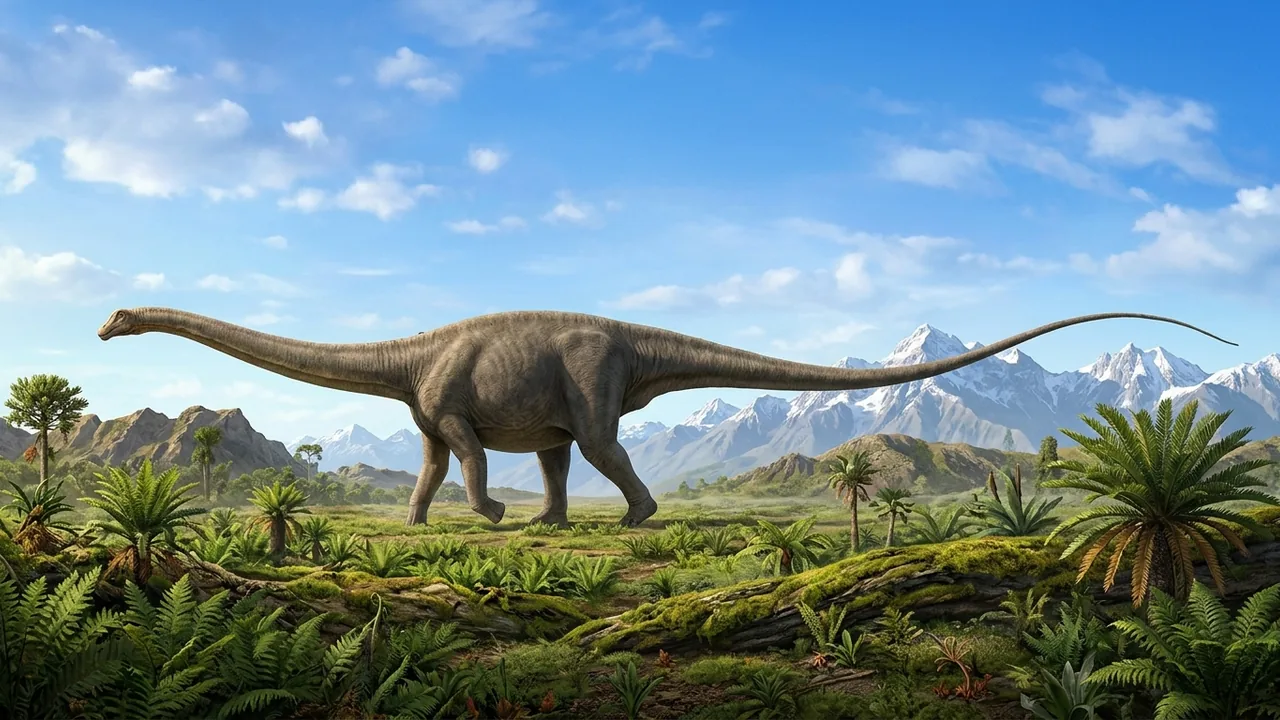
Meet one of the longest animals ever to walk on dry land—Diplodocus (dih-PLOD-oh-kus)! Stretching up to ninety feet from nose to tail, this graceful was longer than a tennis court, yet weighed only about fifteen tons. That made it sleek and athletic compared to bulkier cousins like Brachiosaurus.
Scientists gave Diplodocus the name double beam after spotting special two-pronged bones tucked underneath its tail. Instead of towering straight upward into the clouds, Diplodocus held its slender neck and whip-thin tail level above the ground like a living suspension bridge!
Lost World Habitat: Open Fern Meadows
Around 153 million years ago in the Late Jurassic Period, warm seasonal plains spread across Wyoming, Colorado, and Utah. Winding rivers overflowed each rainy season, watering vast green carpets of low ferns, clubmosses, and jointed reeds.
Diplodocus thrived out on these open fern savannas where tall trees grew farther apart. Traveling in watchful family herds, each long swept its neck smoothly from left to right like a vacuum hose, clearing wide paths through dewy morning greens while armored Stegosaurus grazed peacefully nearby.
What's on the Prehistoric Menu?
Open the jaws of Diplodocus and you would spot a surprising dental tool kit! All of its pencil-thin teeth clustered right at the squared front edge of its mouth, leaving the back of its jaws completely toothless. Those slanted pegs worked just like a blueberry comb or garden rake.
Clamping gently onto a leafy fern frond or stem, Diplodocus tugged its head sideways and stripped off mouthfuls of tender greens without snapping woody branches. Because its horizontal neck reached twenty feet ahead, this clever could graze a huge semicircle before taking another step!
Superpowers, Senses & Anatomy
Old dinosaur books often showed Diplodocus dragging its heavy tail through swamp mud like an alligator. Fossil trackways proved that picture completely wrong—there are zero tail-drag grooves between its footprints! Instead, its forty-five-foot tail floated level in the air as a perfect to its twenty-foot neck.
Underneath the middle tail bones, twin-beamed bones acted like protective skids for blood vessels and strong ligaments. Meanwhile, lightweight air sacs inside its backbone trimmed extra pounds, and a neat row of pointed keratin spines decorated its back from neck to tail tip.
Flight vs. Fight Arena: Bullwhip Defense
Out on open fern plains, hungry Allosaurus predators watched closely for unprotected youngsters. An adult Diplodocus could not outrun a nimble hunter, so it stood firm on Team Fight using its extraordinary tail! Eighty tail bones narrowed down to slender rods at the very tip, acting as both and weapon.
With a powerful flick of its hip muscles, a wave of energy raced down the forty-five-foot tail until the tip whipped past seventy miles per hour—and possibly cracked louder than thunder! No smart predator wanted to step inside that stinging defensive arc.
Fossil Detective Secrets: Gift to the World
In 1878, fossil hunter Othniel Charles Marsh named the first Diplodocus after studying its unique tail bones from Colorado. Twenty-one years later, museum collectors in Sheep Creek, Wyoming, unearthed a magnificent skeleton nicknamed Dippy for Pittsburgh helper Andrew Carnegie.
When European leaders saw newspaper sketches of Dippy, they begged for copies! Plaster experts molded every bone in this famous and shipped full-sized skeletons to London, Paris, Berlin, Madrid, and Buenos Aires, inspiring generations of young kids to become paleontologists.