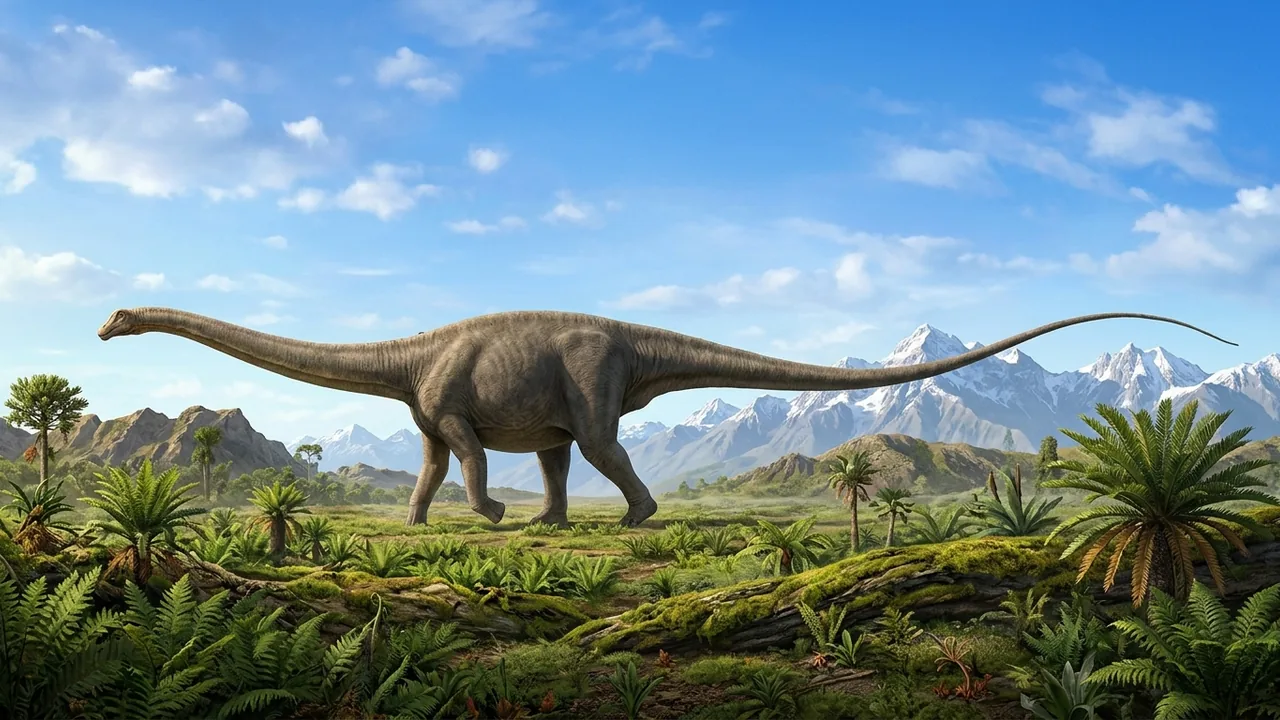
Meet the Legend: Living Cantilever Bridge
Picture a suspension bridge that breathes, walks, and sweeps across a prehistoric plain—that engineering marvel is Diplodocus! Stretching eighty-five to ninety feet from its squared muzzle to its lash-like tail tip, Diplodocus outmeasured almost every neighbor in Late Jurassic North America, yet tipped the scales at a remarkably trim thirteen to sixteen tons.
Paleontologist Othniel Charles Marsh coined the name 'double beam' in 1878 after studying distinctive two-pronged chevron bones beneath its middle tail vertebrae. Applying modern shows why Diplodocus looked so different from towering, front-heavy Brachiosaurus.
With sturdy hind limbs taller than its forelimbs, Diplodocus anchored its center of mass squarely over its pelvis. Out front cantilevered a twenty-one-foot neck; out back extended a forty-five-foot tail composed of roughly eighty tapering vertebrae.
Because deeply air chambers hollowed out its spinal column, this long-bodied titan glided across river valleys with surprising grace, never dragging its tail in the mud.
Even its slender skull weighed just a fraction of a Camarasaurus head, keeping leverage forces low at the end of its horizontal neck as herds strode steadily across wide sunlit floodplains.
Lost World Habitat: Partitioning the Fern Savanna
Between 154 and 152 million years ago, vast semi-arid floodplains covered the Western Interior of North America. Seasonal monsoon rains spilled braided rivers across sunlit lowlands carpeted not with grass, which evolved tens of millions of years later, but with sprawling fern prairies, clubmosses, low cycads, and silica-rich horsetails.
Understanding how Diplodocus shared this Morrison ecosystem with Brachiosaurus, Camarasaurus, Apatosaurus, and Stegosaurus requires examining partitioning. Rather than straining skyward into forty-foot araucaria crowns, Diplodocus held its flexible neck nearly horizontal to sweep wide lateral arcs from ground level up to twelve feet high.
Within the Jurassic food web, fast-growing ferns and horsetails captured abundant solar energy at the producer base, channeling immense energy into migrating Diplodocus herds.
When dry seasons thinned open fern meadows, Diplodocus could rock backward onto its muscular hind legs and braced middle tail skids, rearing tripod-style to browse mid-story ginkgo and conifer foliage up to thirty feet overhead!
Parallel fossilized trackways in Colorado and Wyoming reveal multi-age groups marching along ancient lake shorelines where fresh horsetail shoots sprouted rapidly after warm seasonal floods watered the broad fertile valley.
What's on the Prehistoric Menu?
Capturing enough calories to fuel fifteen tons of active dinosaur demanded relentless foraging efficiency. If you peered inside a Diplodocus skull, you would notice every single pencil-slender tooth crowded along the squared anterior rim of the jaws, angling forward like the tines of a hand rake while the cheek region remained completely toothless.
Finite-element computer models of skull tested three feeding motions—bark biting, ground plucking, and unilateral branch stripping. Stress maps confirmed the slender skull and jaw joints handled sideways branch stripping effortlessly, combing nutrient-rich pinnae off fern rachises and horsetail stems without snapping tough wood.
Because gritty silica crystals inside horsetails abraded enamel rapidly, Diplodocus evolved one of the fastest tooth-replacement rates among sauropods, erupting a fresh crown in each socket roughly every thirty-five days!
Unchewed plant boluses slid down its long esophagus into a massive hindgut fermentation vat, where symbiotic microbes unlocked steady chemical energy from tough Mesozoic plant fibers.
By sweeping a forty-foot semicircle of low greenery from one stationary stance, Diplodocus conserved tremendous muscular energy throughout warm Jurassic afternoons while harvesting hundreds of pounds of greens.
Superpowers, Senses & Anatomy
Supporting a twenty-one-foot neck horizontally without exhausting neck muscles required ingenious skeletal . Along the top of Diplodocus's neck and forward back vertebrae, the bony neural spines split into deep V-shaped forks. Cradled inside that trough ran a thick, rubbery nuchal ligament that acted like an automatic bungee cord, holding the neck aloft passively and springing it back up whenever the head dipped to graze!
At the same time, extensive cavities linked to avian-style air sacs hollowed out the sides of every cervical vertebra into delicate bony honeycombs, slashing skeletal weight while radiating excess body heat during sunny savanna marches.
Down the opposite end of its spine, double-beamed chevron bones beneath tail vertebrae 18 through 25 formed tough sled-like runners that protected caudal arteries whenever the animal propped itself into a feeding tripod.
Preserved skin impressions even revealed a dramatic row of narrow, triangular keratinous spines—up to seven inches tall—marching neatly down the midline of its tail!
Meanwhile, tubular front foot bones arranged in a vertical horseshoe carried chest weight smoothly, leaving a single curved thumb claw free for traction and defense.
Flight vs. Fight Arena: Physics of the Bullwhip
Across open fern savannas, two-ton Allosaurus fragilis and pack-hunting theropods posed lethal threats to young sauropods. Hatchling Diplodocus hatched from cantaloupe-sized eggs buried in warm floodplain trenches and initially hid inside dense forest underbrush—occupying a secretive woodland while growing thousands of pounds heavier each year.
Once mature at fifteen tons, adult Diplodocus shifted squarely onto Team Fight, armed with nature's longest bullwhip! Its final thirty tail vertebrae shrank into lightweight bony rods just millimeters wide, encased in taut skin and tendons.
In 1997, physicist Nathan Myhrvold modeled tail and calculated that a brisk hip swing could accelerate a wave past 767 miles per hour—producing a crack exceeding 200 decibels! More recent 2022 soft-tissue stress models by Simone Conti suggest tendons safely sustained rapid seventy-mile-per-hour strikes—still faster than a highway truck!
Whether cracking at supersonic acoustic speeds to startle predators and signal herd mates or lashing out at highway velocity, that forty-five-foot tail turned open plains into a perilous zone for any stalking Allosaurus.
Adult herds standing flank to flank formed an overlapping wall of sweeping whip tails that guarded growing subadults safely inside the center.
Fossil Detective Secrets: From Sheep Creek to CT Scans
Few individual fossils have shaped global science education like CM 84, the celebrated Diplodocus carnegii skeleton unearthed at Sheep Creek, Wyoming, by Earl Douglass and Arthur Coggeshall in 1899. Financed by Pittsburgh industrialist Andrew Carnegie, 'Dippy' inspired requests from heads of state across Europe and Latin America, prompting Carnegie's mold-makers to ship full-scale plaster casts to ten world capitals.
For seventy years, museum mounts posed Dippy with a drooping tail resting flat on the floor. Beginning in the 1970s, trackway detectives and skeletal experts proved tight vertebral joints and counterbalance ligaments held the tail aloft, inspiring museums worldwide to remount Diplodocus in dynamic, energetic poses!
Modern CT scanners continue unlocking secrets inside diplodocid fossils: in 2022, paleontologist Cary Woodruff documented cauliflower-textured bone growths inside neck cavities of a juvenile diplodocid nicknamed 'Dolly' from Montana.
Those lesions represent the very first fossilized dinosaur respiratory infection ever diagnosed—confirming beyond doubt that bird-like air sacs ventilated Diplodocus necks 150 million years ago, even before any whip theory was imagined!
From Victorian plaster halls to hospital CT scanners, Diplodocus keeps revealing how giant sauropods breathed, moved, and thrived.