Meet the Legend: Ninety-Foot Bridge
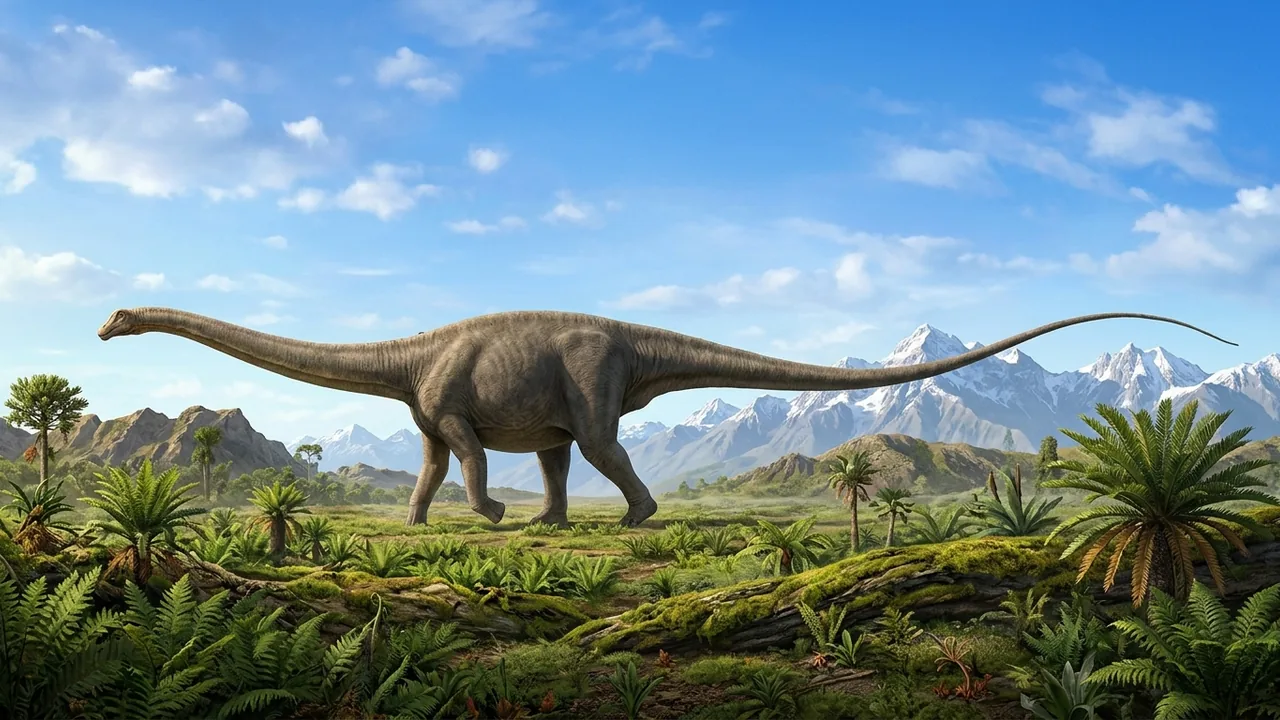
Stretching nearly ninety feet from snout to tail tip, Diplodocus carnegii looked like a living suspension bridge striding across Late Jurassic North America! Although longer than two-and-a-half yellow school buses, this streamlined weighed only thirteen to sixteen tons—less than a third of towering Brachiosaurus.
In 1878, paleontologist Othniel Charles Marsh named Diplodocus, meaning double beam, after examining an unusual tail attachment bone with twin forward and backward prongs. Those double-beamed bones protected vital blood vessels underneath its astonishing forty-five-foot tail.
Every lightweight neck and back vertebra locked into a balanced horizontal frame over sturdy pillar legs, creating a physical built for sweeping wide meadows rather than reaching tall treetops.
When families of Diplodocus marched across sunny western valleys, their long necks and whip tails glided smoothly several feet above the fern-covered ground without ever dragging.
Lost World Habitat: Savannas of Ferns
Roughly 154 to 152 million years ago, Diplodocus inhabited broad, sunlit floodplains stretching across ancient Wyoming, Colorado, Utah, and Montana. Instead of modern grass—which had not evolved yet—lush carpets of ferns, clubmosses, low cycads, and jointed horsetails blanketed open plains between braided rivers.
Sharing one habitat with several giant plant eaters worked smoothly because each species occupied its own ecological . While tall Brachiosaurus trimmed forty-foot evergreen crowns, Diplodocus specialized in the ground-to-twelve-foot fern-savanna niche, sweeping wide arcs across sunlit clearings.
Layers of floodplain mud and sand hardened into rock that preserved Diplodocus bones out West, much as older Mesozoic rift valleys in Virginia's Culpeper Basin preserved dinosaur footprints pressed into ancient lakeside mudstones along the East Coast!
During dry summer months, herds followed winding river channels where underground water kept lush green fern meadows sprouting all year long.
What's on the Prehistoric Menu?
Inside the Late Jurassic food web, sunlit ferns and horsetails captured solar energy as producers, fueling Diplodocus as a massive consumer. Rather than sporting wide spoon-shaped teeth like Brachiosaurus, Diplodocus evolved a blunt, squared-off muzzle lined solely in front with slender, pencil-sized peg teeth.
Microscopic scratch patterns on those teeth reveal a remarkable feeding called unilateral branch stripping. Diplodocus clamped gently onto a fern stem and swept its head sideways, combing off tender leaflets while leaving tough woody stalks intact!
Because its tiny skull held zero chewing molars, swallowed greens passed straight into an enormous gut chamber where billions of helpful microbes digested fibrous cell walls. Rapid tooth replacement sprouted fresh enamel pegs every few weeks whenever gritty horsetails wore older teeth down.
By swinging its twenty-foot neck from left to right like a living lawn rake, Diplodocus cleared wide semicircles of greenery while standing completely still.
Superpowers, Senses & Anatomy
How did Diplodocus hold twenty feet of neck and forty-five feet of tail cleanly off the ground all day? Each cervical and dorsal contained hollow air-sac chambers connected to bird-like lungs, trimming tons of bone weight without losing strength.
Strong elastic ligaments ran along notched neural spines atop its hips and back like steel cables on a bridge, letting the long tail counterbalance the neck effortlessly. Meanwhile, shorter front legs and longer hind legs positioned its center of gravity right over its muscular hips—allowing Diplodocus to rear onto a stable tripod of hind legs and tail when reaching mid-level conifer branches!
Amazingly, rare fossilized skin impressions preserved in fine mudstone revealed polygonal scales plus a striking midline row of pointed keratin spines running along its tail.
Broad nasal openings set high behind its snout gave Diplodocus a sharp sense of smell to locate damp fern hollows and sniff approaching predators.
Flight vs. Fight Arena: Whip-Tail Guardian
Crossing wide fern savannas exposed Diplodocus herds to sharp-eyed predators like Allosaurus and Ceratosaurus. Running fast was impossible for a fifteen-ton giant, so Diplodocus relied on behavioral teamwork and a spectacular tail on Team Fight!
Its last thirty tail vertebrae narrowed into slender cylinders wrapped in tough skin and tendons, forming a living bullwhip. Physics models show a muscular hip swing accelerated a wave down that tapering tail at highway speeds—potentially cracking faster than the speed of sound with a thunderous boom!
Young Diplodocus grew rapidly inside dense woodland cover, filling a sheltered juvenile until large enough to join adult herds out on the savanna, where coordinated tail sweeps and protective circles kept stalking hunters far from vulnerable flanks.
Even a hungry pack of Allosaurus hesitated before charging across a forty-five-foot danger zone patrolled by several booming whip tails at once!
Fossil Detective Secrets: Dippy Goes Global
On July 4, 1899—exactly one year before Elmer Riggs found Brachiosaurus—paleontologist Earl Douglass unearthed crisp Diplodocus bones embedded in rock at Sheep Creek, Wyoming. Funded by steel philanthropist Andrew Carnegie, the Pittsburgh museum team assembled an eighty-four-foot skeleton named Diplodocus carnegii.
When King Edward VII of Britain admired a sketch of this graceful , Carnegie funded lightweight plaster casts of every single , rib, and limb bone! Soon eleven full-sized Dippy skeletons stood in grand museum halls from London and Paris to Argentina and Mexico.
Modern fossil detectives later restudied trackways to lift Dippy's dragging tail horizontally off museum floors, proving that paleontology constantly updates old mounts as fresh biomechanical clues come to light.
Millions of children around the globe fell in love with dinosaurs after standing beneath Dippy's soaring ribcage and counting all eighty bones in its whip-thin tail!