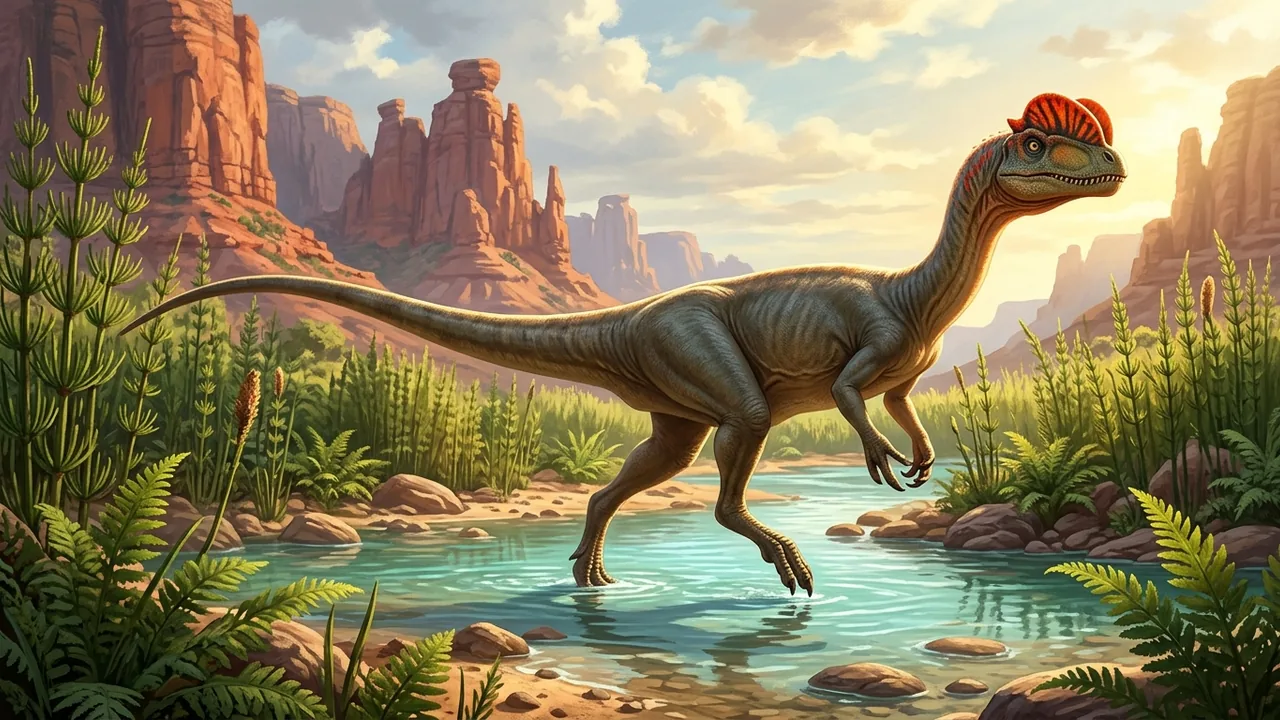
Meet the Legend: Neotheropod Giant vs. Pop Myth
Popular entertainment immortalized Dilophosaurus wetherilli as a diminutive, venom-spitting creature sporting an expandable lizardskin neck frill—yet neither attribute has a shred of osteological support. Real fossil skeletons preserve smooth cervical ribs devoid of frill-supporting rods and solid, ziphodont (blade-like, serrated) teeth lacking venom grooves or delivery ducts.
Far from dog-sized, adult Dilophosaurus measured six to seven meters (20 to 23 feet) in length and weighed roughly 400 kilograms (880 pounds), making it the largest terrestrial vertebrate known from Early Jurassic North America. Following the end-Triassic mass extinction (~201.3 million years ago), which eliminated dominant pseudosuchian archosaurs, theropod dinosaurs rapidly radiated into vacant macropredatory guilds.
Modern positions Dilophosaurus near the base of Averostra-grade neotheropods—bridging slender Late Triassic coelophysoids and the multi-ton tetanurans that later ruled the Middle and Late Jurassic.
Crowned by twin parasagittal crests and balanced horizontally over elongated tibiae, Dilophosaurus proved that giant predatory dinosaurs achieved speed, respiratory sophistication, and visual ornamentation near the very dawn of the Jurassic Period.
Standing nearly two meters tall at the acetabulum, its sleek profile and powerful S-curved neck established the anatomical blueprint that carnivorous theropods refined for the next 127 million years.
Earlier phylogenetic studies once lumped Dilophosaurus with slender Triassic Coelophysis based solely on snout notches, yet twenty-first-century cladistic datasets confirm it occupied its own bold evolutionary rung on the road toward giant tetanuran hunters across Pangaea's northern and southern landmasses alike, forever transforming how paleobiologists model early Mesozoic predator evolution.
Lost World Habitat: Kayenta Formation Stratigraphy
Paleoenvironmental reconstructions of Dilophosaurus rely on the of the Kayenta Formation within the Glen Canyon Group across the Navajo Nation of northern Arizona. High-precision uranium-lead (U-Pb) radiometric dating of volcanic zircon crystals embedded within its silty facies constrains the Dilophosaurus-bearing horizons to the Sinemurian–Pliensbachian boundary of the Early Jurassic, approximately 193 million years ago.
Sandwiched stratigraphically between the windblown Wingate Sandstone below and the vast Navajo Sandstone erg (sand sea) above, the Kayenta Formation records a dynamic mosaic of braided rivers, floodplains, ephemeral playas, and streamside gallery forests crossing tropical western Pangaea.
Fossilized wood, spores, and cuticles indicate lush riparian corridors of araucarioid conifers, bennettitaleans, cycads, ferns, and scouring-rush horsetails bordered by arid inland dunes. Aquatic channels teemed with freshwater hybodont sharks, lungfish, mawsoniid coelacanths, early frogs (Prosalirus), and kayentachelyid turtles, while floodplains supported basal sauropodomorph Sarahsaurus, armored thyreophoran Scutellosaurus, and tritylodontid synapsids.
Remarkably, contemporaneous rift basins along eastern North America—such as Virginia's Culpeper Basin—preserve abundant three-toed trackways (Kayentapus and Eubrontes) impressed into Sinemurian–Pliensbachian lake-margin mudstones.
Together, western skeletal quarries and eastern footprint horizons demonstrate that Dilophosaurus-grade neotheropods patrolled seasonal waterways from the desert edges of Arizona to the rift valleys of ancient Virginia.
Eventually, advancing desert dunes of the overlying Navajo Sandstone swallowed those lush Kayenta river oases completely, sealing an entire Early Jurassic ecosystem beneath hundreds of meters of cross-bedded quartz sand that winding canyon rivers expose again across the Colorado Plateau today in vivid crimson cliffs.
What's on the Prehistoric Menu?
For half a century, paleobiologists debated whether Dilophosaurus could subdue large terrestrial prey, pointing to the pronounced subnarial notch between its premaxilla and maxilla as a potential structural weak point. Early functional interpretations suggested the premaxillary tip plucked only small lizards or fish because torsional struggles might dislocate the upper jaw.
In a landmark 2020 anatomical monograph, paleontologists Adam Marsh and Timothy Rowe dismantled that fragile-jaw model after examining five specimens—including previously unprepared blocks and CT-scanned braincases. Their work revealed that earlier reconstructions suffered from post-burial crushing: in life, deep interlocking palatal plates braced the maxilla rigidly while expanded adductor chambers housed massive jaw-closing musculature.
Armed with four long, recurved premaxillary teeth ahead of twelve ziphodont maxillary crowns, Dilophosaurus wielded a dual-purpose feeding apparatus. Powerful posterior bites and robust cervical ventroflexor muscles allowed it to dispatch hefty terrestrial herbivores such as 400-kilogram Sarahsaurus, while its rosetted snout tip and retracted external nares remained equally adept at seizing meter-long coelacanths in shallow riffles.
Below the neck, stout scapulocoracoids and muscular humeri powered four-digit grasping hands whose enlarged first-digit unguals pinned struggling quarry securely.
Protected in life by subtle extra-oral lip tissue that kept its serrated enamel hydrated, Dilophosaurus commanded every top predatory niche across the Kayenta ecosystem.
across multiple Arizona quarries confirms that Dilophosaurus skeletons repeatedly occur alongside disarticulated fish scales, turtle shells, and sauropodomorph limb elements within overbank flood deposits, underscoring its ecological versatility across wet and dry cycles.
Superpowers, Senses & Anatomy
At the heart of the evolutionary success of Dilophosaurus lay advanced skeletal . High-resolution computed tomography shows paranasal air sinuses extending upward from the nasal cavity directly into the paired crests, excavating internal honeycombs of bony struts that minimized cranial mass while resisting lateral bending.
Farther back along the axial skeleton, cervical and anterior dorsal vertebrae bore deep pleurocoels and camerate internal chambers invaded by pulmonary air sacs—osteological hallmarks of an avian-style flow-through respiratory system. Supplying oxygen continuously during both inhalation and exhalation, this respiratory engine sustained elevated metabolic stamina across warm Jurassic floodplains.
Externally, vascular grooves etching both nasolacrimal crests indicate an overlying keratinous sheath that expanded and reinforced these fragile bony plates for intraspecific visual recognition rather than cranial combat.
Meanwhile, Early Jurassic resting impressions from southern Utah's Glen Canyon Group confirm a crucial forelimb trait: when crouching on damp sand, early neotheropods held their wrists supinated with palms facing medially inward—never pronated palms-down—millions of years before avian flight evolved.
Coupled with elongated distal hind-limb segments and tightly appressed metatarsals, this lightweight pneumatic frame enabled rapid acceleration along firm streamside corridors.
Endocranial scans further reveal well-developed floccular lobes and semicircular ear canals, coordinating rapid eye-and-neck tracking reflexes as the predator pursued agile vertebrates across sunlit sandbars or lunged cleanly into shallow riffles after fast-swimming bony fish. Even its boomerang-shaped wishbone—the furcula—acted like an elastic spring bracing both shoulders during vigorous grappling strikes along muddy oasis banks.
Flight vs. Fight Arena!
Ecological interactions inside the Kayenta floodplain arena pit cursorial apex hunter Dilophosaurus wetherilli against coeval herbivore neighbors employing sharply divergent survival strategies. Small basal thyreophorans such as Scutellosaurus lawleri—barely 1.3 meters long and studded with hundreds of tiny keeled osteoderms—relied primarily on Team Flight, darting bipedally into dense horsetail brakes.
Adult Sarahsaurus aurifontanalis, by contrast, measured over four meters long and carried roughly 400 kilograms on stocky, pillar-like hind limbs ill-suited for outrunning a long-legged neotheropod. Confronted along an open sandbar, Sarahsaurus anchored itself squarely on Team Fight.
Rearing onto its robust pelvis and muscular tail base, the sauropodomorph brandished hypertrophied, trenchant first-digit thumb claws driven by massive deltopectoral crest leverage on the humerus—capable of inflicting severe defensive slashes.
For Dilophosaurus, every attack required careful biomechanical calculation: although its reinforced maxilla and grasping hands could subdue subadult sauropodomorphs, risking a direct strike against its thin, pneumatic crests or lightweight chest ribs carried high evolutionary cost.
Consequently, alert adult Sarahsaurus standing their ground frequently deterred solo ambushes, steering the twin-crested predator toward vulnerable juveniles, smaller reptiles, or seasonal spawning runs of giant freshwater fish.
Over millions of years, that intense Early Jurassic arms race drove sauropodomorph lineages toward multi-ton quadrupedal gigantism while pushing later Middle and Late Jurassic theropods toward deeper skulls, thicker teeth, and even greater bone-shearing bite forces across every ancient continent on Earth, proving how predator-prey trade-offs continually sculpt skeletal anatomy, locomotion, and defensive behavior across geological eras.
Fossil Detective Secrets
The scientific biography of Dilophosaurus spans more than eight decades of collaboration, revision, and technological innovation. In 1940, Navajo leader Jesse Williams discovered weathered theropod vertebrae and limb bones in Kayenta mudstones near Tuba City, Arizona, alerting paleontologist Samuel Paul Welles of the University of California Museum of Paleontology.
Welles excavated two articulated skeletons in 1942 and initially assigned the holotype (UCMP 37302) to the European wastebasket genus Megalosaurus in 1954 because erosion had destroyed its dorsal skull roof. Only after collecting a gigantic crested specimen (UCMP 77270) in 1964 did Welles recognize the twin crests and establish Dilophosaurus in 1970.
Because gypsum crystals and burial compaction warped those original skulls, generations of museum mounts relied on sculpted plaster noses that exaggerated jaw fragility. Between 2015 and 2020, Adam Marsh and Timothy Rowe prepared additional Texas Memorial Museum skeletons collected on the Navajo Nation, applying micro-CT scanning and phylogenetic across five individuals.
Their work revealed robust palatal bracing, pervasive vertebral , and distinct growth variation—while Early Jurassic slabs from Utah to Virginia illuminated live locomotion.
Stripping away both plaster guesswork and cinema fantasy, paleontology restored Dilophosaurus as the true twin-crested monarch of Early Jurassic North America.
Today, respectful scientific partnership between university researchers, museum curators, and the Navajo Nation protects these irreplaceable Kayenta badlands so future paleobiologists can continue studying how dinosaurs first rose to rule Earth's continents nearly two hundred million years ago in thrilling anatomical detail.