Meet the Legend: Dawn of the Giant Hunters
Few dinosaurs suffer from a wider gap between popular fiction and fossil reality than Dilophosaurus wetherilli. Cinema audiences often imagine a knee-high reptile snapping open a ribbed neck frill and spitting blinding venom. Yet not a single fossil bone supports a frill, venom groove, or miniature stature.
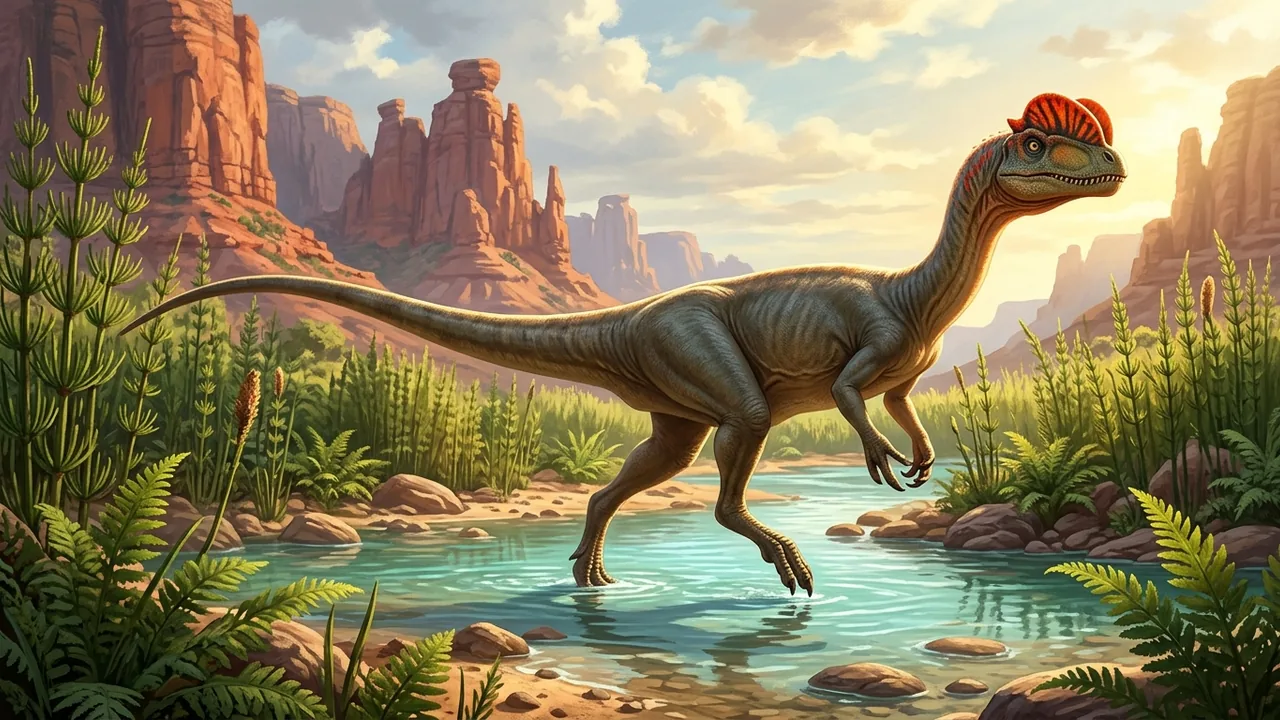
Real Dilophosaurus stretched twenty to twenty-three feet from snout to tail and weighed nearly 880 pounds—roughly the mass of a grizzly bear packed onto a sleek, two-legged sprinter chassis! Living 193 million years ago during the Early Jurassic, it was the largest terrestrial animal anywhere in North America.
Following the end-Triassic extinction that wiped out giant crocodile-line competitors, theropods suddenly expanded into vacant top-predator roles. Dilophosaurus led that evolutionary breakthrough, towering six feet at the hip with twin semicircular crests rising proudly above its snout.
Balanced horizontally over long shins and three-toed feet, its muscular neck and grasping four-fingered hands made it an agile pioneer of giant dinosaurian predators.
Skeletal and respiratory air-sac worked together across its frame, proving that the very first giant meat-eating dinosaurs were fast, warm-bodied athletes rather than slow, tail-dragging lizards.
Lost World Habitat: Kayenta Oasis Food Webs
During the Early Jurassic Period, southwestern North America sat near tropical latitudes along the western edge of breaking-up Pangaea. Vast windblown sand seas bordered braided river valleys that flowed seasonally from highland mountains, creating fertile oasis corridors preserved today in Arizona's Kayenta Formation.
Solar energy powered dense riparian galleries of conifers, cycads, ginkgoes, ferns, and silica-rich horsetails. Those primary producers supported a multi-layered web: freshwater unionid clams, lungfish, and yard-long coelacanths crowded deeper river bends, while early frogs, turtles, and mammal-like tritylodonts foraged under shady banks.
Browsing across higher floodplains were armored thyreophorans like Scutellosaurus and bulky early herbivores such as Sarahsaurus.
Standing alone at the apex trophic rung, Dilophosaurus linked aquatic and terrestrial energy pathways—patrolling wet sandbars for giant fish during dry spells and ambushing land herbivores when monsoon rains turned river valleys lush.
Because desert sand dunes hemmed in these green river ribbons on both sides, seasonal waterholes concentrated thirsty animals closely together, turning every shady creek bend into a busy Early Jurassic crossroads pulsing with prehistoric life from sunrise until dusk. Fallen conifer trunks washed downstream even formed cool logjams where giant fish sheltered.
What's on the Prehistoric Menu?
For nearly fifty years, textbooks described Dilophosaurus as a delicate-jawed hunter because a curved arch—the —indented the joint between its front premaxillary bone and main maxilla. Early researchers worried that a struggling herbivore might twist that joint apart.
In 2020, paleontologists Adam Marsh and Timothy Rowe overturned that hypothesis using modern CT scans and jaw . Their analysis revealed thick, interlocking bony struts behind the palate and broad attachment chambers for powerful adductor jaw muscles capable of delivering high-force, bone-puncturing bites!
Rather than weakening the snout, the subnarial gap worked like the notched tip of a crocodile's or spinosaur's jaw: long, backward-curved front teeth hooked slippery coelacanths or small reptiles while twelve tall, serrated maxillary blades sheared flesh cleanly.
Backed by long humerus and forearm levers ending in sharp, recurved thumb claws, Dilophosaurus possessed all the grappling and biting hardware needed to hunt juvenile and adult neighbors.
Subtle lip scales covered those serrated crowns when its jaws closed, keeping tooth enamel hydrated under dry desert breezes between riverside hunts while continuous tooth replacement kept every socket sharp and ready throughout its active life.
Superpowers, Senses & Anatomy
How did Dilophosaurus grow past twenty feet without becoming sluggish? The answer lies in extensive skeletal . Invading air sacs connected to its sinuses and lungs carved honeycomb chambers inside its twin nasolacrimal crests, cervical neck vertebrae, and anterior backbones.
From an engineering perspective, internal air struts acted like aircraft wing ribs—cutting skeletal weight dramatically while stiffening thin bony plates against bending forces. Simultaneously, respiratory air sacs promoted continuous, bird-like unidirectional airflow across the lungs, fueling sustained aerobic sprints of twenty-five miles per hour across river flats.
External grooves etched into the twin crests indicate a protective keratinous covering in life, expanding their profile for colorful visual signaling among mates and territorial rivals.
Meanwhile, rotational wrist joints folded its four-fingered hands inward toward the chest—protecting razor-sharp claws while walking—and long shin-to-thigh bone ratios delivered crisp, ground-covering strides.
Deep muscle scars along its shoulder blades and upper arm bones further prove its forelimbs could pull heavy loads inward toward its chest with impressive grappling force whenever swift prey stumbled within reach along muddy stream margins during morning hunts beside shady conifers.
Flight vs. Fight Arena!
Along a sunlit Arizona point bar, apex hunter Dilophosaurus intercepts fourteen-foot Sarahsaurus aurifontanalis! Across this Early Jurassic arena, body mass and weapon geometry dictate which survival strategy each neighbor deploys.
Lightweight four-foot Scutellosaurus chooses Team Flight instantly, sprinting bipedally into horsetail thickets while relying on rows of tiny dermal scutes as backup insurance. Heavyset Sarahsaurus, weighing roughly 450 pounds on stocky pillar legs, cannot out-sprint a long-striding predator capable of twenty-five-mile-per-hour bursts.
Instead, Sarahsaurus commits to Team Fight: rearing onto sturdy hind limbs and tail, it brandishes oversized, strongly curved thumb claws anchored to muscular forearms.
favors caution on both sides—Dilophosaurus uses agile footwork and inward-grasping hands to probe for an opening while protecting its fragile pneumatic display crests, breaking off the engagement whenever an alert adult Sarahsaurus holds a balanced defensive stance.
By shifting smoothly between terrestrial ambushes at lower levels and shallow-water fishing when adult herbivores stood guard together on firm ground, Dilophosaurus thrived across unpredictable Early Jurassic wet and dry seasons without risking crippling injuries to its slender display crests or lightweight chest ribs during risky standoffs.
Fossil Detective Secrets
Modern understanding of Dilophosaurus began in 1940 when Navajo leader Jesse Williams guided paleontologist Samuel Welles to eroded mudstone outcrops near Tuba City, Arizona. Welles excavated three skeletons in plaster jackets and initially named the species Megalosaurus wetherilli in 1954 because the damaged holotype skull hid its crests.
When a fresh specimen excavated in 1964 revealed twin paper-thin nasolacrimal ridges, Welles coined Dilophosaurus—two-crested lizard—in 1970. For decades afterward, plaster reconstructions based on crushed fossils misled artists into thinking its upper jaw had a loose, weak joint.
Starting in the 2010s, researchers digitally scanned five Kayenta specimens with high-energy X-ray tomography, stripping away distortion to measure true , muscle scars, and bite .
Paired with Early Jurassic resting traces from Utah showing bird-like folded wrists and footprints from Virginia's Culpeper Basin, real fossil detective work permanently retired Hollywood's tiny venom-spitter in favor of North America's true twin-crested giant.
Comparing juvenile and mature skeletons in museum collections even showed how the and tall crests grew steeper and stronger as young desert hunters matured into full-sized floodplain rulers across ancient western North America.