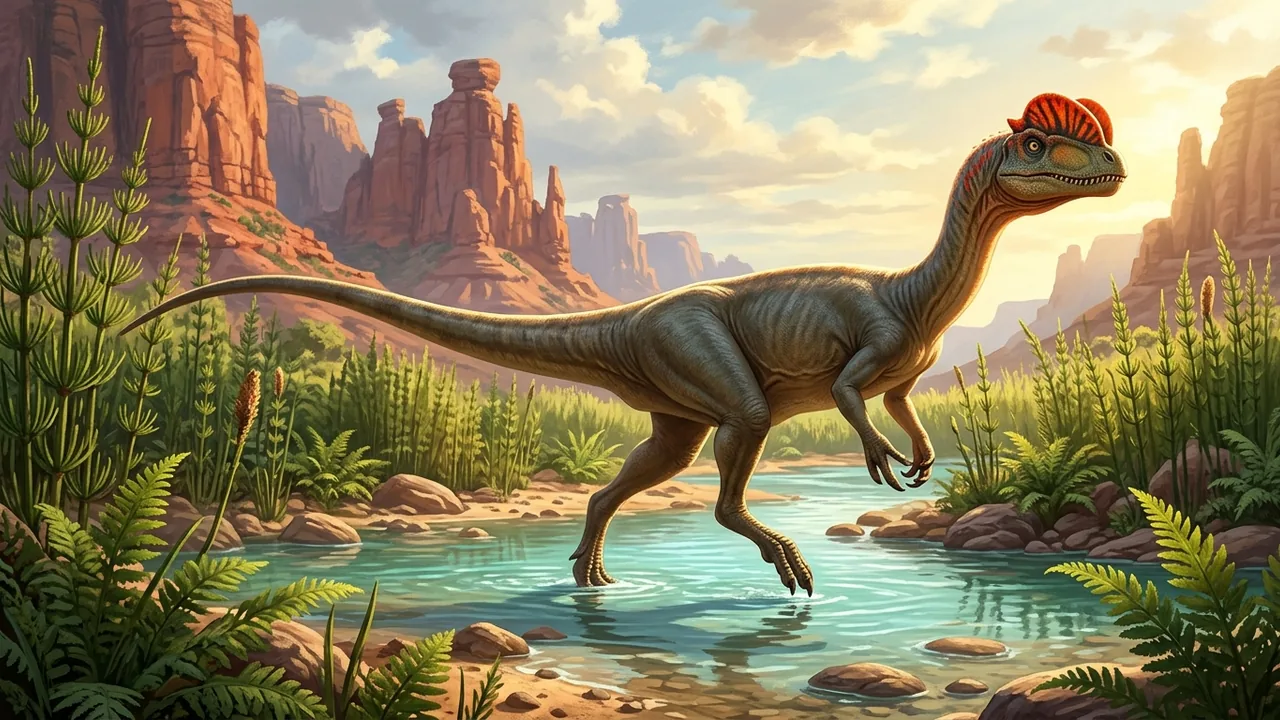
Meet the Legend: Busting the Movie Myth!
If you have ever seen popular monster movies, you might picture Dilophosaurus as a dog-sized lizard that unfolds a rattling neck umbrella and spits goo! Real fossils tell a much cooler—and much bigger—truth. That frill and venom idea was pure movie !
In real life, Dilophosaurus wetherilli had a smooth, muscular neck, zero venom, and towered taller at the hips than a grown-up human. Stretching twenty feet from snout to tail—longer than a full-size pickup truck—and weighing nearly 900 pounds, it ruled Early Jurassic North America as an .
Lost World Habitat: Streams Beside Sand Dunes
During the Early Jurassic Period, northern Arizona was a land of striking contrasts. Beyond the horizon rolled towering orange sand fields swept by warm winds. Yet clear seasonal rivers carved lush green ribbons right between the dry rocky hills!
Along those wet riverbanks grew shady conifers, tree ferns, and crunchy horsetail reeds. Freshwater fish, armored reptiles, and early mammals shared the sparkling pools. Ancient stone trails even show where three-toed predators paused to crouch and rest on soft, damp sandbars beside the water.
What's on the Prehistoric Menu?
For decades, old books guessed that Dilophosaurus had weak jaws and only ate small scraps. In 2020, new X-ray scans proved that old guess wrong! Its deep jawbones anchored thick muscles strong enough to tackle biggest neighbors along the river.
As the neighborhood's undisputed , Dilophosaurus hunted stocky plant-eating dinosaurs like Sarahsaurus and small armored reptiles called Scutellosaurus. When shiny three-foot fish swam through shallow riffles, a notch near its snout tip and inward-facing clawed hands helped it snatch slippery swimmers cleanly.
Superpowers, Senses & Anatomy
Look closely at the twin half-moon crests rising along its snout! On a museum skull, the bone looks paper-thin. Inside, however, tiny honeycomb air pockets stiffened the bone just like corrugated cardboard while keeping its head light.
Tiny grooves on the bone surface show that tough —the same material in eagle beaks and your fingernails—wrapped over both crests, likely painted in bold colors so Dilophosaurus could recognize friends from far away. Long, athletic legs and air-filled backbones helped this giant sprint swiftly without tiring.
Flight vs. Fight Arena!
Beside a fern-lined watering hole, hungry Dilophosaurus steps out from behind a sand and challenges Sarahsaurus! Sarahsaurus is a fourteen-foot plant-eater weighing as much as a grand piano, browsing low leaves near the creek.
Dilophosaurus charges with long, ground-covering strides, trying to outflank its meal with speed and agility. Too stocky to outrun the swift hunter, Sarahsaurus plants its sturdy hind legs on Team Fight and swings two huge, curved thumb claws! If Sarahsaurus holds its ground firmly, the cautious predator prowls downstream toward easier fish.
Fossil Detective Secrets
In the summer of 1940, a Navajo man named Jesse Williams noticed purple-gray dinosaur bones weathering out of red rock near Tuba City, Arizona. He guided paleontologist Sam Welles to the spot, where scientists carefully excavated three Early Jurassic skeletons!
At first, nobody knew the dinosaur wore crests because erosion had worn off the top of the skull. Years later, a new Arizona specimen revealed those twin -covered ridges, busting every monster before movies were even filmed! Today three-toed slabs across North America celebrate this true Jurassic pioneer.