Meet the Legend: Real Science vs. Movie Fiction
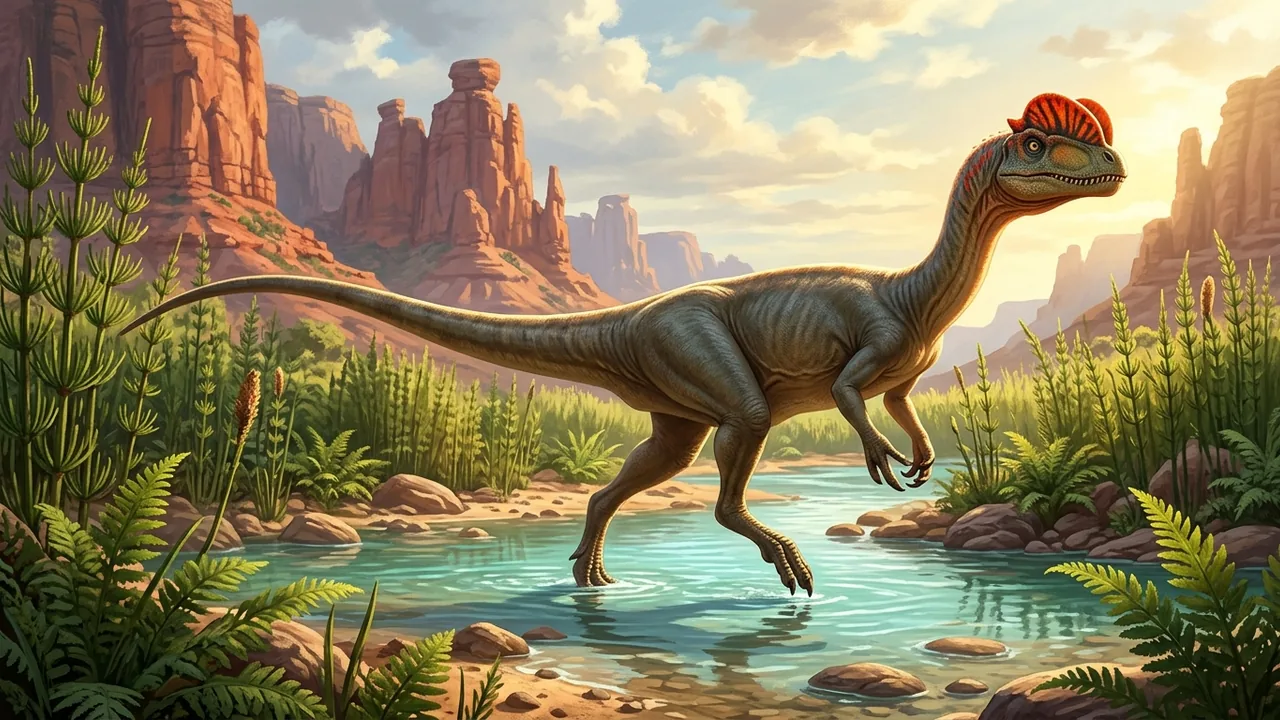
Mention Dilophosaurus, and many people picture a knee-high reptile flaring a rattling neck frill and spitting poison. Paleontologists love sharing the real story because fossil science is far more impressive! Real Dilophosaurus wetherilli had zero neck frill, zero venom glands, and grew longer than a family minivan.
Measuring twenty to twenty-three feet long and weighing roughly 880 pounds, this Early Jurassic stood six feet tall at the hip. Before Dilophosaurus arrived around 193 million years ago, most meat-eating dinosaurs were slender hunters no bigger than dogs or coyotes.
Crowned with two parallel, half-moon bony crests along the top of its snout, Dilophosaurus pioneered giant body size among North American predators.
Its muscular S-curved neck, inward-facing clawed hands, and horizontal balancing tail made it a swift, athletic ruler of dawn-age Jurassic floodplains.
Lost World Habitat: Arizona Oases & Virginia Tracks
One hundred ninety-three million years ago, all Earth's continents were beginning to pull apart from the giant supercontinent Pangaea. Across what is now northern Arizona, seasonal rivers wound between desert sand dunes, nourishing a vibrant streamside of conifers, cycads, tree ferns, and horsetails.
Freshwater lungfish, coelacanths, frogs, and armored croc-relatives thrived in those sunny channels alongside early plant-eating dinosaurs. Meanwhile, two thousand miles east in ancient Virginia, rift-valley lakeshores recorded the exact same Early Jurassic chapter in stone!
Rock quarries in Virginia's Culpeper Basin preserve thousands of three-toed footprints—named Kayentapus and Eubrontes—pressed into wet mud by twenty-foot cousins of Dilophosaurus.
Even though eastern soils dissolved most bones, Virginia's stone footprints and Arizona's desert skeletons fit together like puzzle pieces showing coast-to-coast Early Jurassic life across ancient North America's warm river valleys.
What's on the Prehistoric Menu?
Energy in the Arizona oasis began with sunlight feeding riverside horsetails, ferns, and tall conifers. Plant-eating dinosaurs such as fourteen-foot Sarahsaurus and dog-sized, plate-backed Scutellosaurus munched those greens, supporting Dilophosaurus at the top of the food chain.
For many years, paleontologists wondered whether a noticeable gap behind the front upper teeth meant Dilophosaurus had a weak jaw limited to small prey. Modern skull studies flipped that old idea upside down!
Thick jaw muscles anchored inside deep skull openings gave Dilophosaurus a powerful slicing bite capable of bringing down large land herbivores along the riverbank.
At the same time, its narrow snout tip, backward-set nostrils, and hooked front teeth served as a handy fishing for plucking yard-long freshwater fish out of shallow pools during dry desert months when rain grew scarce.
Superpowers, Senses & Anatomy
How could Dilophosaurus carry two tall crests on its head and grow twenty feet long while staying light on its feet? Its secret superpower was a skeleton! Hollow air pockets connected to its nasal passages and lungs filled its neck vertebrae, backbones, and even the insides of its twin crests.
Those internal air struts reinforced thin bone walls while trimming pounds of extra weight—an evolutionary still seen in eagles and ostriches today! Outside the bone, tough keratin sheaths likely extended the crests taller and displayed vivid colors to attract mates or warn rivals.
Below its shoulders, strong arms ended in inward-facing palms—“clapping” hands rather than dangling bunny paws—armed with curved thumb claws.
Long lower leg bones and springy three-toed feet completed an athletic frame built to chase fast meals along winding sandy creeks.
Flight vs. Fight Arena!
Sunlight glints off a shallow desert stream as hungry Dilophosaurus stalks toward a browsing Sarahsaurus! In the Early Jurassic Flight versus Fight arena, tiny neighbors like Scutellosaurus bolt into dense fern thickets on Team Flight, trusting speed and small back scutes to escape.
Fourteen-foot Sarahsaurus, however, weighs several hundred pounds and cannot outrun the long-legged across open sandbars. Instead, Sarahsaurus pivots onto Team Fight, bracing on sturdy hind legs and raising massive, curved thumb claws backed by muscular forearms!
Dilophosaurus circles nimbly, testing its rival's reach with quick feints while keeping its delicate display crests safely clear of swinging claws.
When a healthy adult Sarahsaurus stands firm without flinching beside the riverbank, smart predators conserve valuable energy and trot downstream to ambush unwary fish or smaller reptiles basking near the reeds.
Fossil Detective Secrets
The detective trail of Dilophosaurus began in 1940 when Navajo rancher Jesse Williams spotted fossilized bones eroding from purplish mudstone on the Navajo Nation in northern Arizona. Paleontologist Samuel Welles and his crew excavated three skeletons, though the best one had lost the top of its skull to wind and rain.
Not until 1964, when Welles uncovered another Arizona skull preserving twin ridges of bone, did scientists realize this hunter wore two dramatic crests—inspiring the name Dilophosaurus in 1970!
Decades later, high-resolution CT scans in 2020 mapped hidden air chambers and muscle scars across five specimens, proving its jaws were sturdy rather than fragile.
Combined with Early Jurassic footprints from Arizona, Utah, and Virginia, real paleontology replaced Hollywood monster myths with an unforgettable pioneer giant that young fossil detectives still study today.