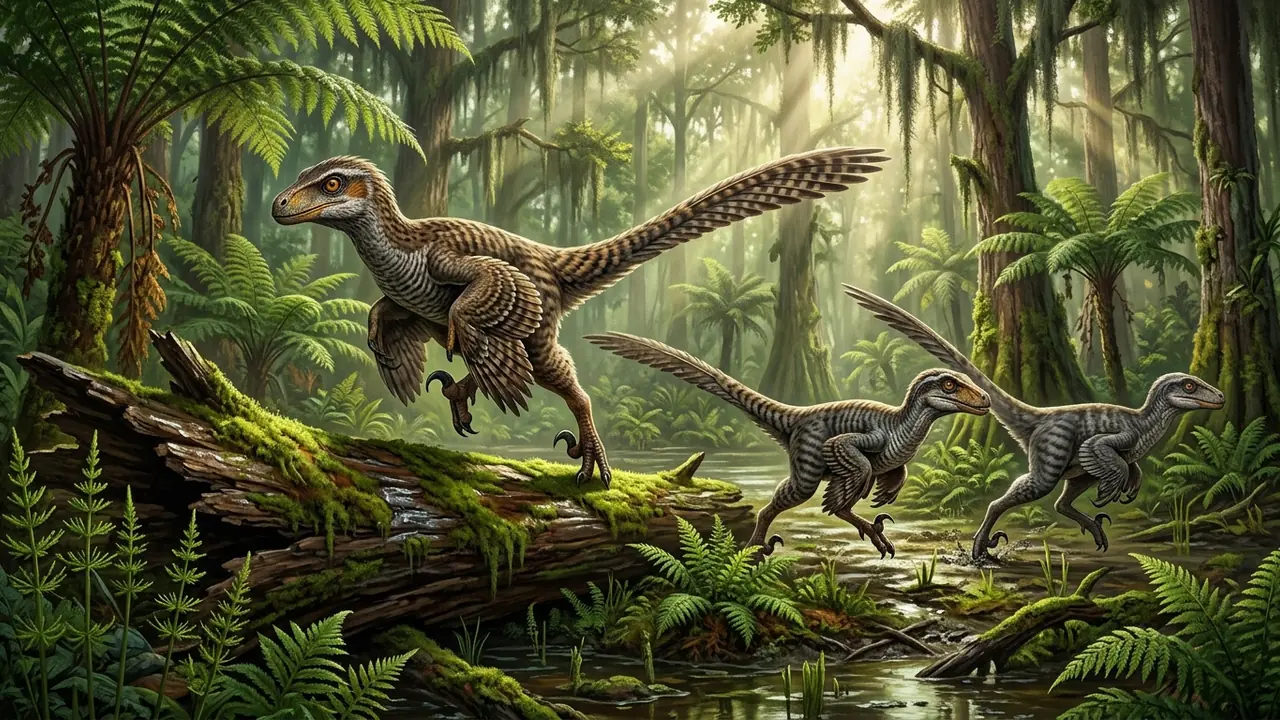
Meet the Legend: Osteology of a Renaissance Icon
Few fossil discoveries have overturned scientific orthodoxy as decisively as Deinonychus antirrhopus. Measuring up to 3.4 meters (11.2 feet) in total length, standing roughly 0.87 meters at the hip socket, and weighing 73 to 100 kilograms (160 to 220 pounds), this robust dromaeosaurid combined wolf-class body mass with unmistakable avian skeletal architecture. When adventure novels and cinema popularized human-scaled raptors, they adopted the exact dimensions and Montana provenance of Deinonychus while relabeling it with the name of its diminutive Mongolian cousin Velociraptor!
Detailed reveals an animal far more extraordinary than scaly fiction. Pneumatic air sacs invaded its cervical and dorsal vertebrae through deep pleurocoel openings, lightening the axial skeleton while supporting an efficient avian-style unidirectional lung system. Its muscular forelimbs featured a fused wishbone, or furcula, alongside a crescent-shaped semilunate carpal wrist joint capable of folding broad, pennaceous wing feathers neatly against its flanks.
Described by Yale paleontologist John Ostrom in 1969, Deinonychus catalyzed the Dinosaur , sweeping aside nineteenth-century stereotypes of sluggish ectothermic reptiles.
Although adult Deinonychus specimens derive from mudstones slightly too coarse to preserve fragile keratinized feather filaments directly, phylogenetic bracketing across dozens of feathered basal and derived dromaeosaurids confirms that full contour plumage, winged forearms, and aerodynamic tail fans clothed this Early Cretaceous apex athlete from hatchling to maturity!
From its S-curved mobile neck down to its spring-hinged digitigrade ankles, every joint radiated warm-blooded metabolic vigor, speed, balance, and keen predatory intelligence across ancient North American swamp forests.
Lost World Habitat: Cloverly Floodplains & Stratigraphy
To reconstruct the Early Cretaceous world of Deinonychus, geologists examine the Aptian-to-Albian of the Formation across Montana and Wyoming alongside coeval strata of the Antlers Formation in Oklahoma and Texas. Radiometric dating of volcanic bentonite ash horizons and detrital zircon crystals places Deinonychus securely between 115 and 108 million years ago, several million years before the rising Western Interior Seaway completely divided North America into separate landmasses.
Within the Cloverly sequence, especially the Little Sheep Mudstone and Himes Members, variegated red, purple, and gray floodplain mudstones alternate with lenticular river-channel sandstones and nodular carbonate paleosols. Together these beds record low-gradient meandering river systems, seasonal oxbow swamps, and humid subtropical gallery forests dominated by bald cypresses, ginkgoes, bennettitalean cycadeoids, tree ferns, and early flowering angiosperms.
Remarkably, coeval Potomac Group clays along the Atlantic Coastal Plain of Virginia and Maryland preserve nearly identical wetland flora alongside isolated dromaeosaurid teeth, confirming feathered raptors spanned North America coast to coast!
Across western Cloverly floodplains, periodic dry spells concentrated wildlife around shrinking watering holes where Deinonychus shared mossy trails with spike-shouldered nodosaurid Sauropelta, towering titanosauriform Sauroposeidon, apex carcharodontosaurid Acrocanthosaurus, snapping freshwater turtles, lungfish, and abundant herds of iguanodontian ornithopod Tenontosaurus tilletti.
Reading paleosol mineral chemistry across these layered mudstones reveals warm greenhouse temperatures moderated by monsoonal rains that turned broad river valleys into lush, vibrant, green predator-prey arenas every spring and summer across the ancient continent. Fossilized charcoal fragments in those same layers even record occasional lightning-sparked forest fires sweeping dry conifer uplands before new ferns sprouted rapidly!
What's on the Prehistoric Menu? Ontogeny & Pack Debates
Because Yale Quarry near Bridger and multiple and Antlers bonebeds preserved numerous shed Deinonychus teeth alongside partial skeletons of both predators and Tenontosaurus tilletti, paleontologists long cited Deinonychus as textbook proof of cooperative, mammal-like pack hunting. Over the past decade, geochemical and anatomical breakthroughs have added fascinating nuance by examining Deinonychus , charting how its diet and locomotion shifted dramatically from hatchling to adult!
In 2020, stable carbon isotope analyses of tooth enamel led by Joseph Frederickson revealed that small juvenile Deinonychus teeth carry significantly different isotopic signatures than large adult teeth collected from the exact same Cloverly localities. Unlike modern wolf pups fed regurgitated big-game meat by parents, young raptors foraged independently on small forest lizards, amphibians, mammals, and insects!
Allometric corroborates that dietary split: juveniles possessed proportionally longer forelimbs, lighter wing loading, and sharper wrist flexion suited for wing-assisted incline running or climbing trees out of reach of larger predators.
Once mature 80-kilogram adults transitioned into the floodplain mesopredator guild, multiple hunters converged on vulnerable Tenontosaurus individuals, whether coordinating silent ambushes like modern Harris's hawks or gathering in assertive feeding mobs like Komodo dragons and Nile crocodiles around rich seasonal marshes!
This clever ontogenetic niche partitioning meant a single dromaeosaur species occupied both small woodland insectivore-carnivore roles and large-prey ambush roles across its full lifespan without adult parents and growing independent offspring ever competing directly for scarce swamp prey. Modern Komodo dragons show a remarkably similar age split, with tree-climbing youngsters eating geckos and insects before adults hunt deer on open ground!
Superpowers: Raptorial Talons, Jaws & Caudal Rods
Functional reveals Deinonychus was engineered more like an eagle-jawed grappling specialist than a delicate stilt-legged sprinter. Its skull, deep, fenestrated, and reinforced against torsional twisting forces, housed roughly seventy laterally compressed, ziphodont teeth whose posterior serrations were markedly coarser than their anterior denticles, maximizing backward-pulling cutting efficiency. Meanwhile, extraordinarily long, muscular forelimbs bore three deeply curved ungual claws anchored to hands whose palms permanently faced medially toward one another.
Below the knee, a relatively short sub-arctometatarsalian foot sacrificed extreme cursorial top speed in exchange for immense mechanical advantage through Pedal Digit II. Specialized hinge joints hyperextended its 12-to-13-centimeter curved keratinous sickle talon nearly 180 degrees clear of muddy ground during two-toed locomotion, then drove the point downward via stout digital flexor tendons to pin struggling prey under Raptor Prey Restraint!
Stabilizing every athletic pounce was its signature counterbalance tail. Across caudal vertebrae beyond the flexible hip base, elongated prezygapophyses and chevron processes extended forward up to ten segments in tightly bundled bony rods.
Combined with shifts across in forelimb wing loading and broad caudal feather fans, that stiffened beam let Deinonychus execute instantaneous banking turns across slick cypress roots while keeping binocular eyes locked onto evasive prey!
Digital X-ray endocasts also reveal enlarged olfactory lobes and acute inner-ear semicircular canals, giving this agile wetland hunter hair-trigger spatial awareness, precise head-eye balance control, and crisp target tracking through dim, fern-shadowed Early Cretaceous forest understories. Large bony sclerotic rings inside both eye sockets further indicate wide pupils capable of gathering faint twilight glimmer beneath dense cypress canopies!
Flight vs. Fight Arena: Floodplain Physics & Risk
Across floodplains, confrontations between Deinonychus antirrhopus and Tenontosaurus tilletti pitted coordinated raptorial offense against high-mass Team Fight deterrence. Measuring up to 7 meters (23 feet) long and weighing nearly 900 to 1,000 kilograms, a mature Tenontosaurus outweighed a solitary adult Deinonychus roughly ten to one! Even without osteoderm armor plates or brow horns, Tenontosaurus wielded an elongated, heavily muscled tail stiffened by an ossified tendon lattice alongside stout forelimbs capable of powerful defensive shoves.
From a biomechanical perspective, engaging a healthy one-ton ornithopod head-on carried severe fracture risks for hollow-boned theropods. Taphonomic mapping at multi-individual Cloverly quarries repeatedly records subadult or adult Deinonychus skeletons interspersed directly beside Tenontosaurus bones, suggesting defensive tail blows or fierce competition among hungry predators around carcasses claimed genuine casualties!
Detailed skeletal shows Deinonychus reduced those hazards by isolating juvenile, injured, or mired targets along muddy oxbow banks where heavy herbivores lost traction.
By leaping high onto flanks clear of dangerous caudal sweep zones, sinking Pedal Digit II crampons deep into thick hide, and beating winged forearms furiously to maintain balance, groups of Deinonychus turned agility and endurance into a decisive predatory edge!
Yet healed bite scars preserved on surviving Tenontosaurus limb bones prove conclusively that whenever an alert adult herbivore stood firm on solid dry ground, pivoted rapidly, and lashed its sinew-braced tail sideways, Team Fight frequently prevailed in the swamp arena. That dynamic balance between raptorial speed and herbivore brawn kept both floodplain populations thriving side by side for millions of Early Cretaceous years!
Fossil Detective Secrets: Ostrom & the Bird Connection
The modern Dinosaur began on an August afternoon in 1964 near Bridger, Montana, when Yale paleontologist John Ostrom and Grant Meyer spotted curved claws protruding from eroded mudstone at what became the celebrated Yale Deinonychus Quarry. Earlier in 1931, American Museum collector Barnum Brown had quietly excavated a partial skeleton nearby while preparing a Tenontosaurus, informally calling it Daptosaurus, yet never published a formal scientific description.
Between 1964 and 1966, Ostrom's crews recovered over 1,000 exquisitely preserved bones representing multiple individuals, enabling his landmark 1969 Peabody Museum monograph. By analyzing wrist flexion, sub-horizontal spinal posture, digitigrade hind-limb joints, and rod-locked caudal mechanics, Ostrom demolished outdated dogmas of sluggish ectothermic dinosaurs.
Four years later, after recognizing a mislabeled Solnhofen specimen of Archaeopteryx in a Dutch museum collection, Ostrom published painstaking comparative demonstrating that living birds inherited their semilunate carpals, furculae, tridactyl hands, and feathers directly from small coelurosaurian theropods!
Subsequent discoveries of fossilized feathered dromaeosaurids across northeastern China vindicated every anatomical prediction unlocked from North American Cloverly , cementing Deinonychus forever as the fossil detective triumph that reunited ancient dinosaurs with the living birds in our skies.
Every single time a red-tailed hawk folds its feathered wings atop a wooden fencepost, swivels its sharp golden eyes, or grips a swaying tree branch with curved inner talons, you are watching the living evolutionary legacy of Ostrom's Montana raptor in action today! Few discoveries in all of natural history demonstrate more vividly how a single fossil site can rewrite textbooks across the entire planet.