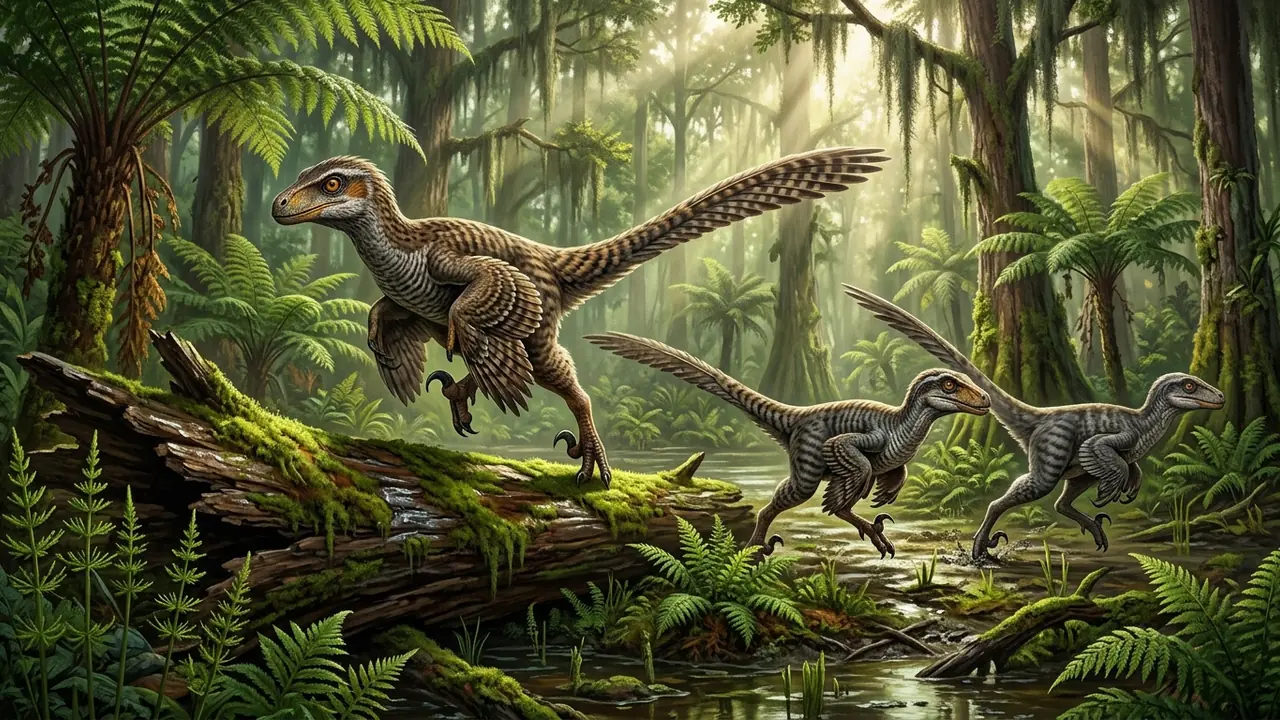
Meet the Legend: Heavyweight Feathered Dromaeosaur
Meet the true heavyweight inspiration behind modern raptor fame: Deinonychus antirrhopus! Classified as an Early Cretaceous , an adult stretched up to 11 feet (3.4 meters) from snout to tail tip, stood roughly 2.9 feet at the hip, and weighed between 160 and 220 pounds (73 to 100 kilograms), matching the mass of a large timber wolf or adult human athlete.
When filmmakers created human-sized screen raptors, they quietly borrowed every measurement from Montana's Deinonychus while using the catchier name of its turkey-sized cousin Velociraptor! Yet real skeletal anatomy paints an even more vibrant portrait than cinema ever imagined.
Hollow, air-filled vertebrae lightened its muscular torso, curved wrist joints folded broad winged forearms neatly against its ribs, and a stiffened tail acted as a long horizontal .
Armed with deep, alligator-strength jaws, warm hawk-like forest plumage, three giant curved hand claws, and five-inch retractable foot talons, Deinonychus combined serious predatory muscle with unmistakable bird-like grace as it bounded across mossy logs, shallow bayou creeks, and sunlit fern clearings across ancient North American woodlands, setting a brand-new standard for how scientists understand active prehistoric hunters!
Lost World Habitat: Floodplain Webs & Climate
Roughly 115 to 108 million years ago, western North America looked nothing like today's dry Rocky Mountain foothills. Instead, warm rivers wound across low, humid floodplains stretching from Montana and Wyoming southward into Oklahoma and Texas. Towering bald-cypress trees, ginkgoes, cycads, and dense carpets of horsetails and ferns thrived around misty oxbow lakes and seasonal marshes.
Geochemists measure oxygen and carbon signatures preserved inside fossil turtle shells and dinosaur tooth enamel to take the ancient ecosystem's temperature. Those chemical thermometers show warm, wet rainy seasons alternating with brief dry spells across lush subtropical lowlands.
Within this thriving wetland food web, energy flowed upward from fast-growing swamp plants to armored nodosaurids like Sauropelta, tiny early mammals like Gobiconodon, and abundant herds of horse-sized Tenontosaurus.
Sharing top trophic ranks only with forty-foot carcharodontosaurid Acrocanthosaurus and giant long-necked Sauroposeidon, nimble hunters ruled tangled cypress swamps and dense forest margins where massive multi-ton giants could not easily turn, stalk, or sprint between fallen mossy tree trunks, muddy river bends, and fern-choked oxbow channels during humid Early Cretaceous mornings! Rich floodplain soils preserved fallen conifer cones, freshwater mussel shells, and delicate fern fronds right beside their three-toed footprints.
What's on the Prehistoric Menu? Packs & Isotopes
For decades paleontologists debated whether Deinonychus hunted in cooperative wolf-like packs, because multiple skeletons and scores of shed serrated teeth kept turning up beside Tenontosaurus carcasses! In 2020, scientists tested that famous idea by analyzing carbon ratios inside tiny juvenile teeth versus large adult Deinonychus teeth.
In modern wolf packs, parents bring chunks of big game back to pups, giving young and old wolves identical chemical tooth signatures. Surprisingly, juvenile and adult Deinonychus teeth showed different carbon isotope values! Lightweight youngsters occupied a lower niche, hunting forest lizards, frogs, and small mammals independently while climbing trees to avoid bigger carnivores.
Full-grown adults shifted upward in trophic rank to tackle subadult and adult Tenontosaurus across open floodplains. experiments on deep bone-puncture grooves reveal adult Deinonychus jaws clamped down with 4,100 to 8,200 Newtons of bite force, rivaling a large American alligator!
Whether adults coordinated silent ambushes or mobbed prey together like modern Komodo dragons and cooperative Harris's hawks, group feeding around boggy riverbanks unlocked rich big-game calories that fueled their warm-blooded, high-energy floodplain lifestyle through both rainy springs and dry autumn months!
Superpowers: Torque Levers & Tail Counterbalance
How fast and agile was a 180-pound feathered ? Skeletal show Deinonychus sprinted in bursts around 25 to 30 miles per hour (40 to 48 km/h), though its hind feet were engineered more like power wrenches than delicate track spikes! Compared with long-footed ostrich dinosaurs, Deinonychus had short, stout foot bones that multiplied muscular leverage when clamping down with its curved five-inch second-toe talons.
Using Raptor Prey Restraint, Deinonychus leaped onto quarry, pinned it beneath its full weight, and anchored both hooked inner talons deep while flapping winged forearms to keep steady equilibrium. Three giant, curved hand claws assisted in gripping slippery hides.
Behind its hips stretched a remarkable dynamic . Overlapping bundles of bony tendons and vertebral rods stiffened eighty percent of the tail into a rigid horizontal beam while leaving the base free to whip sideways.
Swinging that feathered counterbalance mid-leap let Deinonychus bank sharply around mossy cypress trunks, keep its keen forward-facing eyes locked tightly onto darting swamp prey, and land squarely on both outer weight-bearing running toes without losing forward momentum across wet forest trails! Broad tail fan feathers added extra aerodynamic stability whenever the agile hunter vaulted over muddy creek channels.
Flight vs. Fight Arena: Raptors vs. Sinew Tail!
Picture a rain-slick floodplain glade where Team Apex Hunter tested Team Fight! Agile Deinonychus entered with binocular depth perception, alligator-strength jaws, five-inch pinning talons, and a whip-smart tail . Standing across the ferns was Tenontosaurus tilletti, a muscular ornithopod stretching up to 24 feet long and tipping the scales at 1,800 to 2,200 pounds!
Tenontosaurus lacked spikes or armor shields, yet gave this defender formidable weapons of its own. Over half its body length consisted of a deep, heavy tail wrapped in a lattice of ossified sinews, alongside stout forelimbs tipped with broad claws.
A single sweeping tail strike carried enough momentum to fracture hollow ribs on impact! Solitary attacks against a healthy one-ton adult were perilous.
Deinonychus therefore targeted isolated juveniles, tired stragglers, or boggy mud traps where multiple hunters could circle from opposing angles, leaping clear of dangerous tail swings on spread feathered arms until superior stamina, agile footwork, quick vocal communication, and relentless gripping talons finally decided the muddy floodplain contest along the shady cypress bayou! Whenever an alert adult Tenontosaurus held firm dry footing and swung its heavy tail steadily, cautious raptors wisely backed off to search for easier quarry elsewhere.
Fossil Detective Secrets: Ostrom's Breakthrough
Modern dinosaur science owes a massive debt to a rocky Montana slope explored in August 1964. When Yale paleontologist John Ostrom and field assistant Grant Meyer knelt beside eroding mudstone near Bridger, two curved claws gleamed in the sunlight! Over three field seasons, excavations recovered more than 1,000 bones from multiple individuals of this extraordinary .
At the time, textbooks portrayed dinosaurs as lumbering, cold-blooded reptiles. Applying functional to every joint, Ostrom published a revolutionary 1969 monograph demonstrating that Deinonychus stood horizontally, held its tail aloft as a stiff , folded its wrists sideways like a bird, and balanced on one leg while striking with the other!
No sluggish ectotherm could sustain such athletic coordination. Ostrom went further, documenting dozens of shared skeletal features linking Deinonychus directly to Jurassic dino-bird Archaeopteryx.
Coupled today with digital micro-CT braincase scans and tooth enamel analyses, Deinonychus ignited the famous Dinosaur Renaissance, proving beyond doubt that modern birds are living feathered theropod dinosaurs soaring right above our backyards, city parks, green forests, and sunny schoolyards every single day of the year! Every museum visitor who gazes up at its dynamic leaping skeleton sees the exact fossil clue that changed paleontology forever.