Meet the Legend: Athlete of the Early Cretaceous
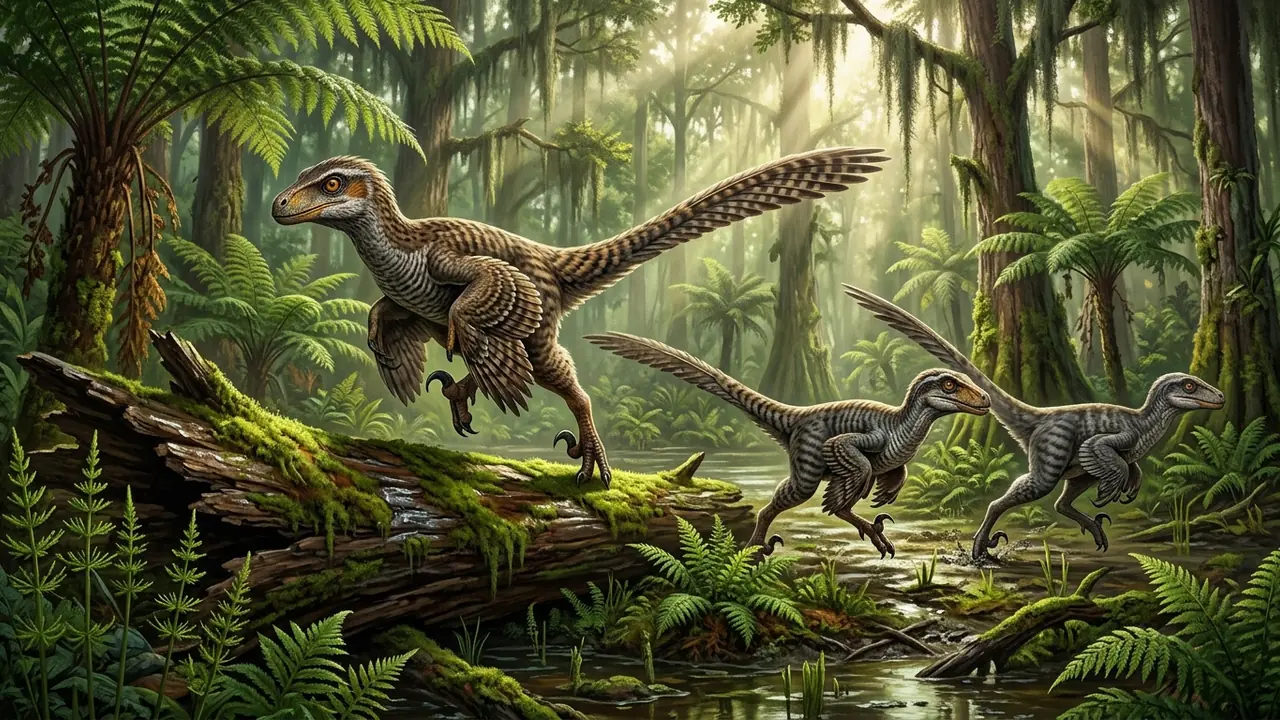
Step into an ancient cypress forest 112 million years ago and meet Deinonychus antirrhopus, whose Greek name translates to counterbalancing terrible claw! Measuring eleven feet from snout to tail tip and weighing 160 to 220 pounds, this muscular raptor stood roughly four feet tall at the head. While popular movies borrowed its size and Montana home for scaly screen villains, the real animal looked far more like a fierce, ground-running hawk!
Thick, patterned feathers served as an insulating for an active, lifestyle. Broad wing plumes covered its long three-fingered arms, and a fan of feathers framed its stiff horizontal tail.
Every recognizes Deinonychus as a game-changer in science history. Its agile skeleton proved once and for all that many dinosaurs were swift, intelligent, bird-like hunters rather than slow, tail-dragging lizards!
Lost World Habitat: Ancient Cypress Floodplains
During the Early Cretaceous Period between 115 and 108 million years ago, Deinonychus inhabited a lush landscape across present-day Montana, Wyoming, and Oklahoma. Slow, winding rivers spilled across wide floodplains during rainy seasons, feeding misty oxbow lakes, muddy bayous, and shady forests of bald cypresses, ginkgoes, cycads, and waist-high ferns.
Even eastern North America hosted remarkably similar coastal swamps at the exact same time! Along the Mid-Atlantic corridor of Virginia and Maryland, Early Cretaceous Potomac Group clays and sandstones preserve fossil conifers alongside shed raptor teeth closely matching Deinonychus, showing feathered dromaeosaurs prowled wetlands from the Rockies to the ancient Atlantic coast!
Dappled brown feathers acted as a camouflage among tangled tree roots and mossy logs, letting this hunter slip unseen past snapping river turtles, spike-armored Sauropelta, and watchful grazing ornithopod herds.
What's on the Prehistoric Menu?
Sunlight filtering through swamp canopies powered a rich . Ferns, horsetails, and low cycads served as green producers, feeding insects, freshwater snails, and plant-eating dinosaurs such as horse-sized Tenontosaurus. Frogs, lizards, and small mammals ate wetland bugs, while Deinonychus ruled near the top of the local food chain!
Chemical clues locked inside fossil tooth enamel reveal a clever survival twist: baby and juvenile Deinonychus ate different meals than adults! Lightweight youngsters chased lizards, frogs, and mammals through forest underbrush, flapping their feathered arms to scramble up tree trunks away from danger.
Once grown to full wolf weight, adult Deinonychus needed larger meals to fuel their muscles. Multiple raptors often gathered around Tenontosaurus trails, using group ambushes or bold mobbing tactics to bring down prey far heavier than one hunter alone!
Superpowers, Senses & Raptor Anatomy
Every bone in Deinonychus was built as a specialized hunting . On the second toe of each hind foot curved a terrifying five-inch sickle claw! Special toe joints held this hooked weapon high off muddy trails while Deinonychus ran on its third and fourth toes, keeping the keratin tip sharp enough to pin struggling prey like a giant eagle talon.
Unlike short-armed tyrannosaurs, Deinonychus possessed long, muscular arms tipped with three huge curved hand claws. Wrist bones shaped like half-moons allowed its feathered arms to fold neatly against its sides or flap outward for balance.
Inside its deep skull, forward-angled eyes provided sharp depth perception for judging leaps across mossy logs. Meanwhile, bundles of thin bony rods stiffened its tail into a straight counterbalance rudder, letting this acrobat pivot mid-stride without slipping!
Flight vs. Fight Arena: Swamp Clash!
Imagine a misty morning clearing where Team Apex Hunter confronted Team Fight! Deinonychus brought speed, binocular vision, razor reflexes, and five-inch gripping toe claws into the arena. Facing it stood Tenontosaurus tilletti, a sturdy plant-eater stretching over twenty-two feet long and weighing close to 2,000 pounds!
Although Tenontosaurus lacked sharp horns or heavy back plates, it relied on a formidable defensive : an extra-long, muscular tail reinforced with crisscross bony tendons. Swung sideways with full hip power, that heavy tail could bowl over a solitary predator in an instant!
To overcome a defender ten times its own body weight, Deinonychus relied on agile flanking leaps, spread wing feathers for balance, and coordinated group pressure. Yet healed bite marks on fossil bones prove alert Tenontosaurus adults frequently fought free and survived!
Fossil Detective Secrets: Sparking a Revolution
How can one fossil skeleton rewrite every science textbook on Earth? For over a century, museum halls displayed dinosaurs as sluggish, cold-blooded reptiles shuffling slowly through marshes. Then in August 1964, Yale John Ostrom and colleague Grant Meyer crouched on a rocky hillside near Bridger, Montana, and spotted gleaming curved claws eroding out of Early Cretaceous mudstone!
Over several summers, Ostrom's team excavated more than a thousand beautifully preserved Deinonychus bones. Studying its springy ankles, folding bird wrists, and rod-locked balancing tail, Ostrom published a landmark 1969 report arguing Deinonychus had to be an energetic, athlete.
Further comparisons between Deinonychus and the early winged bird Archaeopteryx proved birds evolved directly from small theropod dinosaurs! Thanks to careful fossil detective work, Deinonychus sparked the Dinosaur Renaissance and revealed living birds as surviving members of the dinosaur .