Meet the Legend: The Real Big Raptor
Have you ever wondered which real dinosaur inspired the human-sized raptors in popular adventure movies? Say hello to Deinonychus, whose name means terrible claw! Stretching eleven feet from snout to tail tip—nearly as long as a compact car—this athletic stood hip-high to an adult human and weighed 160 to 220 pounds, matching a giant mastiff dog.
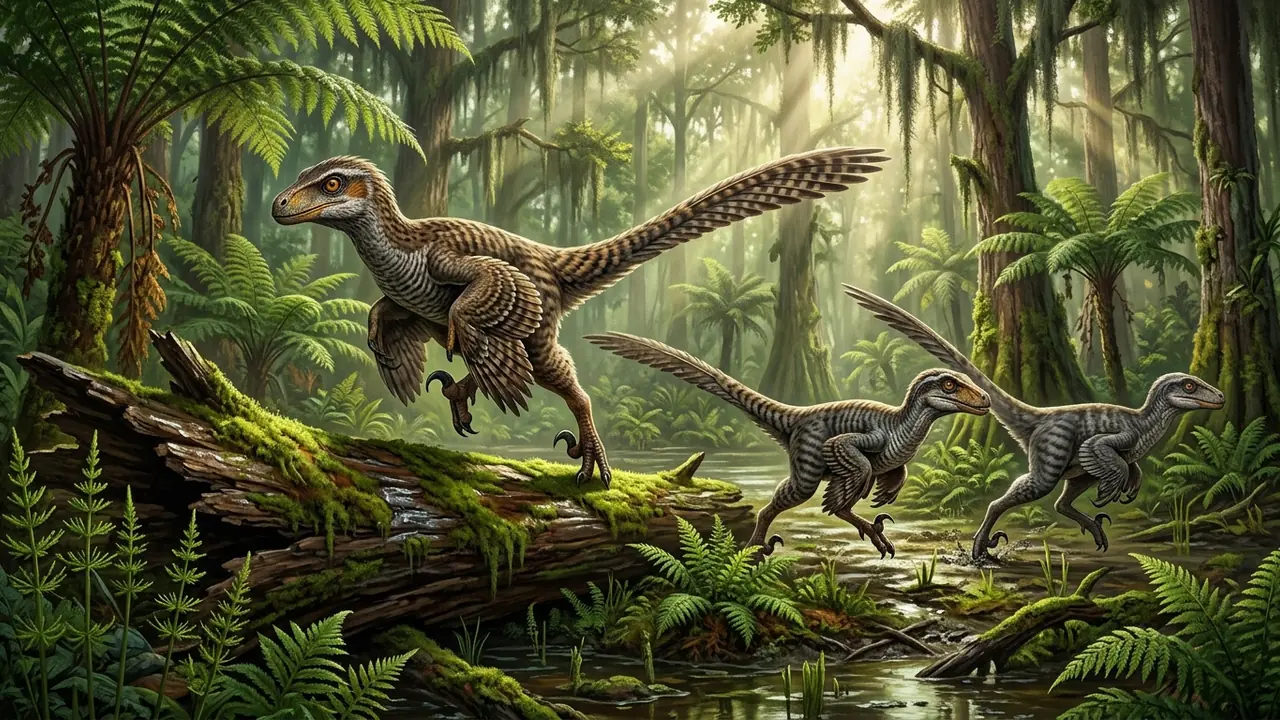
Unlike scaly movie monsters, real Deinonychus wore mottled brown and cream like a forest hawk! Long wing feathers lined its strong arms, and a fan of tail feathers helped steer every bold leap.
Lost World Habitat: Cypress Swamps & Creeks
Around 115 to 108 million years ago during the Early Cretaceous Period, Deinonychus prowled across Montana, Wyoming, and Oklahoma. Instead of dry mountains, western North America featured a warm, humid crisscrossed by slow rivers, misty bayous, and shady bald-cypress swamps. Lush ferns, horsetails, and cone-bearing trees blanketed the soft, muddy ground.
Patterned forest helped Deinonychus blend into dappled shadows beneath mossy logs. It shared these wet woods with armored, spike-shouldered Sauropelta, snapping river turtles, early mammals, and herds of plant-eating Tenontosaurus.
What's on the Prehistoric Menu?
Deinonychus was a powerful whose menu changed as it grew up! Tooth chemistry shows small, agile youngsters hunted lizards, frogs, and small mammals among low branches, even flapping winged arms to scramble up slanted tree trunks for safety. Full-grown adults tackled much bigger meals across the muddy .
Paleontologists have dug up multiple Deinonychus skeletons and dozens of shed serrated teeth right alongside horse-sized Tenontosaurus bones! Whether cooperating like wolves or gathering eagerly like hungry hawks, groups of Deinonychus teamed up to grip prey with sixty backward-curved teeth and sharp claws.
Superpowers: Five-Inch Claws & Tail Poles
On the second toe of each foot, Deinonychus carried a curved, five-inch claw as long as a grown-up's hand! While trotting on its outer two toes, special ankle hinges held that giant talon high off wet mud and stones so the point stayed needle-sharp for pinning prey.
Its second scientific name, antirrhopus, actually means counterbalancing! Bundles of slender bony rods wrapped around its tail bones, turning the tail into a stiff pole for rock-solid . Combined with flapping arm and inward-facing grasping hands, Deinonychus leaped across slippery swamp logs like a gymnast!
Flight vs. Fight Arena: Swamp Showdown!
When Deinonychus met Tenontosaurus on a muddy , Team Apex Hunter clashed with Team Fight! Adult Tenontosaurus stretched over twenty feet long and weighed nearly a ton—ten times heavier than a single raptor! Although it lacked bony armor plates, Tenontosaurus swung a long, muscular tail stiffened by tough tendons like a heavy defensive whip.
One solid tail slam could knock a careless off its feet! Deinonychus answered with quick teamwork, leaping agility, steady tail , and gripping five-inch talons, darting in and out before that sweeping tail could connect.
Fossil Detective Secrets: Dinosaur Renaissance!
Before the 1960s, most museum books pictured dinosaurs as slow, cold-blooded swamp lizards dragging heavy tails through mud. Everything changed in August 1964 when paleontologist John Ostrom spotted curved claws sticking out of a Montana hillside! Studying Deinonychus's folding bird-like wrists, stiff tail , and powerful talons, Ostrom realized this must have been warm-blooded, fast, and full of energy.
His 1969 discovery launched the famous Dinosaur Renaissance! Today, scientists know feathered raptors like Deinonychus were close cousins of living birds—turning dusty old lizard myths upside down forever.