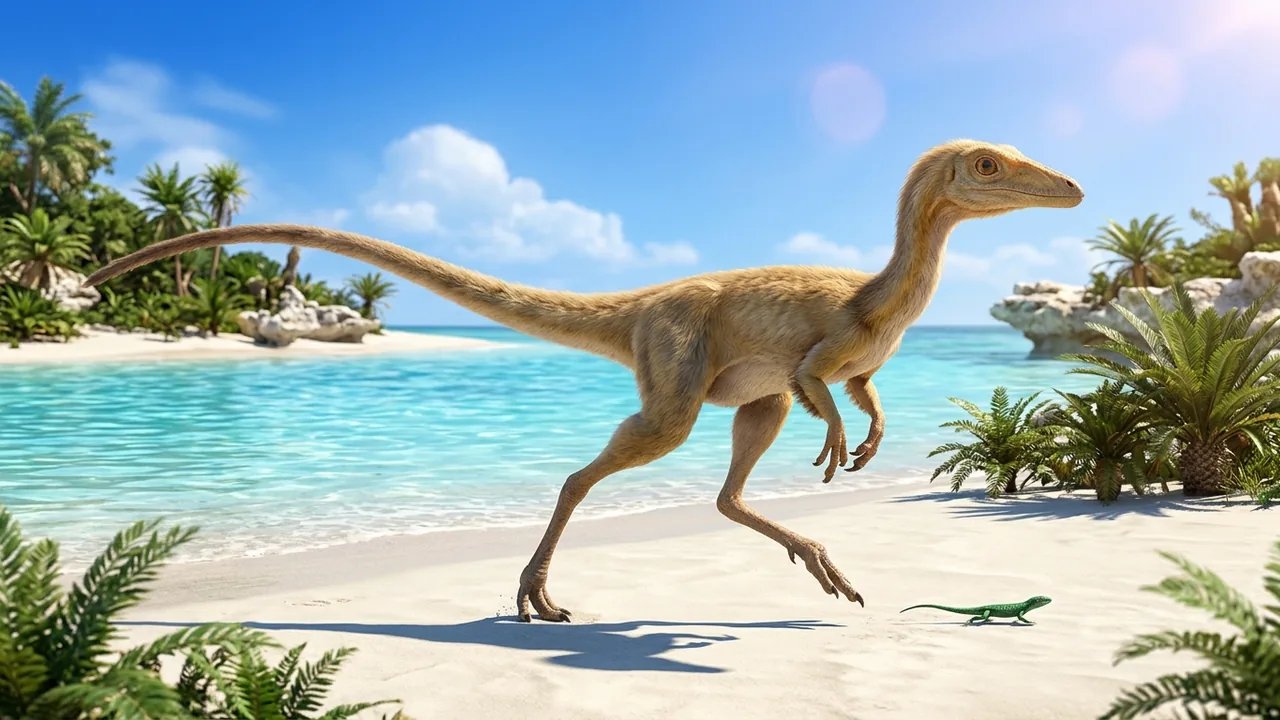
Meet the Legend: Basal Coelurosaurian Architecture
Within dinosaur evolutionary history, few small skeletons carry greater scientific weight than Compsognathus longipes. Positioned near the base of as type genus of family Compsognathidae, this diminutive Late Jurassic carnivore demonstrated early in paleontological history that theropods spanned chicken-weight sprinters as well as multi-ton continental giants. While the celebrated Bavarian juvenile holotype (BSP AS I 563) measures 89 centimeters long and weighed roughly 0.8 to 1 kilogram in life, the mature French specimen (MNHN CNJ 79) reached 1.25 meters (4.1 feet) in length and approximately 2.5 to 3.5 kilograms (5.5 to 7.5 pounds).
More than half of that slender axial length consisted of an attenuated tail of over forty caudal vertebrae lacking stiffened dromaeosaurid rod bundles, allowing whip-smooth lateral balance adjustments during tight turns.
Its delicately fenestrated, seven to ten centimeter skull inspired Johann Andreas Wagner's 1861 genus name meaning elegant jaw, housing acute ring-supported eye sockets above narrow, tapered mandibles.
Pneumatic air sacs hollowed out its cervical and anterior dorsal vertebrae to trim skeletal mass, while tridactyl hands bore a reduced functional third digit beside two longer grasping claws.
Although carbonate slabs did not preserve soft epidermal filaments directly around Compsognathus bones, exceptional volcanic lakebed fossils of sister compsognathid Sinosauropteryx prima from Liaoning and Bavarian juvenile cousin Juravenator confirm downy, unbranched protofeathers insulated its energetic body across breezy subtropical islands! That warm fuzzy covering kept its small body active from sunny dawn until cool twilight along the reef shore.
Lost World Habitat: Solnhofen & Canjuers Lagoons
Reconstructing the vanished island home of Compsognathus takes geologists into two classic Tithonian-stage (roughly 150 to 148 million years ago) marine carbonate sequences: Germany's Plattenkalk in Bavaria and southeastern France's Canjuers in Var. During the Late Jurassic Period, high global sea levels submerged much of western Europe beneath a warm, shallow sea bordering the tropical Tethys Ocean, leaving scattered low carbonate islands across the Franconian and Provence platforms.
Submarine sponge-microbial mounds and stony coral reefs partitioned back-reef basins into quiet, stratified lagoons sheltered from open ocean waves. Intense subtropical sunshine and evaporation concentrated dense, hypersaline, oxygen-depleted brines along the deep lagoon floors!
Because lethal salt levels and bottom anoxia excluded burrowing worms, crabs, and scavenging fish from those quiet basins, any terrestrial insect, pterosaur, early winged avialan like Archaeopteryx, or coastal runner swept offshore by seasonal monsoonal squalls sank gently onto undisturbed, microscopic lime mud.
On the adjacent semiarid coral islands, thin porous soils lacked large river networks, supporting low drought-hardy scrublands of scaly-leaved Brachyphyllum conifers, bennettitalean shrubs, seed ferns, and coastal cycads.
This extraordinary lagoonal turned fine lithographic limestones into high-definition biological archives capturing complete island food webs, from lacy dragonfly wing veins and circling horseshoe crab trackways right up to articulated skeletons of swift island theropods! Geologists still quarry these thin cream-colored rock beds carefully by hand to uncover new Late Jurassic treasures every summer across southern Germany and sunny Provence. Splitting each flat slab feels like opening a prehistoric picture book sealed beneath ancient tropical waves!
What's on the Prehistoric Menu? Cololite Forensics
Direct dietary evidence rarely survives fossilization, yet holotype BSP AS I 563 from the limestone preserves one of vertebrate paleontology's most celebrated specimens right inside its thoracic ribcage! Nestled neatly between its dorsal ribs and pelvic girdle lies the articulated skeleton and skull of a nimble, tree-and-rock-climbing squamate lizard swallowed nearly intact shortly before the young dinosaur perished.
When American paleontologist Othniel Charles Marsh inspected the Bavarian slab in 1881, he famously misinterpreted those tiny internal bones as an embryonic Compsognathus inside its mother, proposing live birth in dinosaurs! In 1903, Hungarian researcher Franz Nopcsa overturned that hypothesis by demonstrating unmistakable lizard vertebrae and limb proportions, later assigned by Yale's John Ostrom in 1978 to rapid-running island lizard Bavarisaurus macrodactylus.
In 2018, high-resolution osteological re-analysis by Jack Conrad revealed the gut lizard actually represented a distinct fast scleroglossan species named Schoenesmahl dyscheres, confirming Compsognathus hunted diverse agile lizards across dry island scrublands!
Dental specialization matched this swift-prey niche with remarkable precision: anterior premaxillary and maxillary teeth were slender, smooth, and sharply recurved for snagging darting lizards or flying dragonflies, whereas rear cheek teeth were flattened sideways with fine serrations for slicing.
Paired with fossilized marine crustacean shell fragments preserved beside the French Canjuers adult, every forensic cololite clue portrays an active, opportunistic beach and scrubland micro-carnivore! Few fossils anywhere on Earth capture an ancient predator-prey chase so vividly in solid limestone after 150 million years of deep geologic time.
Superpowers: Multibody Biomechanics at 40 MPH
Within basal , Compsognathus longipes pushed small-bodied cursorial engineering to extraordinary athletic extremes across the sunny archipelago. Its species epithet longipes, meaning long-footed in Latin, highlights elongated lower hind-limb segments: the shin bone substantially exceeded thigh bone length, and closely bound central foot bones lengthened the effective lever arm of every digitigrade stride while keeping ankle and toe mass remarkably low.
In 2007, paleobiomechanists William Sellers and Phillip Manning quantified that athletic potential using evolutionary-robotics multibody dynamic computer simulations. Constructing detailed three-dimensional musculoskeletal models across five bipedal theropods, namely Tyrannosaurus, Allosaurus, Dilophosaurus, Velociraptor, and Compsognathus, their supercomputer algorithms tested millions of muscle activation sequences until each virtual skeleton achieved maximum stable forward velocity without falling!
Pint-sized Compsognathus outperformed every larger dinosaur tested, reaching an estimated peak sprint velocity of 17.8 meters per second, or nearly 40 miles per hour (64 km/h), surpassing computer-modeled modern ostriches and shattering elite human sprint records by more than twelve miles per hour!
Ultra-low rotational limb inertia, favorable muscle-force-to-body-mass scaling, and hollow pneumatic neck and back bones enabled blistering start-up acceleration across hard-packed coral sand.
Meanwhile, large forward-and-sideways oriented eye sockets provided crisp visual target tracking, and its whip-slender, forty-plus-vertebra tail swung smoothly behind the hip sockets to stabilize instantaneous pursuit turns around limestone boulders without ever skidding! Every springy tendon in its slender ankles stored elastic recoil energy like a miniature carbon-fiber track star sprinting effortlessly down a sunlit coral beach. Pound for pound, few land animals in Earth's history ever accelerated with sharper mechanical precision!
Flight vs. Fight Arena: Island Speed Trade-Offs
Across sunlit carbonate cays of the and Canjuers island chains, Compsognathus navigated a razor-sharp evolutionary trade-off along the Team Flight spectrum: maximizing velocity to out-sprint agile squamate quarry while simultaneously evading formidable coastal predators! On open coral shingle, adult lizards such as Bavarisaurus macrodactylus deployed elongated hind feet and long counterbalance tails of their own to dart toward narrow limestone crevices in blinding bursts.
Only upright parasagittal hind-limb posture, a hallmark of Dinosauria and that freed runners from Carrier's constraint, the side-to-side trunk bending that squeezes lungs in sprawling lizards, gave this warm-blooded island hunter decisive aerobic endurance and top-speed superiority during twisting beach chases!
Yet along the turquoise tidal margin of every reef lagoon, the ecological tables turned in an instant. Lacking bony dermal osteoderms, brow horns, or bone-crushing jaws, a three-kilogram theropod stood completely defenseless against four to five meter thalattosuchian marine crocodylomorphs like Dakosaurus maximus and Machimosaurus patrolling deep reef channels, as well as larger island megalosaurid theropods lurking on neighboring landmasses.
In this exposed coastal arena, hyper-alert visual surveillance, hollow skeletal lightening, camouflage protofeathers, and instantaneous 38 to 40 mile per hour escape bursts served as an unbeatable survival shield.
Whether rocketing down an emerald lizard for breakfast or vanishing inland into drought-hardy conifer scrub ahead of surging lagoon jaws, pure Team Flight locomotion kept Compsognathus thriving across Late Jurassic Europe! Speed alone conquered every hazard between white reef beaches and dry island interiors for millions of sunny years.
Fossil Detective Secrets: Huxley & Three Fingers
Few fossil species illustrate how careful and comparative anatomy refine scientific knowledge over centuries better than Compsognathus longipes. Acquired in 1859 by physician and collector Joseph Oberndorfer from Bavarian limestone quarries near Kelheim, just two years before the first feathered skeleton of Archaeopteryx surfaced from the very same rock unit, Compsognathus immediately captured the attention of pioneering English anatomist Thomas Henry Huxley.
In a landmark 1868 lecture in London, Huxley placed bird-ankled Compsognathus right alongside winged Archaeopteryx as Exhibit A proving that living birds evolved directly from small dinosaurian ancestors! Exactly 110 years later in 1978, Dinosaur Renaissance leader John Ostrom published a definitive osteological redescription of Compsognathus alongside his celebrated studies of Archaeopteryx, confirming its foundational place near the base of and spotlighting its remarkable lizard stomach contents.
Even its delicate forelimb structure taught paleontologists a century-long taphonomic detective lesson! Because gentle lagoonal decay and slight bottom drift had detached tiny wrist bones and outer finger phalanges around the juvenile German holotype, generations of textbooks reconstructed Compsognathus with functionally two-fingered hands.
When quarry workers uncovered the fifty-percent-larger adult skeleton at southeastern France's Canjuers in 1971, initially nicknamed Compsognathus corallestris before researchers recognized it as a mature Compsognathus longipes, well-preserved articulated wrist joints proved beyond doubt that Europe's iconic coral-island speedster sported three clawed fingers on every hand! More than 160 years after its discovery, this pint-sized legend continues lighting up evolutionary science and inspiring young fossil explorers worldwide.