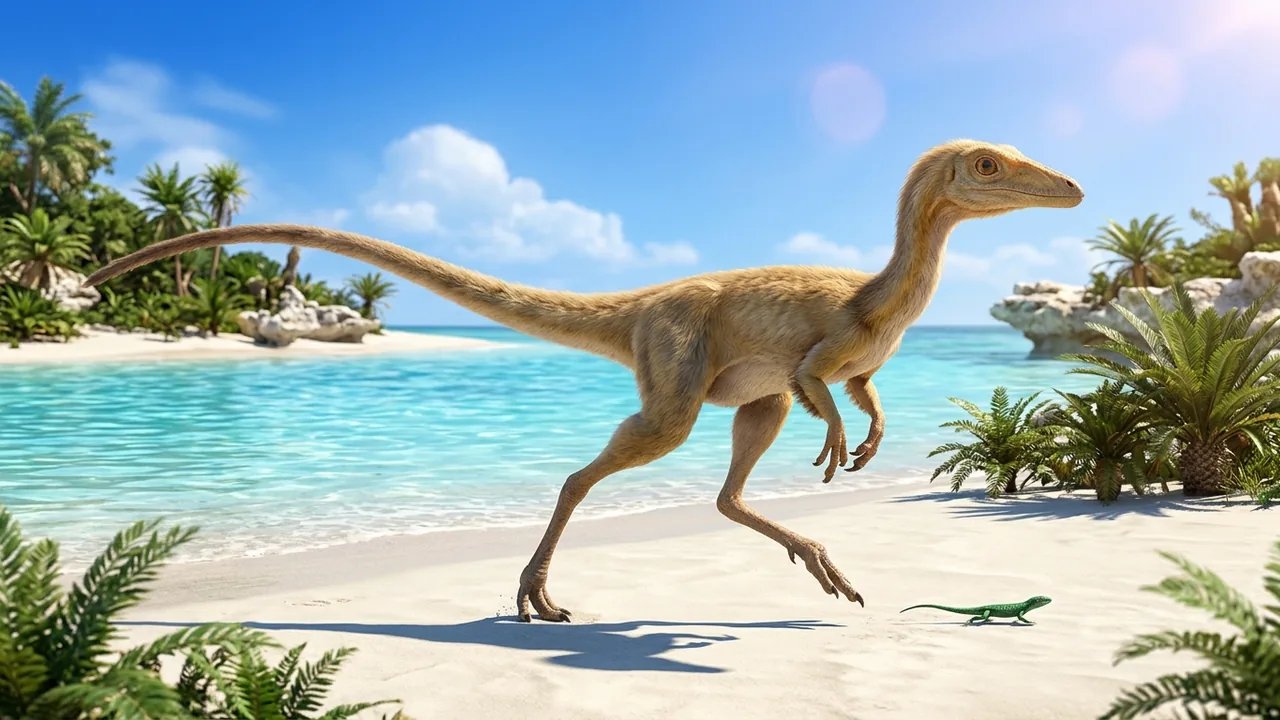
Meet the Legend: Elegant-Jawed Island Sprinter
When people imagine Late Jurassic dinosaurs, giant sauropods usually steal the spotlight—yet one of science's most famous fossil stars weighed no more than a backyard chicken! Meet Compsognathus longipes, whose name translates to elegant jaw with long feet. Adults measured three to four feet from snout to tail tip and tipped the scales between five and a half and seven and a half pounds.
More than half of that length belonged to a slender bony tail held straight out behind its hips for balance. Fossils of close compsognathid cousins confirm its sleek body wore a downy coat of sandy-brown —an essential physical that trapped body heat and camouflaged the little hunter against sun-bleached driftwood.
Every studying Compsognathus marvels at how lightness, keen senses, and bird-like grace packed huge athletic talent into such a pint-sized frame!
Lost World Habitat: Turquoise Lagoons & Reefs
One hundred and fifty million years ago during the Late Jurassic Period, Earth's continents were actively drifting apart. While the young Atlantic Ocean was opening along eastern North America near ancient Virginia, warm tropical waters flooded much of Europe, turning southern Germany and southeastern France into a sunlit island chain!
Ring-shaped coral and sponge reefs sheltered calm, crystal-clear lagoons from rolling ocean surf. Ashore, dry sandy islands supported drought-hardy conifers, seed ferns, and prickly cycads watered by passing sea breezes, where small body size served as a smart island when fresh water ran scarce.
Beneath those quiet lagoons, silky lime mud settled layer by layer into ultra-fine rock. Whenever tropical storms swept shore insects, flying pterosaurs, early dino-bird Archaeopteryx, or nimble Compsognathus into deep salty basins, calm bottom mud preserved their delicate bodies like crisp photographs in stone!
What's on the Prehistoric Menu?
Small islands rarely grow enough lush foliage to feed multi-ton plant-eaters, so island ecosystems build compact, fast-moving coastal webs! Near the base of Compsognathus's island , tough cycads and conifers fed beetles, lacewings, grasshoppers, and cockroaches, while rocky tide pools brimmed with tiny ocean crustaceans.
Swift insect-eating lizards such as Bavarisaurus darted across warm rocks to snap up those bugs, and nimble Compsognathus hunted both the crunchy insects and the fast lizards! Its narrow, tapered snout functioned as a precision tweezer , reaching deep into coral rock crevices where wider jaws could never fit.
More than sixty tiny, sharply curved front teeth gripped wriggling lizards securely while three clawed fingers held slippery prey steady. Once caught, small quarry went down almost whole, leaving unmistakable bone clues locked right inside one famous German skeleton's ribcage for scientists to admire!
Superpowers, Senses & High-Speed Anatomy
When you weigh only six pounds, every ounce of muscle can launch you forward like a coiled spring! Compsognathus possessed textbook sprinter proportions: hollow, air-filled bones shaved away excess weight, while long shin bones and tightly bound foot bones multiplied stride length across firm, sunlit beach sand.
Biomechanical computer tests estimate this pint-sized athlete could hit bursts between 35 and 40 miles per hour, making it one of the fastest two-legged runners ever to live on Earth! A cozy coat of soft served as a vital thermal , keeping high-energy leg muscles warm and ready for instant acceleration.
Meanwhile, huge round eye sockets housed sharp eyes angled slightly forward to judge exact leaping distances toward darting dragonflies, while its stiff horizontal tail whipped left and right like a tightrope walker's pole during hairpin beach turns around driftwood logs!
Flight vs. Fight Arena: Beach Sprint Showdown!
On sunlit coral sandbars, survival belonged to the quickest feet! In our coastal matchup, Compsognathus faced swift island lizard Bavarisaurus, and also stayed alert for giant predators patrolling the rolling surf. With fragile hollow ribs and zero bony armor, Compsognathus relied 100 percent on Team Flight speed and hair-trigger agility.
When chasing dinner, explosive two-legged acceleration proved a winning hunting that let Compsognathus overtake zig-zagging lizards before they could slip under coral boulders. Yet higher up the coastal , fourteen-foot marine crocodylomorphs lurked quietly inside turquoise channels right beside the beach!
One splash in the shallows triggered instant behavioral escape: giant watchful eyes spotted danger immediately, sandy blurred across white shingle, and a 38-mile-per-hour sprint carried Compsognathus safely up dry dunes before heavy ocean jaws could ever clear the surf!
Fossil Detective Secrets: Two Countries, One Puzzle!
Few dinosaurs boast a cooler scientific detective story than Compsognathus! In 1859, fossil collector Joseph Oberndorfer acquired a jewel-like little skeleton from creamy limestone quarries near Solnhofen, Germany, and scientist Johann Andreas Wagner named it in 1861. Because gentle lagoon currents had scattered its tiny wrist bones, generations of books drew Compsognathus with only two fingers per hand!
Even more mysterious was a tiny skeleton curled inside its ribs. In 1881, famous American Othniel Charles Marsh guessed it was an unborn baby dinosaur, until sharp-eyed researchers zoomed in under magnifying lenses and identified the skull and long tail of a swallowed lizard!
Finally, in 1971, a second, fifty-percent-larger adult skeleton turned up in French lagoon limestone at Canjuers, proving to every paleontologist worldwide that Compsognathus grew to chicken weight and sported three clawed fingers on each hand all along!