Meet the Legend: Chicken-Weight Island Runner
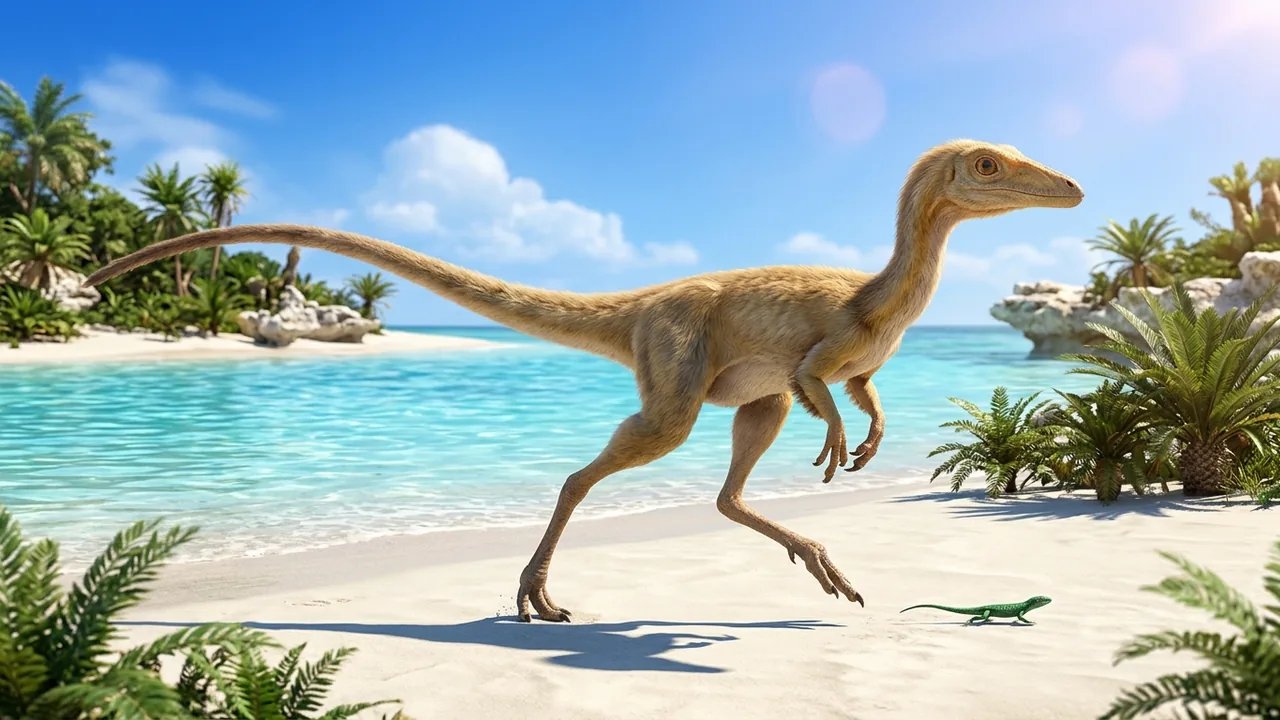
Picture a dinosaur light enough to perch on a garden bench, weighing just six or seven pounds like a plump rooster or small house cat! Meet Compsognathus, whose Greek name means elegant jaw. From the tip of its narrow snout to the end of its whip-thin tail, an adult measured three to four feet long.
Forget movie myths of slimy green monster swarms with venomous bites! Real Compsognathus had zero venom and wore a warm, sandy-brown coat of fuzzy . Bright eyes and slender hind legs made this tiny an beach runner!
Lost World Habitat: Europe's Tropical Islands
One hundred and fifty million years ago during the Late Jurassic Period, Europe looked like the sunny Bahamas! Warm, shallow sea water covered much of Germany and France, dotting the ocean with a tropical of low coral islands, white sandbars, and calm turquoise lagoons.
Because fresh rainwater drained quickly through porous island sand, tall giant trees were rare. Instead, scrubby conifers, tough cycads, and low fern thickets rimmed the beaches. Compsognathus trotted along tide lines beside horseshoe crabs, flying pterosaurs, and feathered dino-bird neighbor Archaeopteryx!
What's on the Prehistoric Menu?
Without giant plant-eating dinosaurs living on its small dry islands, what fueled this , pint-sized ? Compsognathus specialized in small, lightning-quick coastal prey! Darting between driftwood and low bushes, it snapped up dragonflies, beetles, tide-pool crabs, and speedy island lizards like Bavarisaurus.
Over sixty tiny, backward-curved teeth lined its narrow jaws, gripping slippery lizard scales tightly while three clawed fingers pinned wriggling catches. One famous fossil preserved a whole lizard skeleton folded neatly inside Compsognathus's stomach, proving it gulped small lizards down almost whole!
Superpowers: 35-MPH Beach Rocket!
Pound for pound, Compsognathus ranked among the fastest sprinters of the entire dinosaur age! Hollow, air-filled bones kept its skeleton feather-light, while extra-long shin and foot bones stretched every stride across packed coral sand. Computer tests estimate this runner could burst past 35 miles per hour—leaving the fastest human Olympian in the dust!
Fuzzy insulated its warm-blooded muscles during breezy island evenings. Meanwhile, its extra-long bony tail stretched straight out behind its hips, swinging smoothly to steer tight corners without skidding!
Flight vs. Fight Arena: Dual-Speed Survivor!
On sunlit beaches of the European , Team Flight speed worked both for catching lunch and for staying alive! Watch Compsognathus spot an emerald Bavarisaurus lizard sunning on white coral rock. Both racers explode across the sand, twisting around fern clumps until Compsognathus's longer legs win the sprint!
Moments later, ripples stir the lagoon where a fifteen-foot sea crocodile lurks near shore. Thin-boned Compsognathus never fought big reptiles—one instant bound sent the fuzzy speedster bolting safely inland into tangled island brush!
Fossil Detective Secrets: Two Famous Skeletons!
Quiet lagoon bottoms across Germany and France collected silky mud that hardened into creamy, super-smooth . Quarried for centuries to print detailed maps and books, those flat stone slabs preserved jellyfish, dragonfly wings, and two world-famous Compsognathus skeletons!
Found in Bavaria in 1859, the first rabbit-sized youngster seemed to have only two fingers per hand because gentle currents shifted tiny wrist bones. Over a century later in 1971, quarry workers in southern France uncovered a chicken-sized adult in fine limestone—proving this fuzzy actually had three clawed fingers all along!