Meet the Legend: Pint-Sized Coelurosaur Pioneer
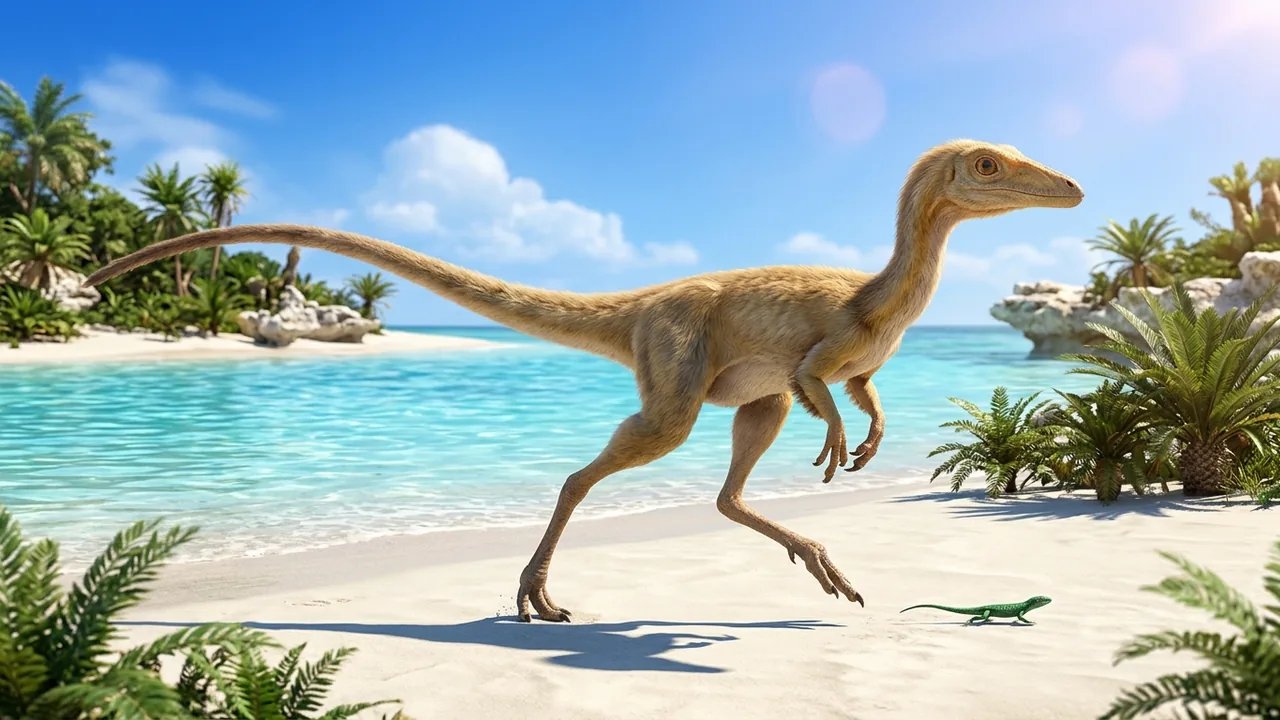
Meet the nimble little hunter that proved dinosaurs came in pint-sized packages too: Compsognathus longipes! Classified as an early , the slender, bird-related branch of theropod dinosaurs, a full-grown French adult stretched roughly 4 feet (1.25 meters) long while its famous German juvenile cousin measured just under 3 feet (0.9 meters). Even at full adult size, thin-walled hollow bones kept total body mass between 5.5 and 7.5 pounds (2.5 to 3.5 kilograms), no heavier than a plump barnyard hen or small house cat!
More than half of its entire body length belonged to a slender, tapering bony tail held horizontally behind the hips as an agile running . Its narrow, three-inch skull earned the name elegant jaw, tapering smoothly toward sharp, peg-like front teeth and keen, ring-supported eyes.
Although European lagoon slabs preserved bones rather than soft plumage on Compsognathus itself, spectacular fossils of sister compsognathids like Sinosauropteryx preserve dense halos of downy across virtually identical skeletons.
Clothed in warm, sandy-gold fuzz that insulated active leg muscles and blended seamlessly into sunlit coral shingle, Compsognathus looked far more like an energetic coastal roadrunner than any scaly movie monster!
Lost World Habitat: Europe's Late Jurassic Lagoons
Travel back 150 million years to the Late Jurassic Period, and the modern map of Europe vanishes beneath a sparkling subtropical sea! Shallow arms of the ancient Tethys Ocean flooded what are now southern Germany and southeastern France, creating a sun-drenched archipelago of low carbonate islands, white coral-sand beaches, and quiet turquoise lagoons.
Massive underwater sponge mounds and stony coral reefs formed natural barriers that blocked open-ocean waves and restricted deep water circulation inside calm lagoon basins. Ashore, porous limestone soils held very little standing freshwater, favoring drought-adapted conifers, bennettitalean shrubs, low seed ferns, and tough coastal cycads.
Within this compact island ecosystem, multi-ton continental dinosaurs were largely absent because small islands could not grow enough tall trees to feed giant herds. Instead, energy flowed rapidly from coastal scrub plants to abundant dragonflies, beetles, and shore crustaceans, upward into swift lizards, gliding dino-bird Archaeopteryx, fish-skimming pterosaurs like Rhamphorhynchus, and fleet-footed Compsognathus!
Warm sea breezes, blinding white coral sand, and tangled shoreline driftwood created an open, high-visibility hunting arena where sandy camouflage, sharp eyesight, and instant sprinting reflexes decided every single coastal meal.
What's on the Prehistoric Menu? Gut-Content Clues
While paleontologists usually infer dinosaur diets from tooth shape alone, Compsognathus preserved unmistakable direct proof right inside its ribcage! Curled neatly inside the abdominal cavity of the famous Bavarian fossil lies the articulated skeleton of a swift, long-tailed island lizard swallowed almost whole just hours before the young dinosaur perished near the shore.
Occupying a nimble mid-tier carnivore slot in its island web, Compsognathus patrolled wrack lines and low fern thickets for fast squamate lizards like Bavarisaurus, alongside crunchy beetles, giant lacewings, dragonflies, and tide-pool crabs, as evidenced by crustacean shell fragments discovered beside the French adult skeleton.
Jaw suited slippery, fast-wriggling quarry with surgical precision. Unlike bone-crushing giant theropods, Compsognathus possessed a slender, lightweight skull armed with small, sharply recurved front teeth spaced wide to snag darting lizards like tiny grappling hooks, followed by slightly flattened rear teeth for clean shearing.
Three-fingered hands tipped with curved claws pinned squirming catches securely while rapid neck muscles tossed prey backward down the throat, delivering concentrated protein fuel to sustain warm-blooded running muscles shielded beneath soft insulating ! Strong stomach acids dissolved small bones rapidly during active island mornings.
Superpowers: 40-MPH Computer-Modeled Sprint!
Just how fast could a six-pound accelerate across hard-packed coral sand? In 2007, researchers William Sellers and Phillip Manning built detailed three-dimensional computer musculoskeletal models of five two-legged dinosaurs, ranging from six-ton Tyrannosaurus down to chicken-weight Compsognathus, and let supercomputers test millions of muscle-firing combinations until each virtual runner hit peak speed!
Compsognathus won the prehistoric track meet outright, posting a calculated top sprint near 17.8 meters per second, or roughly 39 to 40 miles per hour (64 km/h)! That blazing pace topped even computer-modeled modern ostriches and left champion Olympic human sprinters more than twelve miles per hour behind in the sand.
Several anatomical gifts unlocked such explosive running biomechanics: ultra-light hollow limb bones, powerful hip-anchored leg muscles, shin bones significantly longer than the thighs, and narrow three-toed feet that struck the ground like stiff elastic springs.
Out behind its pelvis, more than forty slender tail vertebrae formed a whip-thin horizontal that swung cleanly through sharp turns around coral boulders, while downy prevented precious body heat from escaping into cool evening sea winds! Sensitive inner-ear balance canals kept its bright eyes steady over bumpy shell beaches.
Flight vs. Fight Arena: Catching Prey & Dodging Jaws!
Step onto a glaring white Late Jurassic sandbar where Team Flight speed operated as a double-edged survival superpower! In our coastal chase matchup, Compsognathus squared off against nimble island lizard Bavarisaurus, a long-legged sprinter equipped with its own whip-like tail and rated 8 out of 10 for darting speed among shoreline rocks and driftwood.
Whenever Bavarisaurus bolted toward narrow coral crevices, Compsognathus relied on high-stepping bipedal and forward-overlapping binocular eyesight to close the gap in split seconds, banking tightly without skidding across loose shell sand!
Yet just one step higher lurked gigantic aquatic hazards along the water's edge. Patrolling deep reef channels right beside those sunny beaches were thirteen to fifteen foot marine crocodylomorphs like Dakosaurus and Machimosaurus, armed with heavy, skull-crushing jaws!
Weighing barely seven pounds with paper-thin hollow bones and 1 out of 10 armor, Compsognathus never lingered to fight bigger reptiles. One ripple in the turquoise shallows triggered instant Team Flight evasion, launching this pint-sized inland into dense cycad scrub at nearly 40 miles per hour before heavy marine predators could ever clear the surf!
Fossil Detective Secrets: Solving Two Mysteries!
Compsognathus stars in two of paleontology's greatest detective mysteries! Discovered in 1859 inside ultra-fine Solnhofen lithographic limestone in Bavaria, Germany, the first skeleton was so tiny and complete that English biologist Thomas Henry Huxley compared its bird-like hind-limb directly with nearby Archaeopteryx in 1868, sparking the revolutionary scientific idea that living birds descended from small dinosaurs!
Mystery One sat curled right inside its fossilized ribs. In 1881, American fossil hunter Othniel Charles Marsh proposed those tiny internal bones belonged to an unborn dinosaur embryo, until Hungarian researcher Franz Nopcsa and later Yale paleontologist John Ostrom proved it was actually a swallowed fast-running island lizard!
Mystery Two puzzled museum artists for 112 years: because gentle bottom currents had drifted tiny wrist and finger bones apart on the German juvenile, generations of books restored Compsognathus with two-fingered hands like Tyrannosaurus.
Then in 1971, quarry workers at Canjuers in southern France uncovered a fifty-percent-larger adult skeleton in smooth lagoon limestone, revealing three clawed fingers on each hand and completing our vivid portrait of Europe's iconic coral-island sprinter! Today both treasured slabs inspire young fossil detectives visiting museums in Munich and Paris.