Meet the Legend: Coevolution in Stone
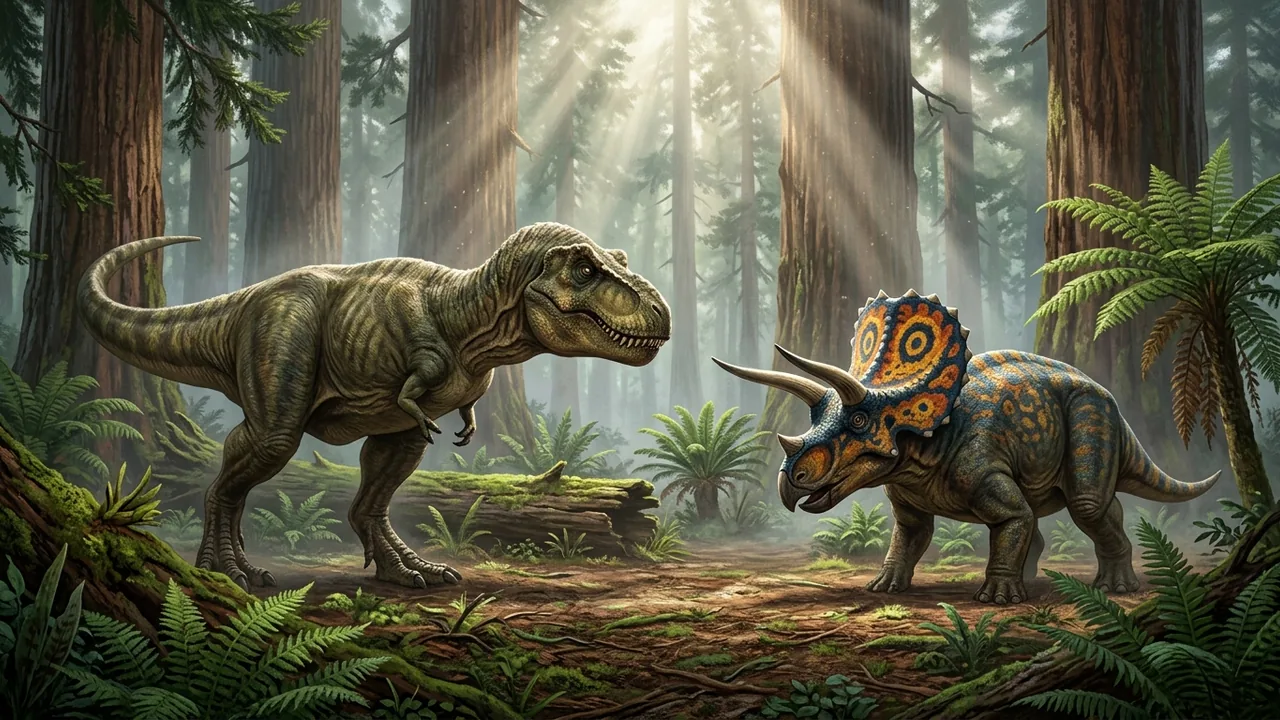
In vertebrate paleontology, few predator-prey matchups pass rigorous geologic testing as cleanly as Tyrannosaurus rex and Triceratops horridus. Popular culture frequently pairs dinosaurs separated by tens of millions of years or entire oceans, yet high-precision across the Hell Creek, Lance, and Scollard Formations of western North America places these two Maastrichtian giants in the exact same river basins between sixty-eight and sixty-six million years ago. Argon-argon radiometric dating of volcanic bentonite ash beds confirms both species coexisted right up until the end-Cretaceous asteroid impact.
Across those final two million years of the Mesozoic Era, tyrannosaurid predators and chasmosaurine ceratopsians locked into intense evolutionary . As Tyrannosaurus rex evolved vaulted, torsion-resistant skulls and bone-splintering dentition atop an eight-ton bipedal frame, Triceratops evolved nine-ton quadrupedal bulk crowned by meter-long supraorbital horns and an unfenestrated cranial shield.
Quantitative fossil censuses across eastern Montana badlands underscore how frequently their paths intersected. Because Triceratops accounts for nearly forty percent of all large dinosaur skeletons recovered from upper Hell Creek strata, adult tyrannosaurs encountered horned defenders along virtually every floodplain drainage.
Ontogenetic studies of growth series even show how Triceratops horns curved backward in juveniles before sweeping threateningly forward in subadults—the exact life stage when solitary defense against tyrannosaurs became critical! Meanwhile, bone histology rings inside tyrannosaur leg bones reveal teenage T. rex packed on nearly five pounds of muscle per day to reach giant size.
Neither lineage could afford anatomical weakness. Together, T. rex and Triceratops stand as paleontology's premier natural experiment pitting maximum vertebrate bite force against specialized cranial .
Lost World Habitat: Maastrichtian Delta Plains
During the latest Maastrichtian stage, tectonic uplift of the ancestral Laramide Rockies shed vast aprons of sand, silt, and mud eastward toward the retreating Western Interior Seaway. What erodes today as dry Montana and Dakota badlands was then a humid subtropical coastal plain braided by meandering rivers, oxbow bayous, metasequoia dawn redwood swamps, cycads, tree ferns, and diverse early hardwood angiosperms. Fossil leaf margins and pollen assemblages indicate warm mean annual temperatures without hard winter freezes, fueling lush year-round plant growth.
Detailed sedimentary within the Hell Creek Formation reveals how microhabitat boundaries governed predator-prey encounters. Raised natural river levees supported dense conifer, ginkgo, and magnolia gallery forests whose deep shadows concealed stalking mega-theropods.
Just meters away from those forested channels, poorly drained overbank floodplains opened into broad herbaceous fern brakes and horsetail meadows where low-browsing Triceratops enjoyed clear, unobstructed sightlines across hundreds of yards.
Sharing these dynamic waterways were champsosaurs, softshell trionychid turtles, giant alligatoroids, club-tailed Ankylosaurus, dome-headed Pachycephalosaurus, feathered dromaeosaurs, and immense herds of hadrosaurid Edmontosaurus. Even sequential evolutionary changes appear across upper strata, where earlier Triceratops horridus gradually gave way to its descendant species Triceratops prorsus alongside apex tyrannosaurs.
Paleosols—fossilized floodplain soils rich in root traces and amber droplets—show that heavy seasonal rains alternated with firmer dry spells. Every sudden boundary between dark levee timber and sunlit floodplain meadow functioned as a living tactical arena where stealth and vigilance collided daily, testing whether firm ground or muddy mire favored hunter or defender.
What's on the Prehistoric Menu?
Comparative and dental microwear textures demonstrate how cleanly Hell Creek giants partitioned ecological resources. Triceratops functioned as an obligate low-level fibrous browser: its narrow toothless rostral bone and lower predentary beak snapped tough palms, cycads, and woody angiosperms, while vertical batteries of thirty-six to forty tooth columns per jaw side delivered high-angle orthogonal shear. Whereas duck-billed hadrosaurs pulverized softer foliage with angled grinding strokes, Triceratops guillotined coarse stems like industrial shears.
Tyrannosaurus rex occupied the apex carnivore niche while undergoing dramatic ontogenetic shifts across its roughly twenty-eight-year lifespan. Sleek, long-shinned juvenile tyrannosaurs pursued agile ornithopods at high speed, avoiding direct food competition with multi-ton adults whose skulls deepened abruptly during adolescence to handle struggling megaherbivores.
Once mature, T. rex targeted megaherbivores—primarily hadrosaurs and ceratopsians—practicing extreme osteophagy, or active bone consumption, unmatched by earlier Jurassic carnosaurs! Large phosphatic coprolites packed with acid-rounded ceratopsian bone fragments prove T. rex digested skeletal marrow alongside muscle tissue, extracting essential calcium and phosphorus to fuel rapid skeletal .
Between hunts, shock-absorbing arctometatarsalian hind feet conserved elastic tendon energy across vast floodplain home ranges, allowing eight-ton adults to patrol winding river corridors quietly upwind until subtle scent plumes betrayed a solitary browser feeding near forest cover.
Even Triceratops's muscular neck frill played a hidden feeding role: broad bone surfaces anchored enlarged jaw adductor muscles that powered nonstop woody plant shearing from dawn until dusk, linking feeding power and defensive inside one integrated skull! Microscopic scratches across fossilized Triceratops enamel even confirm crisp vertical slicing strokes through silica-rich floodplain stems every single afternoon.
Superpowers, Senses & Anatomy
High-resolution CT scanning illuminates the competing biomechanical toolkits that made every Hell Creek standoff perilous. Tyrannosaurus rex possessed fused, rugose nasals and expanded adductor muscle chambers generating bilateral bite forces estimated between 35,000 and 57,000 Newtons—roughly 8,000 pounds per square inch at the posterior maxillary teeth! Rather than fragile laterally flattened blades, its thick D-shaped teeth acted as reinforced spikes shielded in life by extra-oral lip tissue that kept enamel hydrated against fracture.
Cranial endocasts confirm T. rex paired fifty-five degrees of hawk-grade binocular visual overlap with immense olfactory bulbs, low-frequency cochlear hearing, and pressure-sensitive neurovascular snout foramina that registered exact jaw contact forces during close grapples.
Triceratops countered with extraordinary defensive . Whereas nearly all earlier ceratopsids lightened their neck shields with wide parietal openings called fenestrae, adult Triceratops matured a solid squamosal-parietal bone wall up to two inches thick! Wrapped in tough keratin skin, that solid plate resisted piercing bites while anchoring powerful jaw and neck muscles.
Beneath the braincase, a nearly spherical condyle articulated with fused syncervical neck vertebrae like an oiled ball-and-socket pivot, empowering Triceratops to whip twin meter-long keratin-sheathed brow horns rapidly toward any incoming threat without straining its spinal cord.
Deep vascular grooves etched across fossil horn cores confirm living keratin sheaths extended well beyond the bony tips, creating twin curved lances engineered to absorb and redirect multi-ton collision stresses without snapping under peak impact loads when nine tons of ceratopsian braced firm.
Flight vs. Fight Arena!
In evolutionary ecology, prey species invest finite metabolic energy into either cursorial Flight speed or structural Fight weaponry. Carrying a thousand-pound horned cranium on robust, wide-gauge forelimbs ruled out rapid sprinting, establishing Triceratops as an uncompromising specialist of Team Fight across Late Cretaceous North America.
Biomechanical simulations point to a genuine 50/50 tactical verdict governed by sightlines, substrate traction, and detection timing. Neither eight-ton biped nor nine-ton quadruped risked reckless high-speed galloping, because massive rotational inertia meant a stumble at top speed risked fatal rib or limb fractures on slick floodplain clay.
When Tyrannosaurus rex used gallery-forest cover and upwind silence to close distance undetected, a sudden lunge behind the squamosal frill margin could bypass the brow horns and end the encounter swiftly with a single cervical bite before the defender completed its defensive turn.
Conversely, when Triceratops detected the predator across an open floodplain fern brake, splayed forelimb posture let it spin rapidly around its hind limbs while its spherical joint kept three lethal horns aimed squarely at T. rex's unarmored chest and pelvis!
Faced with nine metric tons of braced horn momentum, an obligate biped risked catastrophic abdominal trauma or femoral fracture from a single misstep. Consequently, forged true tactical parity—forcing experienced tyrannosaurs to test awareness cautiously, circle nervously outside horn reach, and abort compromised ambushes in search of less heavily armed hadrosaur quarry along neighboring river channels. Every encounter thus hinged on split-second sensory awareness, turning muddy river margins and sunlit clearings into nature's ultimate biomechanical proving ground.
Fossil Detective Secrets
Paleopathologists distinguish post-mortem scavenging from live predator-prey combat by inspecting microscopic cellular bone around fossilized tooth marks. When a carcass is bitten after death, tyrannosaur dentition leaves crisp, unhealed crushed bone margins—patterns abundantly documented across Triceratops pelvic ilia and caudal vertebrae where T. rex dismantled carcasses and scraped nutrient-rich muscle attachments using a distinctive puncture-and-pull feeding stroke.
Remarkably, Museum of the Rockies paleobiologists analyzed multiple adult Triceratops supraorbital horn cores and squamosal frill plates bearing deep, elliptical puncture wounds and serrated pull-furrows whose exact tooth spacing matches adult Tyrannosaurus rex jaws.
Surrounding those deep gouges sit smooth, elevated calluses of dense woven repair bone pierced by organized vascular canals! Because osteoblast bone remodeling requires weeks to months of active blood supply after trauma, these specimens prove beyond doubt that living Triceratops absorbed full-force T. rex bites directly on their horns and shields, wrenched free, and survived for years afterward across Montana floodplains.
Silicone dental peels lifted from one healed squamosal groove even record microscopic serration drag lines requiring roughly 7,000 Newtons of pulling force! Other museum skulls preserve healed horn-to-horn punctures from rival Triceratops sparring matches alongside tyrannosaur tooth scars, confirming the cranial shield served dual social and anti-predator defensive roles.
Preserved together in upper Hell Creek right below the end-Cretaceous boundary clay, these paleopathological treasures transform silent stone into an indisputable eyewitness archive of Earth's greatest prehistoric rivalry. High-resolution synchrotron imaging continues to uncover new healed microfractures each decade, revealing just how fiercely horned herbivores defended their Late Cretaceous floodplains.