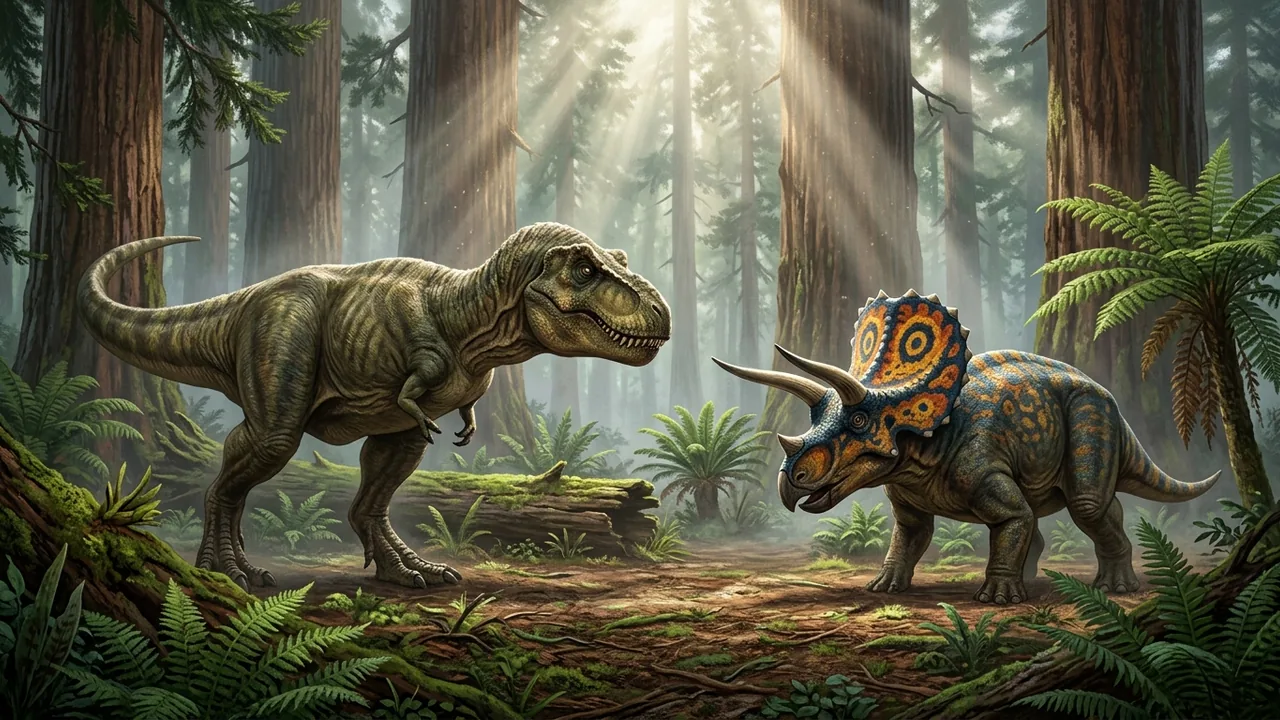
Meet the Legend: Ultimate Rivals
Few matchups in Earth's history spark more wonder than Tyrannosaurus rex facing Triceratops horridus! Even better, paleontologists know these two Late Cretaceous titans truly shared the exact same western river valleys sixty-eight to sixty-six million years ago. Whenever their trails crossed in misty clearings, nature's greatest survival test began.
Tyrannosaurus rex stretched roughly forty feet from snout to tail tip and weighed up to eight tons on two muscular hind legs. Across the ferns stood thirty-foot, nine-ton Triceratops, whose Greek name means three-horned face. Both giants outweighed modern African elephants!
Every bone on both dinosaurs reflects a specialized shaped by millions of years of living side by side. While T. rex evolved as an apex with bone-crushing jaws, Triceratops answered with three long horns and a solid neck shield, keeping their ancient ecosystem in balance.
Lost World Habitat: Ancient Floodplains
During the Late Cretaceous Period, lush coastal floodplains stretched across Montana, Wyoming, and the Dakotas beside a warm inland sea. Towering dawn redwoods, cycads, tree ferns, and early flowering magnolias thrived in mild, frost-free air. Softshell turtles, crocodiles, and small feathered dinosaurs shared every muddy river bend.
Across North America, different rock layers capture chapters of prehistoric habitats. Right in Virginia's Culpeper Basin, older Mesozoic sandstone quarries preserve real fossilized footprints where three-toed meat-eaters stalked across mudflats beside plant-eating neighbors! Those Virginia tracks show -and-herbivore food chains thrived from coast to coast.
Out west sixty-six million years ago, winding Hell Creek rivers carved shady redwood groves right beside sunny fern clearings. That patchwork landscape mattered every day: dense forest edges offered shadowy cover for a stalking predator, while wide meadows gave watchful Triceratops room to stand guard.
What's on the Prehistoric Menu?
In the Hell Creek food chain, warm sunlight powered thickets of palms, cycads, and ferns, which fed heavy plant eaters like Triceratops. Using a narrow parrot-like beak and tall stacks of shearing cheek teeth, Triceratops sliced tough woody stems that taller duck-billed dinosaurs passed right by. Eating close to the ground kept its belly full year-round.
At the top of the food web stood Tyrannosaurus rex, a powerful adapted to hunt multi-ton neighbors. Feeding an eight-ton body required huge meals, yet chasing alert adults across slippery mudflats wasted precious energy and risked dangerous falls.
Instead, T. rex used oversized smell centers inside its skull and wide, cushioned footpads to creep quietly downwind. Slipping silently between giant redwood trunks, the hunter waited for an unguarded feeding moment to launch a sudden forest before its neighbor looked up!
Superpowers, Senses & Anatomy
To challenge an armored neighbor, T. rex relied on pinpoint senses and jaw strength. Its broad back skull angled both eyes forward, giving it sharp vision better than a modern hawk's! That 3D depth perception helped T. rex judge exact distances past swinging horn tips, while scaly lips protected sixty thick, serrated teeth.
Triceratops countered with remarkable defensive anatomy built for tough encounters. In life, its bony horn cores wore tough outer sheaths of —the same sturdy protein in your fingernails and eagle talons—making its twin brow horns even longer and sharper!
Behind those three horns rose a solid bony frill without any weak openings where teeth could poke through. Anchored on a smooth, ball-shaped neck joint like a trailer hitch, Triceratops could whip its armored head sideways or upward in a split second!
Flight vs. Fight Arena!
When danger approaches, wild animals survive through either speedy Flight or sturdy Fight adaptations. Weighing up to nine tons on four stocky legs, Triceratops belonged firmly on Team Fight! Turning tail to run away would only expose its unarmored hindquarters to a fast-striding hunter.
Who won when these two legends met? Paleontologists call it a balanced 50/50 matchup shaped by awareness and terrain! If T. rex launched an unseen from misty redwoods and clamped onto Triceratops's flank before it pivoted, the held the winning edge.
However, if Triceratops smelled or heard T. rex approaching across an open fern glade, the defender braced wide front legs and spun smoothly on its round neck joint. Facing three -tipped horns and a solid bone shield head-on forced many wise hunters to back away safely!
Fossil Detective Secrets
Scientists never have to guess about this rivalry because stone fossils preserve eyewitness proof! Across Montana and the Dakotas, paleontologists have excavated Triceratops neck frills and brow horns scarred with deep, oval punctures matching the exact spacing of Tyrannosaurus rex teeth.
When museum researchers inspected those bite grooves under powerful microscopes, they discovered smooth ridges of healed bone tissue growing right around the marks! Because living bone takes months to repair itself, those fossils prove real Triceratops fought off T. rex and lived on for years afterward.
One famous Montana Triceratops even lost a horn tip in a clash and grew a smooth, rounded cap of healthy bone! Alongside other skeletons showing unhealed feeding marks, these fossil detective clues confirm an unforgettable Late Cretaceous rivalry where brave defense matched king-sized jaws.