Meet the Legend: Heavyweight Neighbors
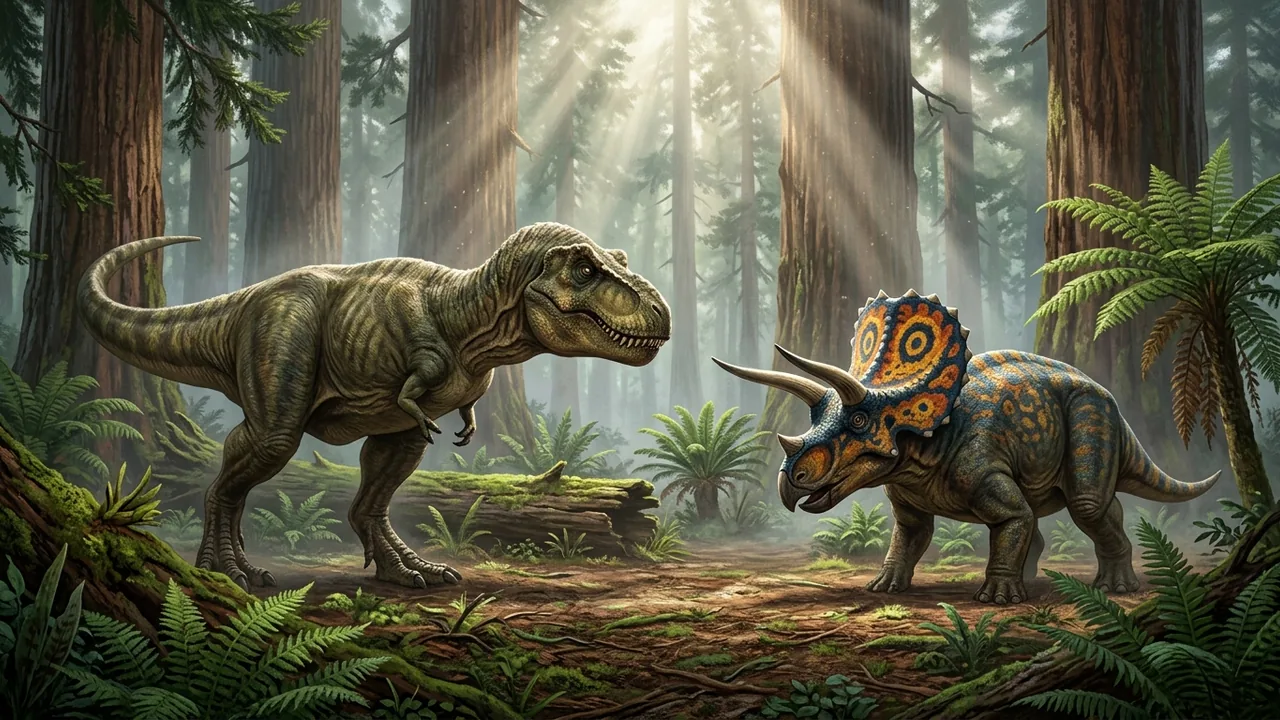
Picture a forty-foot Tyrannosaurus rex stretching as long as a yellow school bus! Standing across a sunlit clearing is Triceratops, a thirty-foot plant eater built like a sturdy dump truck on four thick legs. Both heavyweights tipped the scales around eight or nine tons!
Tyrannosaurus rex means tyrant lizard king, while Triceratops means three-horned face. Unlike make-believe dinosaur contests that mix creatures from totally different ages, these two titans were real neighbors sixty-six million years ago. Whenever hungry jaws met three gleaming horns, the ultimate Late Cretaceous showdown began!
Lost World Habitat: Floodplain Forests
Sixty-eight to sixty-six million years ago, Montana and the Dakotas looked nothing like dry prairies today. Warm, misty rivers curved lazily through towering dawn redwoods, fan-leaved ginkgoes, spiky cycads, and broad green fern meadows where winter snow never fell.
Armored softshell turtles paddled beside crocodiles while small feathered dinosaurs darted up mossy tree trunks. Wide muddy clearings sat right beside shadowy forest borders. Those tangled woods gave big hunters shady cover to hide, while open fern meadows gave Triceratops clear sightlines to spot danger early!
What's on the Prehistoric Menu?
Triceratops spent every morning clipping tough palm fronds, ferns, and woody shrubs close to the ground. A narrow, hook-shaped beak on the tip of its snipped stems cleanly before rows of stacked cheek teeth sliced each mouthful into pieces.
Tyrannosaurus rex needed hundreds of pounds of meat each week to fuel its giant frame. Using huge scent bulbs inside its skull, T. rex tracked smells on the breeze for miles! Rather than running a long race, it crept softly along forest edges hoping to launch a surprise .
Superpowers, Senses & Anatomy
Each rival packed incredible natural tools! Tyrannosaurus rex carried about sixty thick, banana-shaped teeth tucked neatly behind scaly lips. Instead of cutting thin slices like steak knives, those rounded teeth hammered downward with enough power to crack solid dinosaur bone.
Triceratops answered with a solid bony wider than a kitchen table and three forward-pointing horns. Hidden right behind that skull sat a round ball-and-socket neck joint shaped like a smooth trailer hitch. That clever joint let Triceratops its heavy head rapidly to block attacks from any angle!
Flight vs. Fight Arena!
Carried on four heavy, pillar-like legs, Triceratops could never outrun every predator like an ostrich. Instead, this horned fortress stood proudly on Team Fight! Inside shadowy woods, T. rex held the upper hand if its cushioned feet crept close enough for a sudden side .
Out in a bright fern clearing, the advantage shifted fast! Triceratops planted its wide front elbows, spun quickly to toward the hunter, and aimed two yard-long brow horns straight at hip height. Scientists rate an open face-off an exciting fifty-fifty tie!
Fossil Detective Secrets
How can scientists be certain these two titans truly battled in real life? Fossil bones preserve amazing detective clues! Paleontologists digging in Montana uncovered Triceratops brow horns and wide shields marked with deep grooves that match T. rex tooth spacing.
Even more exciting, microscope checks reveal those deep grooves had over with smooth new bone! Because bone only repairs itself while an animal is alive, those scars prove Triceratops was no easy meal. Brave defenders blocked T. rex jaws, stood tall, and marched away!