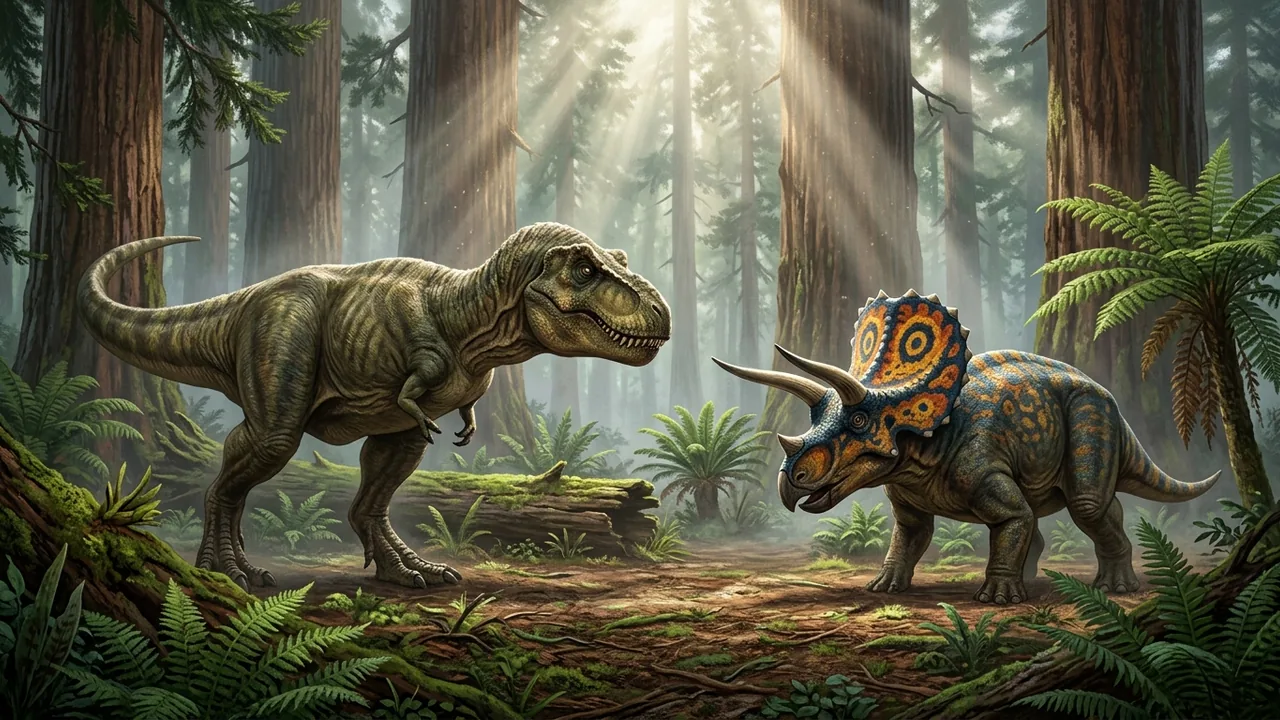
Meet the Legend: Physics of Two Titans
Imagine two Late Cretaceous heavyweights built like opposing physics experiments! Tyrannosaurus rex stretched forty feet long, stood twelve feet tall at the hips, and balanced up to eight tons on two muscular hind legs. Facing it across the fern plain stood Triceratops horridus, a compact thirty-foot quadruped weighing up to nine tons whose giant horned skull measured nearly a third of its entire body length.
Modern paleontologists use —applying engineering levers, force equations, and digital CT scans to fossil skeletons—to test how real prehistoric neighbors matched up without movie guesswork. Because both species shared western North America for nearly two million years, every bone in their bodies faced genuine evolutionary testing.
While T. rex concentrated overwhelming crushing force into a five-foot reinforced skull counterbalanced by a stiff horizontal tail, Triceratops distributed massive weight low to the ground behind a seven-foot solid neck shield.
Even their stances contrasted sharply: agile bipedal leverage met four-wheel-drive stability! By studying muscle attachment scars on fossilized hips and jaws, researchers calculate exact stride speeds, turning circles, and impact forces. Neither giant relied on luck; every joint operated as precision natural machinery.
Lost World Habitat: Hell Creek Trophic Web
Between sixty-eight and sixty-six million years ago, broad coastal floodplains sloped eastward from the rising Rocky Mountains toward the warm Western Interior Seaway. Humid subtropical breezes nourished lush forests of dawn redwoods, fan-leaved ginkgoes, cycads, palms, horsetails, and early flowering hardwoods across Montana, Wyoming, and the Dakotas. Seasonal summer rains flooded winding river channels and created sunny fern clearings right beside shadowy forest borders.
Within this vibrant web, green plants captured abundant solar energy to support staggering numbers of giant herbivores. Duck-billed Edmontosaurus stripped mid-level branches, club-tailed Ankylosaurus cropped low herbs, and sturdy Triceratops sheared dense woody thickets along swamp edges.
In every ecosystem, only about ten percent of food energy transfers from plant eaters up to top carnivores, while ninety percent fuels daily movement, body warmth, and growth.
Consequently, Hell Creek valleys supported dozens of browsing Triceratops for every single adult Tyrannosaurus rex patrolling the river bends! Fallen redwood logs, muddy oxbow ponds, and abrupt woodland margins formed natural arenas where stealthy hunters and alert horned defenders crossed paths every day, testing whether shady timber or firm sunlit ground decided survival.
What's on the Prehistoric Menu?
Fueling nine tons of horned herbivore required nonstop mechanical plant processing. Triceratops snapped fibrous palm fronds and woody stems with a narrow keratin beak, then sliced them cleanly between dental batteries holding up to eight hundred stacked teeth! Unlike modern cattle that grind grass side to side, Triceratops jaw joints sheared straight up and down like heavy industrial pruning shears, opening up tough food sources other herbivores ignored.
Meanwhile, Tyrannosaurus rex occupied the highest level, yet its menu shifted dramatically as it grew from a slender youngster into a bulky giant. Long-legged teenage tyrannosaurs sprinted after swift, smaller prey, leaving heavily defended multi-ton herbivores to full-grown adults.
To patrol sprawling river territories without burning excess calories, T. rex relied on a specialized foot structure: its middle foot bone pinched tightly like a wedge between the outer foot bones, absorbing heavy impact shock and returning spring-like energy with every stride.
Once an adult tyrannosaur secured a meal, nothing went to waste. Powerful stomach acids dissolved swallowed bone chunks so T. rex extracted rich calcium minerals and fatty bone marrow alongside muscle tissue!
Superpowers, Senses & Anatomy
Engineering scans reveal why both rivals commanded enormous respect across Hell Creek. Tyrannosaurus rex fused its nasal bridge bones into a vaulted arch so its snout wouldn't twist when massive jaw muscles clamped shut. Computer models calculate that its thick, D-shaped rear teeth delivered roughly 8,000 pounds per square inch—between 35,000 and 57,000 Newtons of force—concentrated onto rounded tooth tips that split solid bone like wedges!
Sensory upgrades matched that raw bite power: fifty-five degrees of forward eye overlap gave T. rex keen 3D depth perception, gigantic olfactory bulbs tracked faint scents, and tiny nerve pits along its lipped jaws felt subtle contact instantly.
Triceratops answered with equally brilliant defensive engineering. A nearly spherical ball-and-socket joint right behind the braincase acted like a greased swivel mount, letting thick neck muscles whip twin three-foot keratin-sheathed brow horns sideways or upward.
Behind those gleaming horns stood a solid two-inch-thick bony frill backed by fused front neck vertebrae that absorbed heavy collision shock! Even when huge predator teeth struck that wide bony shield, curved bone geometry deflected much of the downward force.
Flight vs. Fight Arena!
Locomotion physics explains every tactical move when these two titans met. Heavy adults of both species likely topped out between twelve and twenty miles per hour, because sprinting faster placed dangerous bending forces on thick leg bones. Unable to outrun a long-striding biped across floodplains, Triceratops built its entire survival strategy squarely around Team Fight!
In physics, equals mass multiplied by velocity. If T. rex crept upwind through shadowy dawn redwoods and launched a close-range ambush behind the neck shield before its rival pivoted, one bone-splintering bite to the spine could decide the contest immediately.
Out in an open sunlit fern clearing, however, geometry shifted dramatically toward the defender! Wide-set front elbows let Triceratops spin rapidly in place like a bulldozer, keeping its solid bony frill locked between T. rex's jaws and its own neck.
Driving nine tons of forward momentum behind twin yard-long brow horns threatened T. rex's unarmored chest and hips! Because one deep puncture could permanently cripple a two-legged hunter, open clearings produced a balanced 50/50 stalemate where cautious tyrannosaurs often backed down rather than gamble their hunting careers.
Fossil Detective Secrets
Paleontologists verify computer simulations using fossil —ancient injuries and healing scars preserved directly inside petrified bone! Several Triceratops skulls excavated in Montana display deep oval punctures and drag furrows across their squamosal frill shields and brow horns whose exact spacing and serration tracks match adult Tyrannosaurus rex teeth.
Had T. rex merely scavenged an already dead Triceratops carcass, those tooth gouges would preserve sharp, unhealed fracture edges. Instead, microscopic cross-sections reveal smooth, raised collars of remodeled repair bone and fresh blood-vessel channels ringing the bite wounds!
In one famous specimen studied at the Museum of the Rockies, a T. rex clamped clean onto a Triceratops brow horn and raked its frill—yet smooth healed bone proves the horned defender wrenched free and lived for years afterward!
Because growing dense repair bone requires months of active circulation, these scars prove Triceratops repelled real attacks! Every preserved tooth furrow records exact bite angles, jaw spacing, and healing timelines. Meanwhile, unhealed T. rex bite marks on other Triceratops hip bones confirm successful hunts and scavenging meals, capturing both sides of nature's ultimate rivalry in unmistakable stone detail that museum visitors can still touch and study today.