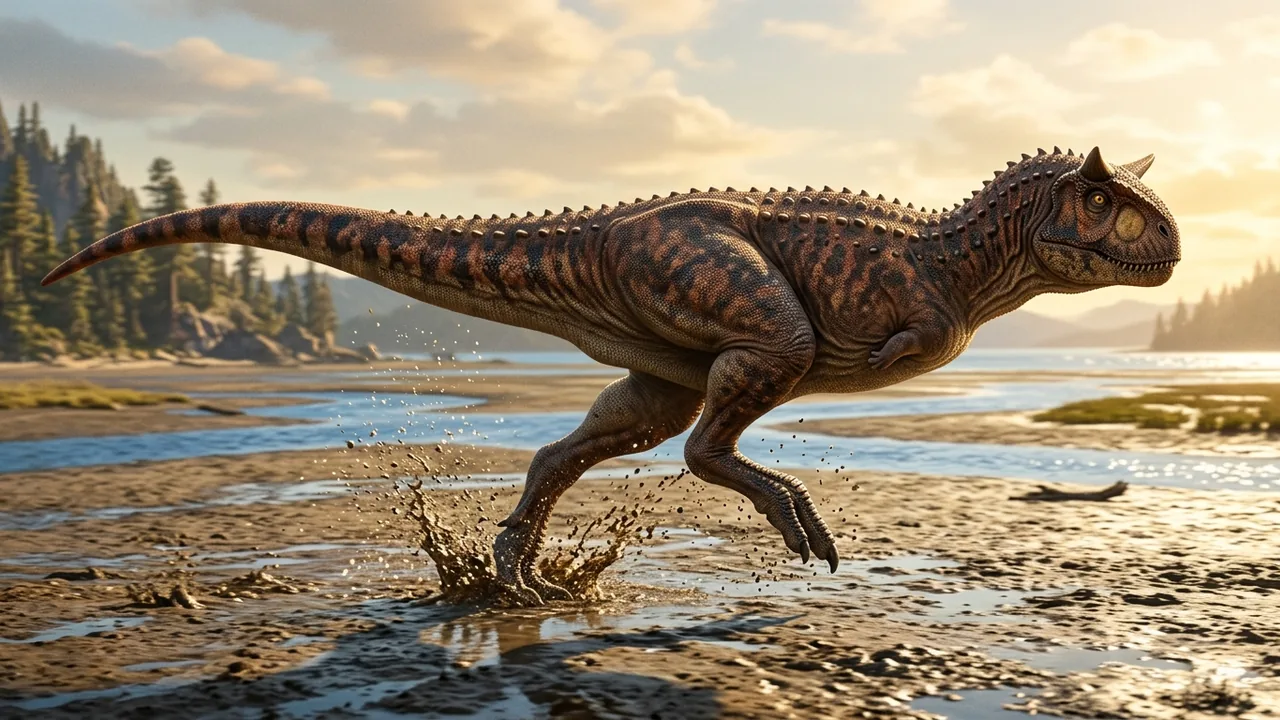
Meet the Legend: Gondwana's Horned Sprinter
When the southern supercontinent Gondwana fragmented during the Cretaceous Period, isolated landmasses became natural evolutionary laboratories. While coelurosaurian tyrannosaurids ascended to apex predator status across North America and Asia, ceratosaurian abelisaurids radiated across South America, Africa, Madagascar, and India. places Carnotaurus sastrei deep within Brachyrostra—a short-snouted South American clade that pushed cranial deepening and forelimb reduction to astonishing extremes.
Measuring roughly 7.8 meters (25.6 feet) in length and weighing between 1.5 and 2 metric tons, Carnotaurus paired thick dorsolateral frontal horns with an unusually tall, narrow skull. In stark contrast to its powerful neck and long, gracile hind limbs, its forelimbs underwent profound evolutionary vestigiality.
Each radius and ulna measured scarcely one-quarter the length of the humerus, forming immobile elbow joints with four short digits angled outward from ball-and-socket shoulders. Although no juvenile Carnotaurus skeletons have yet been found to trace full from hatchling to adult, comparisons with related abelisaurids indicate its brow horns thickened steadily as individuals matured into cursorial coastal hunters.
Even compared alongside Malagasy Majungasaurus and Indian Rajasaurus—close Gondwanan cousins bearing low nasal domes rather than paired orbital horns—Carnotaurus achieved far longer tibial-to-femoral limb ratios, marking a decisive evolutionary shift from ambush grappling toward high-velocity pursuit across open coastal plains.
Its deep, vaulted cranium also featured roughened dermal bone textures indicating a tough keratinous facial covering in life, giving Patagonia's premier predator an unmistakable horned silhouette unlike any northern Laurasian carnivore that ever walked the Mesozoic world.
Lost World Habitat: La Colonia Stratigraphy
Geologists reconstruct the vanished ecosystem of Carnotaurus through the of Argentina's La Colonia Formation in central Chubut Province. Paleomagnetic reversals and microfossil assemblages constrain its middle mudstone facies to the Maastrichtian stage of the Late Cretaceous, approximately 71 to 69 million years ago—just a few million years before the end-Cretaceous asteroid impact.
Alternating beds of fine-grained claystone, laminated siltstone, and cross-bedded sandstone document a warm coastal plain indented by tidal estuaries, barrier spits, and brackish lagoons along the western edge of the shallow Kawas Sea. Fossil pollen and plant cuticles reveal lush gallery thickets of tree ferns, cycads, podocarp conifers, floating Azolla water ferns, and diverse early flowering plants.
This mosaic of firm mudflats and scrub corridors supported extraordinary biodiversity. Sharing the landscape with Carnotaurus were swift elasmarian ornithopods, dwarf saltasaurine titanosaurs such as Titanomachya, side-necked Chelidae turtles, lungfish, burrowing madtsoiid snakes, and long-necked elasmosaurid plesiosaurs that ventured into deep estuarine channels. Rapid burial in calm lagoon mud preserved even delicate dinosaur alongside articulated bone.
Unlike arid inland dune fields elsewhere in Late Cretaceous South America, the coastal La Colonia lowlands experienced humid seasonal rainfall interrupted by marine storm surges. Those shifting brackish waters continually deposited mineral-rich silts across drowned river mouths, creating one of southern Gondwana's richest paleontological windows.
Because volcanic ash horizons in neighboring Patagonian basins provide radiometric calibration points alongside marine dinoflagellate cysts, stratigraphers can correlate these coastal mudflats directly with latest Cretaceous ecosystems worldwide.
What's on the Prehistoric Menu?
Finite-element stress modeling of the Carnotaurus cranium illustrates how skull architecture dictates predatory behavior. Unlike Laurasian Tyrannosaurus rex, whose broad rostrum, fused nasal bridge, and D-shaped teeth withstood torsional bone-crushing forces surpassing 35,000 newtons, Carnotaurus possessed a laterally compressed snout housing slender, blade-like maxillary teeth and a posterior bite force estimated near 3,341 newtons.
What its jaws lacked in crushing pressure, however, they compensated for through rapid mechanical closure and shock resistance. Short mandibular lever arms allowed lightning-fast snaps, while heavily rugose nasal and frontal bones absorbed vertical bending stresses like the reinforced spine of a cleaver.
Furthermore, a kinetic intramandibular joint midway along each lower jaw flexed outward to widen its gape around struggling prey while strong neck ventroflexors drove the upper dentition downward. and tooth-wear comparisons confirm that brachyrostran abelisaurids specialized in dispatching nimble small-to-medium vertebrates—coastal ornithopods, turtles, snakes, and juvenile titanosaurs whose had not yet granted multi-ton bulk—rather than engaging massive adult sauropods head-on.
Subtle extra-oral gingival tissue and lip scales likely sheathed its serrated maxillary crowns when the jaws rested closed, preventing enamel desiccation in salty coastal winds. By pairing rapid, repeatable slashing bites with sustained pursuit stamina, Carnotaurus thrived in an ecological guild completely distinct from northern megatheropods.
This trophic specialization prevented wasteful energy expenditure: instead of risking jaw fractures on heavily ossified adult sauropod limbs, Carnotaurus harvested abundant mid-sized coastal prey across wide estuarine territories throughout seasonal wet and dry climatic cycles along the ancient Patagonian seaway.
Superpowers, Senses & Anatomy
In 2011, paleontologists W. Scott Persons and Philip Currie resolved a long-standing mystery surrounding the unusual anterior vertebrae of Carnotaurus. Instead of projecting horizontally like those of most theropods, its transverse processes—specialized caudal ribs—angled steeply upward with crescent-shaped tips that overlapped neighboring segments.
Three-dimensional muscular reconstructions demonstrated that tilting those ribs dorsally expanded the cross-sectional volume of the M. caudofemoralis longus, the primary femoral retractor muscle anchored to the fourth trochanter of the thigh bone. Accounting for roughly fifteen percent of total body mass, these immense tail muscles generated extraordinary hind-limb thrust, propelling Carnotaurus to estimated top speeds of 48 to 56 kilometers per hour (30 to 35 mph).
Equally revealing was a 2021 re-analysis of its fossilized by Christophe Hendrickx and Phil Bell. Across the neck, thoracic flank, and tail base, fine non-overlapping polygonal basement scales surrounded irregular rows of four-to-five-centimeter unossified conical feature scales. Free of heavy dermal bone or insulating plumage, this textured scaly skin promoted convective cooling during high-output sprints across sunlit Patagonian flats.
Complementing its locomotor powerhouse, endocranial CT reconstructions show enlarged olfactory bulbs for long-range scent tracking alongside forward-cantilevered orbits that granted modest stereoscopic overlap. Air-filled pneumatic sinuses lightened the tall facial bones without sacrificing structural rigidity, keeping the head poised effortlessly above muscular cervical vertebrae.
Meanwhile, semicircular canal geometry within its inner ear indicates rapid gaze-stabilization reflexes, allowing the predator to hold visual focus on darting quarry while sprinting at full stride.
Flight vs. Fight Arena!
Evolutionary trade-offs govern every encounter when cursorial Carnotaurus confronts a herd of armored saltasaurid titanosaurs such as Saltasaurus loricatus. Bursting out of coastal scrub onto firm tidal flats, Carnotaurus exploits maximal stride frequency and caudofemoral leverage, scanning for isolated juveniles before they can retreat behind adult defenders.
Against mature sauropods, however, those interlocking crescentic ribs exact a steep biomechanical price. Rigidly braced vertebrae prevented the tail from whipping laterally as a dynamic counterbalance, widening the predator's turning radius and limiting agile cornering.
Simultaneously, Saltasaurus embodies Team Fight through both and fortified . Full-grown individuals carried ten-centimeter oval bony osteoderm scutes embedded within a tight dermal pavement of millimeter-sized ossicles across their backs and flanks, reinforced by coordinated herd walls and muscular tail sweeps. Even the stout frontal horns of Carnotaurus—internally bolstered by dense trabecular bone for head-and-flank shoving bouts against rival conspecifics—offered zero advantage against multi-ton dermal armor, prompting the sprinter to redirect its hunt toward swift, unarmored quarry.
Conversely, smaller ornithopods sharing the Patagonian plains countered Carnotaurus through pure Team Flight evasion. By exploiting superior lateral agility—darting across uneven creek gullies and executing abrupt directional cuts that the stiff-tailed abelisaurid could not mirror—lightweight herbivores turned biomechanical physics into an invisible shield.
Thus the Late Cretaceous coastal arena balanced straight-line predatory acceleration against dermal armor in large herbivores and hairpin maneuverability in smaller runners, sustaining diverse coexisting lineages across millions of years of dynamic Patagonian prehistory and shifting shoreline habitats.
Fossil Detective Secrets
Remarkably, virtually every anatomical insight into Carnotaurus derives from a single holotype specimen—cataloged as MACN-CH 894 in Buenos Aires—excavated in 1984 by José Bonaparte's Eighth Paleontological Expedition to Patagonia on Estancia Pocho Sastre. Sealed inside dense hematitic concretions within the lower La Colonia Formation, the skeleton lay articulated in classic opisthotonic posture with its neck arched backward, missing only its distal tibiae, feet, and tail tip to surface weathering.
Careful and taphonomic analysis explained its extraordinary preservation: rapid burial in low-oxygen estuarine mud halted scavenging long enough for mineral-rich groundwater to cement molds of delicate right-flank directly beside the bones, alongside fragile throat hyoids.
Decades later, non-destructive paleobiology continues to unlock discoveries from Bonaparte's specimen. Laser surface scanning, photogrammetry, matrices, and high-resolution X-ray CT scans of its pneumatic braincase and inner-ear balance canals have revealed how Carnotaurus stabilized its downward-tilted gaze mid-stride—demonstrating how one meticulously prepared Patagonian fossil can illuminate Late Cretaceous evolution across the entire southern hemisphere.
Ongoing excavations across Chubut Province still search for a second specimen preserving intact metatarsals and juvenile growth stages. Until another skeleton emerges from Patagonian stone, MACN-CH 894 stands as paleontology's premier proof that southern Gondwanan predators evolved sprint adaptations rivaling any hunter in Earth's history.
From ironstone field blocks chipped open with hand chisels to three-dimensional finite-element computer meshes, the detective work behind Carnotaurus bridges classic expedition grit and twenty-first-century computational science in leading research museums around the globe.