Meet the Legend: Crown Prince of Abelisaurids
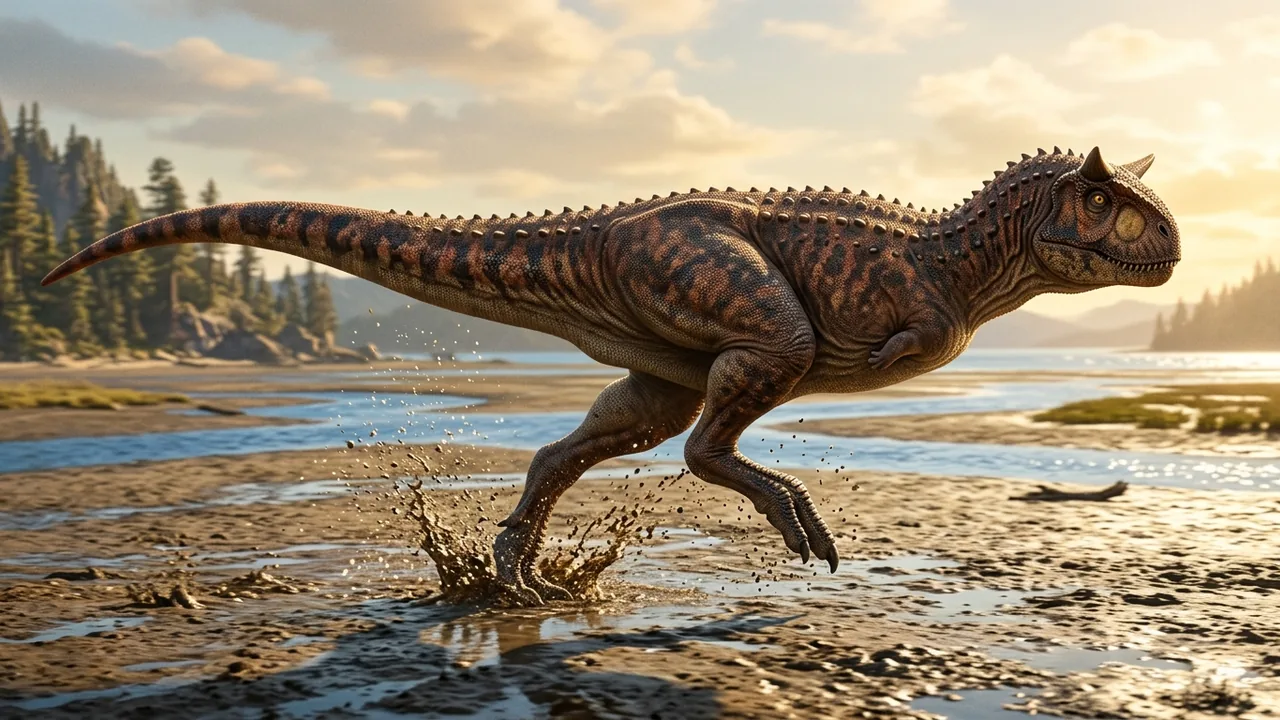
While giant tyrannosaurs ruled northern continents during the Late Cretaceous, a startlingly different dynasty of predators dominated South America, Africa, Madagascar, and India: the abelisaurids. Stretching twenty-six feet from snout to tail and weighing roughly 3,800 pounds, Carnotaurus sastrei emerged as the fastest, most specialized hunter in that southern family.
Everything about its silhouette defied expectations set by northern theropods. Above a deep, boxy snout rose two thick, outward-curving frontal horns like those of a bull, earning it the name meat-eating bull. Even stranger were its forelimbs, which shrank into vestigial stubs with fused, motionless elbows and four tiny fingers facing outward.
Researchers studying dinosaur discovered that shrinking its arms was no evolutionary mistake. Stripping upper-body weight over the front of its hips while lengthening its shins and foot bones transformed Carnotaurus into an aerodynamic sprint specialist built for open Patagonian plains.
Balanced horizontally over pillar-strong ankles and cushioned three-toed feet, its entire skeleton funneled muscular power into forward velocity rather than grappling strength, making it one of the sleekest multi-ton athletes of the Mesozoic Era. Even its neck vertebrae locked smoothly into curved ball-and-socket joints so its head stayed rock-steady at full gallop.
Lost World Habitat: Estuaries & Trophic Webs
Around 70 million years ago, rising Atlantic waters flooded lowlands across northern Patagonia, carving estuaries, tidal mudflats, brackish lagoons, and sunlit scrub plains. Lush groves of cycads, podocarp conifers, aquatic ferns, and early flowering trees captured solar energy at the base of a productive coastal food web.
Across middle tiers, freshwater lungfish, side-necked river turtles, giant madtsoiid constrictor snakes, and fleet-footed elasmarian ornithopods converted plant and insect energy into living biomass. Deeper lagoon channels even hosted long-necked plesiosaurs that swam inland with high ocean tides.
Patrolling the firm boundary where dry scrublands met open tidal mudflats, Carnotaurus occupied the ecosystem's top terrestrial trophic level. As an ambush sprinter, it regulated herbivore grazing patterns across miles of shoreline, preventing fast plant-eaters from stripping riverside vegetation bare.
Because only about ten percent of available energy transfers upward from one trophic rung to the next, a single two-ton hunter required vast coastal territories teeming with smaller herbivores and aquatic reptiles to sustain its active metabolism year-round. Seasonal rainstorms regularly refreshed these estuarine nurseries with nutrients washed down from inland volcanic hills.
What's on the Prehistoric Menu?
How did a two-ton predator with virtually useless arms capture fast-moving meals? Scientists applying engineering scanned the skull of Carnotaurus to measure jaw leverage and bone stress. At its rear teeth, Carnotaurus generated roughly 3,340 newtons—about 750 pounds—of bite force, less than one-tenth the crushing grip of Tyrannosaurus rex.
What Carnotaurus sacrificed in raw crushing force, however, it gained in speed. Short jaw levers allowed its mouth to snap shut twice as fast as longer-snouted predators, ideal for snatching agile ornithopods, shoreline turtles, and snakes.
Simultaneously, thickened nasal and frontal bones braced the skull roof against downward shock like a steel hatchet head, while flexible joints inside the lower jaw widened to hold struggling prey. By targeting smaller and juvenile animals across lower levels, Carnotaurus avoided risky wrestling matches with adult giants.
Curved, serrated upper teeth worked together with muscular neck flexors that pulled backward and downward smoothly, slicing meat cleanly without ever needing forelimbs to pin quarry to the ground. Replacement teeth grew continuously inside deep jaw sockets so chipped crowns never slowed its daily shoreline hunting success.
Superpowers, Senses & Anatomy
The true locomotive engine of Carnotaurus sat hidden inside the front half of its tail. In two-legged dinosaurs, forward propulsion relies on the —a powerful muscle anchored along the tail vertebrae that pulls the thigh bone backward with every stride. In Carnotaurus, each tail vertebra grew crescent-shaped side ribs angled steeply skyward.
Three-dimensional models show those upward ribs created massive attachment space for caudofemoralis bundles weighing up to 250 pounds on each side! Firing like twin pistons, they accelerated Carnotaurus to straight-line speeds between 30 and 35 miles per hour—faster than almost any other multi-ton theropod.
To guide high-speed pursuits, its eye sockets tilted slightly forward, providing partial overlap for judging exact distance to fleeing prey. Enlarged olfactory bulbs sharpened its sense of smell, while mosaic scales with raised conical bumps shed body heat efficiently.
Thickened bone cores inside its twin bull horns also absorbed heavy compression forces, allowing rival adults to lock brows or shove flanks safely during territorial contests without fracturing their short, vaulted braincases. Hollow air pockets inside its neck and back vertebrae trimmed extra skeletal weight so every ounce of muscle thrust translated into speed.
Flight vs. Fight Arena!
Laws of physics shape every move when Carnotaurus challenges a herd of armored Saltasaurus across a coastal flat. Driven by powerful contractions and guided by depth perception, the bull-horned hunter explodes from scrub cover at thirty-five miles per hour, testing whether a young titanosaur trails behind.
Yet also hands Saltasaurus a decisive counter-advantage. Because the upward tail ribs of Carnotaurus hooked tightly together to brace its giant leg muscles, its tail became a stiff beam unable to swing sideways like a rudder during sharp turns.
When agile prey zigzags suddenly—or when adult Saltasaurus pivot into a defensive ring studded with bony osteoderm plates and sweeping tails—the straight-line sprinter loses momentum. Rather than risking a crippling collision against heavy dermal armor, Carnotaurus breaks off its charge to seek unarmored quarry.
Smaller two-legged ornithopods exploit that exact turning limit on Team Flight: by sprinting toward winding creek banks and cutting sharp ninety-degree corners, nimble runners force the rigid-tailed predator to overshoot and regroup. Every chase across the mudflats becomes a lively test comparing acceleration against turning agility and armor.
Fossil Detective Secrets
Remarkably, everything scientists know about Carnotaurus comes from a single fossil skeleton excavated in 1984 on Ángel Sastre's ranch in Chubut Province, Argentina. Encased inside dense iron-rich stone, the specimen lay articulated on its right side, preserving delicate throat bones, upward-angled tail ribs, and wide sheets of fossilized skin impressions.
Laser scans of those skin casts revealed tiny five-sided scales surrounding neat rows of two-inch conical bumps, proving this large wore zero feathers. Medical CT scans of its braincase also mapped semicircular inner-ear canals tuned for steady, nose-down head posture while running.
By uniting field geology with digital —reconstructing muscle volume from bone scars and testing horn strength under simulated shoving loads—paleontologists turned one extraordinary Patagonian boulder into the sharpest portrait yet of a southern hemisphere speedster.
Because erosion had worn away only its lower shins and feet before discovery, museum preparators compared close cousins from Patagonia and Madagascar to restore its long, roadrunner-like ankles with scientific precision. Today life-sized casts of that skeleton stand in natural history halls worldwide, inspiring brand-new fossil expeditions across southern Argentina's rugged badlands every summer.