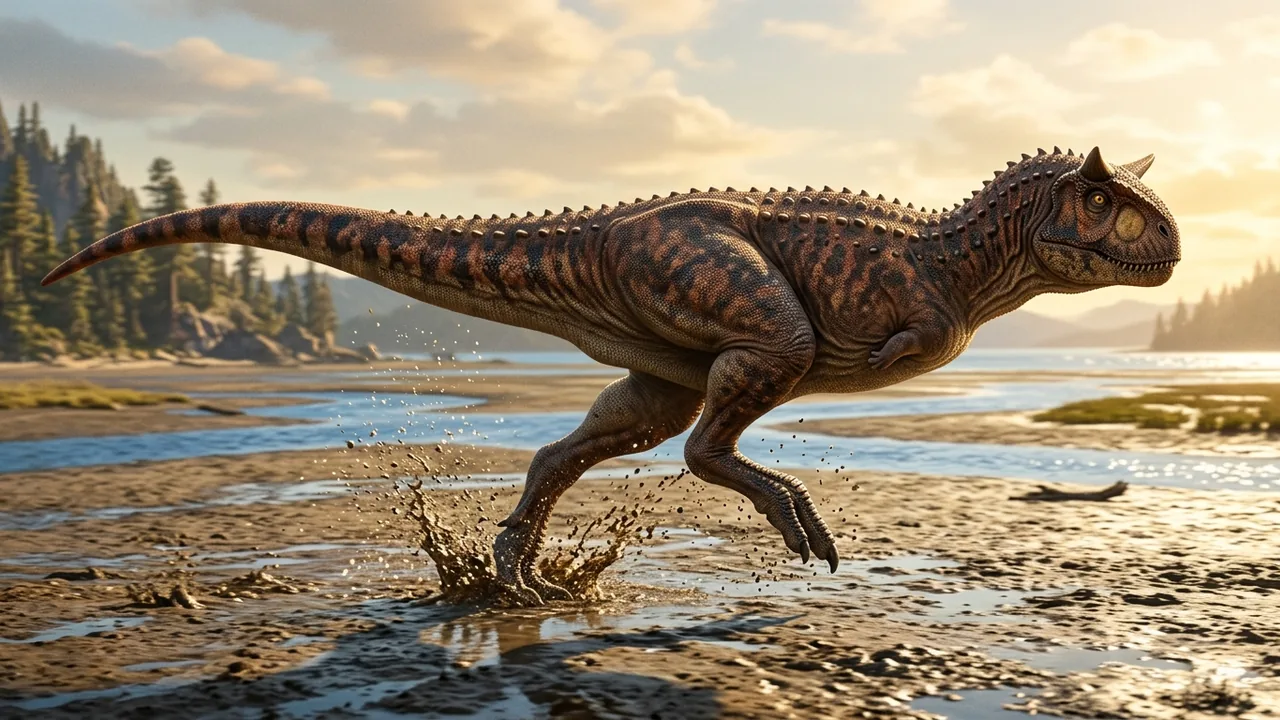
Meet the Legend: Patagonia's Bull Runner
Imagine standing beside a sleek, two-legged stretching twenty-six feet from snout to tail tip, crowned with two thick horns like a charging bull! Carnotaurus sastrei—meaning meat-eating bull—roamed South America near the end of the Age of Dinosaurs, between 71 and 69 million years ago.
Every inch of its body showcased remarkable evolutionary design. While northern cousins like Tyrannosaurus rex built wide, bone-crushing skulls, Carnotaurus evolved a tall, narrow skull, long sprinter legs, and tiny four-fingered arms pressed flat against its chest.
Weighing nearly two tons, this agile hunter used every specialized to outrun neighbors across open Patagonian plains. Even its blunt brow horns gave it an unmistakable profile among prehistoric predators.
When museum visitors stand under its mounted skeleton today, they immediately notice how high its hips towered above the ground, poised like a coiled track runner waiting for the starting whistle.
Lost World Habitat: Estuaries and Mudstones
During the Late Cretaceous, southern Argentina looked very different from Patagonia's cool, windy steppes today. Warm Atlantic waters flooded low valleys, creating sunny barrier islands, tidal channels, and muddy river plains fringed with tree ferns, palms, cycads, and flowering shrubs.
Fine mud and sand washed across these coastal flats whenever seasonal storms rolled ashore. Geologists study similar ancient mudstone processes right in Virginia's Culpeper Basin, where older Mesozoic lake-shore mud hardened into stone and locked in hundreds of three-toed tracks!
In Argentina, calm lagoon sediment buried life along waterholes rapidly. Frogs, lungfish, side-necked turtles, and fleet-footed plant-eating dinosaurs shared every winding creek with watchful Carnotaurus.
Warm wet seasons brought fresh green shoots to the floodplains, while drier months shrank streams into busy watering holes where predators and plant-eaters crossed paths every single morning.
What's on the Prehistoric Menu?
In Patagonia's coastal , bright sunlight fueled lush ferns, conifers, and floating water plants. Agile two-legged plant-eating dinosaurs, freshwater turtles, and young long-necked titanosaurs fed on that greenery, passing stored energy upward to top predators.
Rather than clamping onto giant prey for long wrestling matches, Carnotaurus used a behavioral and physical built for speed: rapid, hatchet-like jaw strikes. Its slender lower jaw featured a flexible middle joint that widened slightly to grip squirming reptiles and swift ornithopods cleanly.
Once Carnotaurus sprinted close along firm shoreline sand, strong neck muscles drove its upper teeth downward quickly, keeping energy flowing through the ancient coastal ecosystem.
Because dozens of serrated, curved teeth lined both jaws and grew back whenever one chipped, this southern hunter always kept a fresh set of slicing blades ready for dinner.
Superpowers, Senses & Anatomy
Each structural on Carnotaurus solved a real survival challenge in warm, open habitats. Inside its muscular tail, tall crescent-shaped side ribs angled skyward, creating extra room for huge thigh-retracting muscles. That biological motor propelled this two-ton past thirty miles per hour across open flats!
Meanwhile, its mosaic of tiny five-sided scales and raised cone bumps lacked heavy bony cores, keeping its body light and helping shed heat under the hot sun.
Forward-tilted eye sockets let Carnotaurus judge depth accurately as it closed in on darting prey, while thick cushioned bones atop its skull roof protected its brain during shoving contests with rival bulls.
Deep nasal passages inside its tall snout also warmed incoming air and detected faint animal scents drifting across miles of breezy coastal scrubland, turning every sense toward finding dinner.
Flight vs. Fight Arena!
Out on a sun-baked floodplain, speedster Carnotaurus confronts a small herd of Saltasaurus! In nature's Flight versus Fight arena, Carnotaurus relies on ambush acceleration, long strides, and quick slicing bites to test whether any young titanosaur has wandered away from the herd.
Adult Saltasaurus counters with stout Team Fight defenses. Embedded inside its thick back skin are hard bony plates surrounded by pebble-like bone nodules that turn sharp teeth aside like chainmail.
Because the interlocking tail ribs that make Carnotaurus a fast straight-line sprinter also stiffen its tail against tight turns, wheeling herds of armored titanosaurs force the horned hunter to back down.
Smaller two-legged plant-eaters choose Team Flight instead, darting into tangled fern thickets and zigzagging sharply around creek bends until the stiff-tailed sprinter gives up the chase completely.
Fossil Detective Secrets
Fossil detectives unlocked the story of Carnotaurus in 1984 during an expedition led by Argentine paleontologist José Bonaparte in Chubut Province. Embedded inside a boulder-hard ironstone concretion lay an articulated skeleton tucked into its classic arched-neck posture, missing only its lower shins, feet, and tail tip.
Because fine wet sealed the carcass before scavengers scattered the bones, rock molds preserved skin across its neck, ribs, and tail—confirming zero feathers and zero bony plates on Carnotaurus itself.
Months of patient chiseling and modern CT scans transformed one extraordinary Patagonian boulder into a museum masterpiece admired by young scientists everywhere.
Even its delicate throat bones survived intact inside the stone, helping researchers model the deep, booming calls Carnotaurus may have echoed across ancient South American shores during misty coastal twilights when hunting began.