Meet the Legend: Horns and Tiny Arms
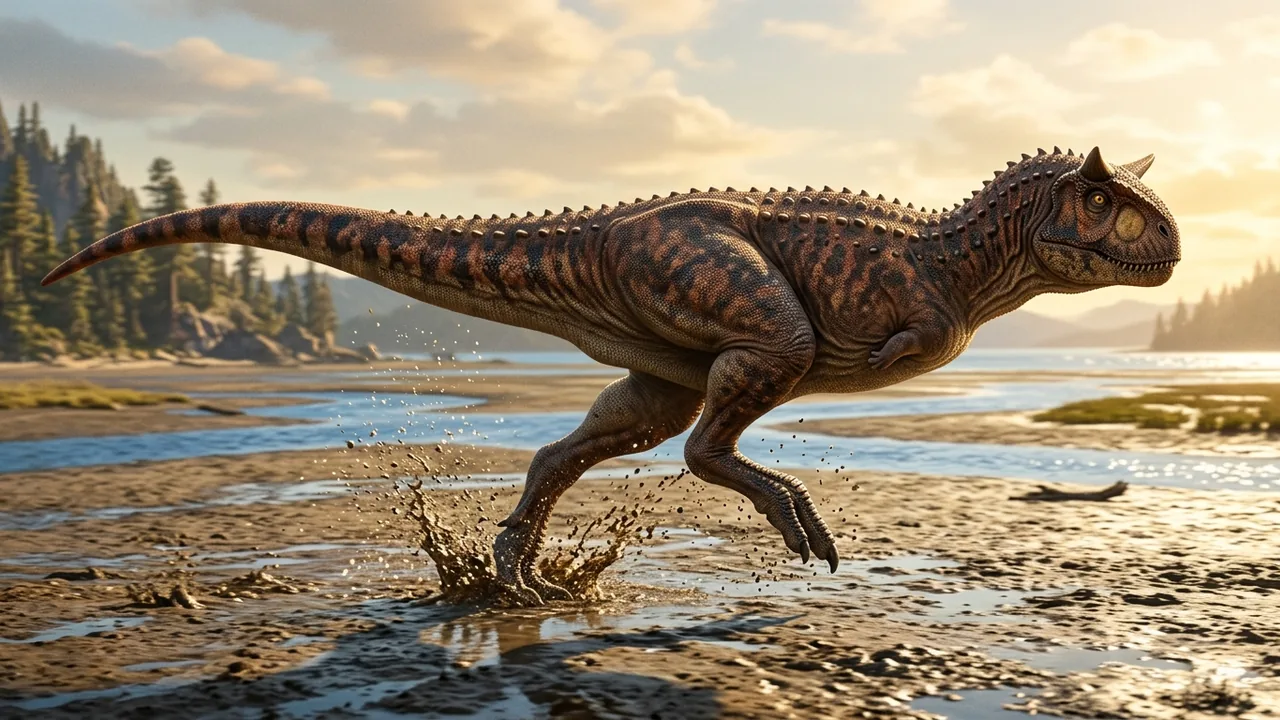
Picture a dinosaur as long as half a yellow school bus and as heavy as a large family SUV, crowned with two thick bull horns! That was Carnotaurus, whose name means meat-eating bull. Unlike long-snouted hunters, Carnotaurus had a tall, boxy skull and a sturdy muscular neck.
Look lower on its chest and you will spot a funny surprise. Its front arms were shorter than bowling pins, with four stubby fingers and stiff elbows that could not even bend! All of its strength belonged to its jaws, neck, and racing legs.
Lost World Habitat: Patagonian Shores
Around 70 million years ago during the Late Cretaceous, Carnotaurus patrolled warm coastal plains in southern Argentina. Winding rivers met salty ocean tides in wide channels bordered by dry scrublands, green palms, and tall conifer trees.
Freshwater turtles, coiled snakes, and lungfish crowded the muddy creeks, while small speedy plant-eaters darted across sunny clearings. Bumpy pebbled skin gave Carnotaurus helpful against sun-baked clay banks and shadowy shrubs. When prey wandered onto firm sandbars, the horned hunter burst out from cover at thrilling speed.
What's on the Prehistoric Menu?
Every fast runner needs plenty of fuel to power its muscles! Instead of wrestling giant armored adults all afternoon, Carnotaurus specialized in chasing nimbler meals along beaches. Small two-legged dinosaurs, river turtles, thick snakes, and unguarded young long-necks topped its menu.
Its tall, short skull worked like a quick pair of kitchen tongs rather than a heavy nutcracker. While its bite was lighter than a giant tyrannosaur's, Carnotaurus snapped its curved teeth shut in a blink and used strong neck muscles to tug backward cleanly.
Superpowers, Senses & Anatomy
Carnotaurus earned its cheetah nickname from an extraordinary tail engine. Inside its tail, wing-like side bones tilted upward to anchor enormous leg-pulling muscles. When those muscles contracted, Carnotaurus rocketed up to 35 miles per hour—as fast as a car cruising down a town street!
Its eyes angled slightly forward so it could judge distance during a chase, while large scent bulbs inside its snout sniffed the coastal breeze. Tiny arms stayed tucked safely out of the way while blunt brow horns flashed warnings to rival bulls.
Flight vs. Fight Arena!
Out on a wide flat, a hungry Carnotaurus spots Saltasaurus, a sturdy forty-foot weighing as much as an elephant! Carnotaurus brings blistering straight-line speed and quick slashing jaws to the arena, hoping to catch a stray youngster.
Full-grown Saltasaurus answers with pure Team Fight defense. Hundreds of hard bony plates dot its leathery hide like cobblestones, and herd mates stand shoulder to shoulder like a living wall. Because its stiff racing tail cannot make tight zigzag turns around swinging sauropod tails, Carnotaurus wisely trots away to hunt smaller prey.
Fossil Detective Secrets
In 1984, paleontologist José Bonaparte led a fossil team onto rancher Ángel Sastre's farm in Patagonia, Argentina. Chipping patiently into concrete-hard rock boulders, they uncovered a nearly complete Carnotaurus skeleton curled in stone from snout to tail!
Best of all, the right side preserved a rare fossil skin . Tiny five-sided scales surrounded neat rows of two-inch cone bumps, proving this southern sprinter wore scaly instead of feathers. Even today, that single remarkable skeleton teaches museum visitors around the globe how South America's bull-horned sprinter lived.