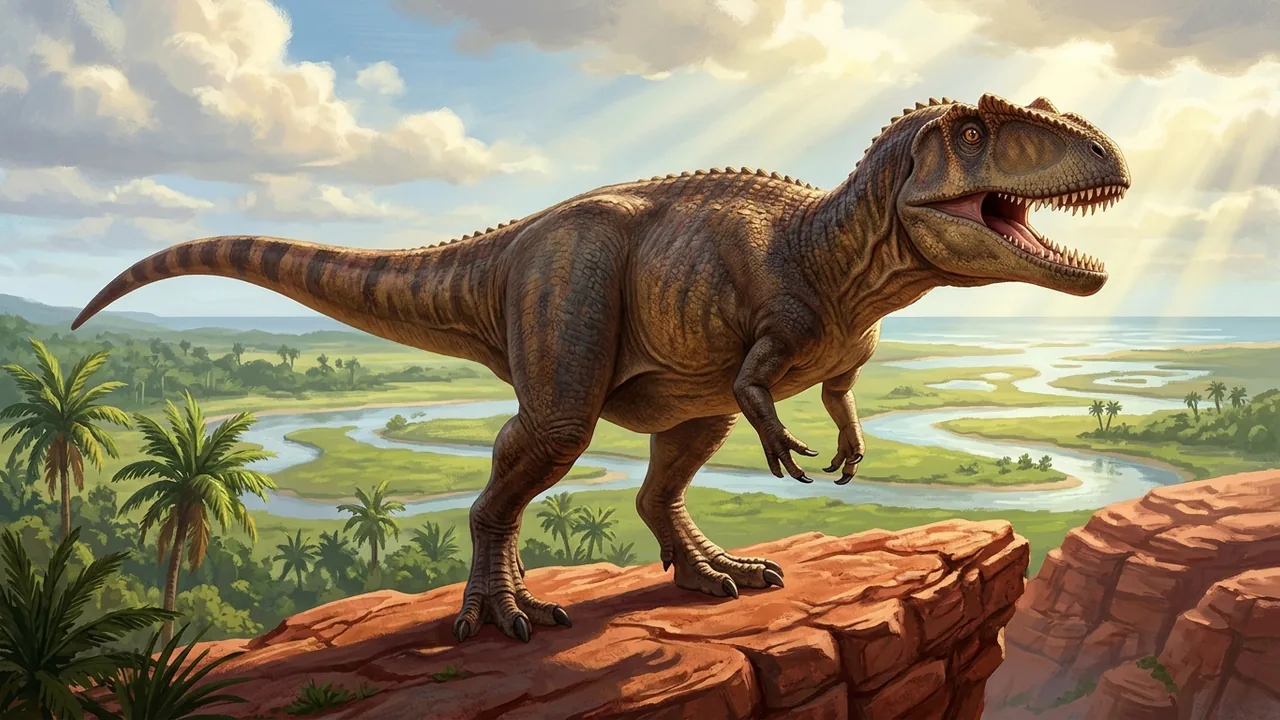
Meet the Legend: Crown Carnosaur of Northern Gondwana
Across the vast river plains and coastal savannas of North Africa (~100 to 94 million years ago), Carcharodontosaurus saharicus stood as the quintessential terrestrial super-predator of northern Gondwana. Reaching twelve to thirteen meters in total length and six to eight metric tons in body mass, this giant tetanuran lent its name to an entire global family of derived allosauroids: Carcharodontosauridae.
Originally coined from isolated Algerian teeth as 'Megalosaurus saharicus' by Charles Depéret and Justin Savornin in 1925, the species received its enduring genus name in 1931 when Bavarian paleontologist Ernst Stromer recognized that its laterally compressed, symmetrically serrated crowns mirrored the triangular dentition of great white sharks (Carcharodon).
Cladistic analyses led by Stephen Brusatte and Paul Sereno place Carcharodontosaurus inside Carcharodontosaurinae as the African sister lineage to South America's Giganotosaurini—reflecting Early Cretaceous vicariance as the opening South Atlantic split western Gondwana.
Postcranially, Carcharodontosaurus retained long, air-sac-pneumatized hindlimbs balanced horizontally by powerful caudofemoralis tail musculature and shortened three-fingered forelimbs rotated palms-inward.
Cranially, its narrow 1.6-meter skull bore sculpted nasal-lacrimal ridges and smooth extra-oral labial tissues protecting sixteen-to-twenty-centimeter maxillary blades.
Together with sister species Carcharodontosaurus iguidensis from Niger's Echkar Formation, these shark-toothed monarchs dominated African terrestrial ecosystems right up to the Cenomanian-Turonian thermal maximum.
Tall dorsal neural spines braced by thick interspinous ligaments stiffened its axial column above deep pelvic girdles, enabling swift cursorial strides across sun-drenched Saharan floodplains without sacrificing structural balance under multi-ton loads. Broad three-toed feet anchored every athletic step across firm coastal sandstone terraces.
Lost World Habitat: Kem Kem, Bahariya & Echkar Basins
Fossils of Carcharodontosaurus span more than three thousand kilometers of Gondwanan stratigraphy—from southeastern Morocco's Kem Kem Group (specifically the fluvial Ifezouane and lagoonal Aoufous formations) eastward through Algeria's Continental Intercalaire and Niger's Echkar Formation to Egypt's coastal Bahariya Oasis. Biostratigraphic correlation of elasmobranch assemblages and overlying Turonian marine limestones constrains these red-bed sequences to roughly 100 through 94 million years ago.
During this greenhouse highstand, warm Tethyan epicontinental seas flooded low-relief Saharan cratons, creating vast deltaic estuaries bordered inland by seasonally semi-arid conifer, tree-fern, and early angiosperm savannas.
Early paleoecologists marveled at 'Stromer's Riddle': the apparent overabundance of large theropods—Carcharodontosaurus, Spinosaurus, abelisaurid Rugops, and noasaurid/ceratosaurian Deltadromeus—within the same rock horizons.
Stable oxygen and carbon isotope geochemistry resolved that paradox by revealing two intertwined yet distinct energy pathways!
Whereas estuarine channels exported immense aquatic primary production through giant Mawsonia coelacanths and Onchopristis sawfish to semiaquatic Spinosaurus, upland alluvial plains supported terrestrial megaherbivores including giant titanosaur Paralititan stromeri, sail-backed diplodocoid Rebbachisaurus garasbae, and iguanodontian Ouranosaurus.
Firm interfluve terraces and gallery-forest margins belonged squarely to cursorial Carcharodontosaurus, demonstrating how spatial heterogeneity across coastal floodplains sustained unmatched Mesozoic predator diversity.
Armored terrestrial crocodyliforms, pelomedusoid side-necked turtles, and giant azhdarchid pterosaurs populated adjacent levees and oxbow marshes, completing an interconnected mosaic of coastal habitats from Morocco eastward to Egypt. Seasonal monsoon pulses regularly replenished inland floodplains, fertilizing lush horsetail meadows and tree-fern corridors across northern Gondwana while depositing iron-rich sands over dinosaur footprints and shed tooth crowns.
What's on the Menu? Shear Mechanics & Hoisting
Capturing multi-ton sauropods across open alluvial plains selected for cranial and cervical biomechanics radically divergent from bone-pulverizing tyrannosaurids. Finite-element beam modeling shows the tall, mediolaterally narrow skull of Carcharodontosaurus sacrificed torsional bone-crunching rigidity to maximize vertical bending strength, wide-gape clearance, and rapid angular closing speed.
Each maxillary and dentary alveolus housed laterally flattened ziphodont blades bearing fine chisel-like serrations fore and aft alongside arcuate transverse enamel undulations that resisted crack propagation during deep soft-tissue shear.
Driven downward and backward by robust epaxial and hypaxial cervical musculature, those blades excised devastating flesh wounds across subadult Paralititan or adult Rebbachisaurus flanks without risking tooth fracture against thick cortical limb shafts.
Quantitative equilibrium modeling by Donald Henderson and François Therrien—inspired by a remodeled biomechanical stress lesion on an Egyptian pelvic ilium—calculated that an adult Carcharodontosaurus could hoist prey weighing up to 424 kilograms clear off the substrate in its jaws while maintaining bipedal stability!
Smaller four-ton iguanodontians and juvenile sauropods fell squarely within solitary pursuit range across firm floodplain terraces.
Seasonal droughts concentrating weakened megaherbivores around shrinking oxbow channels supplemented active savanna predation with high-calorie scavenging opportunities year after year.
Continuous wave-like dental replacement ensured freshly erupted, finely serrated crowns stood ready inside deep sockets whenever high-energy feeding abraded older cutting edges against tough titanosaur dermal hides. Abundant shed crowns scattered across Kem Kem point-bar sands record thousands of successful feeding bouts along those ancient river levees, confirming Carcharodontosaurus dominated North Africa's terrestrial megaherbivore food web.
Superpowers & Senses: Landmark Endocast Neuroanatomy
High-resolution computed tomography of Moroccan braincase SGM-Din 1 by Hans Larsson in 2001 established a foundational benchmark in vertebrate neuroevolution. Measuring roughly 1.6 meters across the full restored cranium yet enclosing an endocranial volume near 275 milliliters, the Carcharodontosaurus allowed quantitative comparison of cerebrum proportions across archosaurs.
Larsson demonstrated that whereas maniraptoran coelurosaurs and Archaeopteryx exhibited dramatically expanded telencephalic hemispheres approaching avian ratios, Carcharodontosaurus retained a narrow, elongate forebrain whose cerebrum-to-total-brain volume ratio (~24 to 29 percent) closely matched extant alligators!
That landmark finding proved avian-grade forebrain expansion evolved specifically within Coelurosauria rather than across all giant theropods.
Far from sensory limitation, however, SGM-Din 1 revealed extraordinary predatory specialization: paired olfactory bulbs and peduncles reached colossal dimensions anteriorly, equipping Carcharodontosaurus to triangulate faint herbivore and carrion plumes across kilometers of savanna.
Robust optic nerve foramina (cranial nerve II) and floccular lobes coordinated keen diurnal visual tracking beneath keratin-armored lacrimal brow crests, while lateral semicircular ear canal geometry indicated a slightly nose-downward alert head carriage.
Extensive antorbital and basicranial pneumaticity further lightened the cranium so cervical levers accelerated strikes effortlessly.
Low-frequency cochlear elongation simultaneously attuned its inner ears to distant rumbles and ground vibrations generated by migrating sauropod herds moving across open Saharan alluvial plains. Together, acute olfaction, stabilized binocular gaze, and lightweight cranial pneumatics forged one of prehistory's sharpest sensory command centers, guiding multi-ton pursuits across shimmering equatorial floodplains from Morocco to Egypt throughout the Mid-Cretaceous greenhouse era.
Flight vs. Fight Arena: Sympatric Giants & Partitioning
Nowhere in the fossil record are the evolutionary mechanics of sympatric predator clearer than along North Africa's river-savanna boundary! Sharing regional basins with fourteen-meter Spinosaurus aegyptiacus could never succeed if both seven-ton theropods contested identical prey daily.
Oxygen-18 enamel geochemistry, limb osteohistology, and rostral mechanics confirm crisp ecological separation: Spinosaurus combined osteosclerotic bone ballast, snout mechanoreceptors, and fluted conical teeth for aquatic piscivory, whereas Carcharodontosaurus deployed hollow cursorial hindlimbs and ziphodont blades against terrestrial herbivores.
On upland floodplains, herbivore prey split between Team Flight speedsters—juvenile ornithopods and agile Ouranosaurus—and multi-ton Team Fight sauropods like Paralititan whose pillar limbs and whip-tails deterred frontal attacks.
Only peak dry-season contraction of estuarine lagoons brought Carcharodontosaurus and Spinosaurus into direct agonistic proximity over stranded sawfish or mired sauropods.
In such rare standoffs, substrate physics dictated tactical advantage: firm sandstone levees favored Carcharodontosaurus's nimble lateral footwork and catastrophic slicing bite, whereas deep channel mud favored low-slung, hook-clawed Spinosaurus.
Elaborate visual structures—Spinosaurus's towering dorsal sail and Carcharodontosaurus's keratin-horned nasal-lacrimal ridges—evolved precisely to settle most interspecific and intraspecific territorial encounters through ritualized display rather than mutual injury.
By respecting microhabitat boundaries and avoiding costly jaw fractures, both giant lineages flourished side by side across millions of years until global Turonian sea-level rise reshaped North Africa. Few chapters in evolutionary ecology illustrate more vividly how divergent anatomy transforms potential rivals into stable neighbors across shared coastal river basins, preserving ecosystem balance across geological ages without relentless daily combat.
Fossil Detective Secrets: War Loss to Saharan Neotype
The taxonomic rescue of Carcharodontosaurus saharicus bridges twentieth-century tragedy and modern expeditionary science. Collected in Egypt's Bahariya Formation in 1914 and described by Ernst Stromer in 1931—comprising partial skull elements, serrated teeth, vertebrae, pelvis, and hindlimbs—the original syntype specimen perished completely when Royal Air Force bombers struck Munich's Alte Akademie on the night of April 24, 1944.
For five decades, Africa's shark-toothed giant survived solely through Stromer's published lithographs and isolated Saharan teeth.
Then in 1995, Paul Sereno led an international expedition across sun-scorched Kem Kem escarpments near Erfoud, Morocco, recovering a spectacularly preserved 1.6-meter cranium (SGM-Din 1) whose rugose maxillae and braincase matched Stromer's 1931 drawings with unmistakable precision.
In 2007, Brusatte and Sereno formally designated SGM-Din 1 as the replacement under International Commission on Zoological Nomenclature rules, permanently stabilizing the taxon while describing sister species Carcharodontosaurus iguidensis from Niger.
Students in Virginia recognize a parallel geological signature of Cretaceous sea-level highstands along Virginia's Potomac Group and Coastal Plain formations—where fluvial dinosaur-bearing clays transition eastward into ancient marine shark horizons.
Together, Moroccan cliff excavations, museum curation in Rabat, and micro-CT neuroanatomy transformed wartime loss into enduring scientific triumph.
Continued collaborative fieldwork across Morocco, Niger, Algeria, and Egypt ensures new skeletal elements and stratigraphic logs steadily enrich North Africa's paleontological legacy for classrooms worldwide. Every sandstone block prepared in modern laboratories brings Ernst Stromer's once-vanished desert monarch into sharper scientific focus, proving persistent international paleontology can triumph even over historical catastrophe.