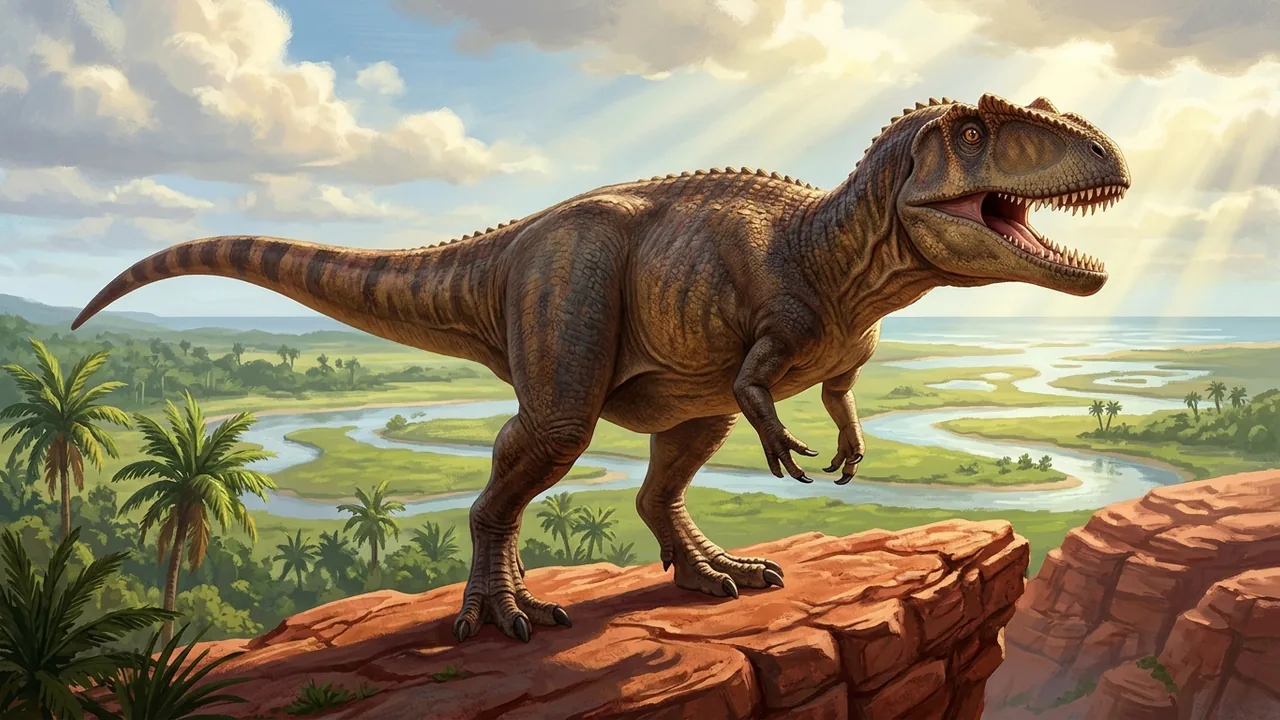
Meet the Legend: Sovereign of the Saharan Savanna
One hundred million years ago, long before rolling sand dunes blanketed the Sahara, North Africa's sunlit plains trembled beneath a forty-two-foot apex predator! Named Carcharodontosaurus saharicus, this six-to-eight-ton carnivore crowned the African branch of the shark-toothed carcharodontosaurid family.
Every bone in its body showcased specialized terrestrial . Unlike short-legged, river-wading Spinosaurus nearby, Carcharodontosaurus stood tall on long, muscular hindlimbs counterbalanced horizontally by a stiffened tail.
Its narrow, five-foot-three-inch skull carried textured brow ridges and protective scaly lips that covered six-to-eight-inch flat, serrated teeth.
Below sturdy shoulders hung three-clawed hands rotated palms-inward toward the chest.
Built for firm footing and explosive savanna bursts, Carcharodontosaurus reigned supreme wherever giant plant-eaters roamed dry ground. Broad three-toed tracks pressed into hardened floodplain silt reveal its confident, athletic stride across ancient North Africa, where warm breezes carried scents of distant sauropod herds across sunlit valleys.
Lost World Habitat: Rivers Draining to the Tethys Sea
During the Mid-Cretaceous Period roughly one hundred to ninety-four million years ago, northern Africa bordered a warm tropical ocean called the Tethys Sea. Vast braided river systems wound northward across Morocco and Egypt, nourishing wet floodplains, gallery conifer groves, and sunny fern-and-horsetail plains.
Inside this vibrant , green plant producers anchored complex food chains both in water and on land. Giant lungfish and sawfish packed deep delta channels, while lush floodplains fed towering titanosaur Paralititan, ridge-backed Rebbachisaurus, and iguanodontian Ouranosaurus.
Smaller fleet-footed dinosaurs, land crocodylomorphs, and soaring pterosaurs filled surrounding habitats from riverbank muds to rocky upland ridges.
Seasonal monsoons flooded low-lying marshes each rainy season before dry months concentrated herds around permanent river bends.
At the top of the dry-land food chain patrolled watchful Carcharodontosaurus, keeping herbivore herds moving across fertile coastal valleys.
What's on the Prehistoric Menu?
Hunting across sun-baked floodplains required a sharp combination of speed, stealth, and jaw ! Carcharodontosaurus targeted medium-sized herbivores such as four-ton Ouranosaurus as well as juvenile and subadult sauropods grazing away from protective adult herds.
Stalking quietly behind riverside tree ferns, it accelerated swiftly on long shin and thigh bones to close distance before quarry escaped. Once alongside prey, wide-hinged jaws swung rapidly, slicing with triangular serrated blades that cut cleanly without snagging on thick ribs.
Biomechanical tests of fossil hip and neck muscle attachments reveal Carcharodontosaurus could hoist animals weighing over eight hundred pounds straight off their feet!
Meanwhile, curved three-fingered claws helped steady smaller prey at close quarters.
When harsh dry spells claimed giant sauropods near shrinking waterholes, keen smell guided Carcharodontosaurus straight to rich scavenging feasts across the open plain.
Superpowers, Senses & Anatomy
Swinging a five-foot-three-inch skull took clever biological engineering! Wide bony openings called fenestrae and hollow air-sac sinuses lightened the cranium dramatically while thick brow ridges reinforced the eye sockets against impact stress.
When paleontologists scanned Carcharodontosaurus's fossilized braincase with hospital X-ray beams, they mapped its sensory superpowers in detail. Enlarged olfactory bulbs sat at the front of its forebrain, giving this predator bloodhound-level scent tracking across breezy floodplains.
Optic nerve passages confirmed sharp eyesight, while inner-ear balance canals revealed it carried its snout tilted slightly downward to spot ground hazards while running.
Even its serrated teeth possessed a hidden microscopic : wavy ripples across the enamel surface spread biting forces evenly so thin blades resisted cracking.
New replacement teeth grew continuously inside deep jaw sockets throughout its entire life, keeping its shark-like bite keen year after year!
Flight vs. Fight Arena: Sharing a Continent of Giants
How could ancient North Africa support two forty-plus-foot predators—Carcharodontosaurus and Spinosaurus—at the exact same time? Ecologists call the secret partitioning! By specializing in different habitats and menus, each apex hunter thrived without fighting exhausting battles every day.
Carcharodontosaurus ruled the dry floodplain niche, chasing swift Team Flight ornithopods and flanking multi-ton Team Fight sauropod herds whose whipping tails guarded young calves.
Down in waist-deep river channels, dense-boned Spinosaurus claimed the aquatic fish-hunting niche.
Whenever severe droughts shrank lagoons and brought both giants face-to-face over a stranded carcass, terrain tipped the balance! Firm dry banks favored agile Carcharodontosaurus footwork, whereas slippery mudflats favored wide-footed Spinosaurus.
Most encounters ended peacefully after booming roars, tall sail postures, and head-high brow displays signaled clear boundaries across the shimmering floodplain, allowing both giant species to flourish for millions of years.
Fossil Detective Secrets: Red Cliffs & Ancient Seas
Over millions of years, Sahara river sands hardened into rust-red rock layers known in Morocco as the Kem Kem beds. After World War II bombings tragically destroyed Ernst Stromer's first Egyptian bones in 1944, Paul Sereno's 1995 expedition rescued Carcharodontosaurus by unearthing an extraordinary skull high on a Moroccan cliff!
Why do dry desert cliffs in Africa hold river dinosaurs right beside ancient marine sawfish and shark teeth? Rising Cretaceous sea levels flooded low continental coasts—a geological story Virginia students can see right in their own state!
Across Virginia's Potomac Group riverbeds and Coastal Plain cliffs, sedimentary clays likewise preserve Cretaceous dinosaur tracks and conifer logs alongside fossil shark teeth from ancient Atlantic shorelines.
Comparing rock layers in Morocco and Virginia shows detectives how shifting seas continually redraw Earth's map!
Every desert fossil expedition brings long-vanished coastlines vividly back to life.