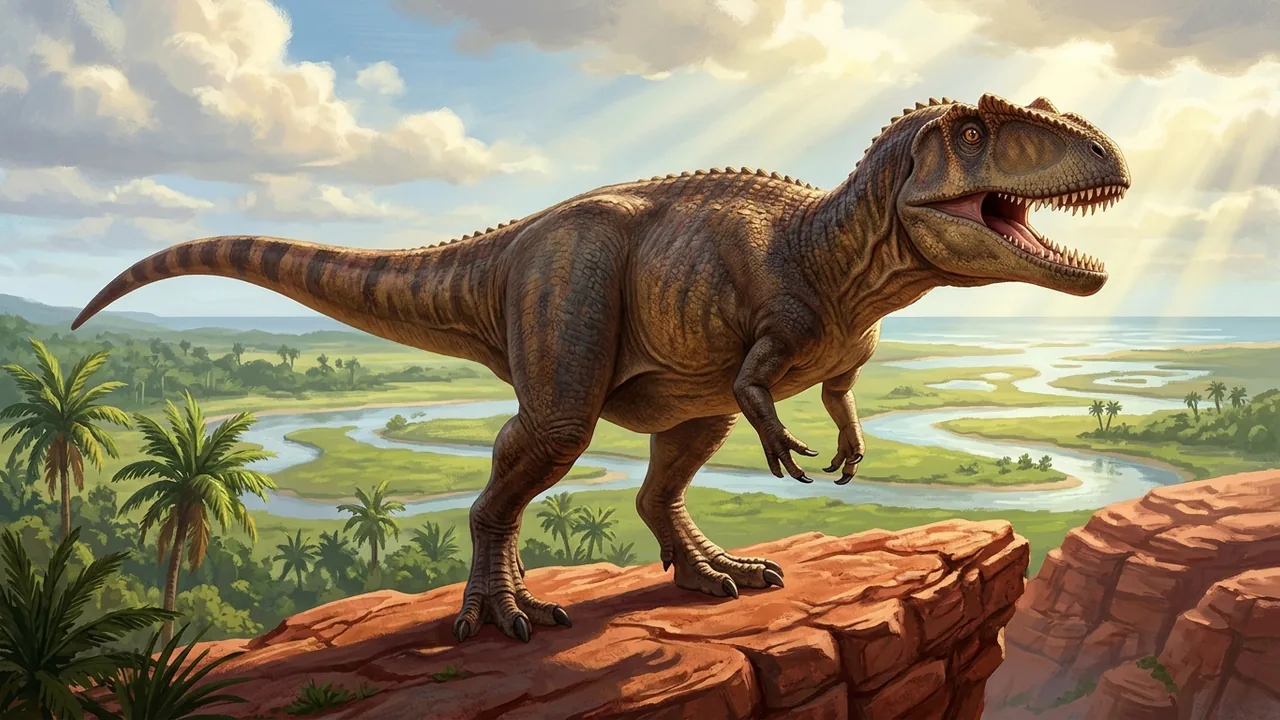
Meet the Legend: Africa's Shark-Toothed Titan
Between one hundred and ninety-four million years ago during the Mid-Cretaceous Period, Carcharodontosaurus saharicus reigned as the supreme terrestrial predator of northern Africa. Stretching forty to forty-three feet (12 to 13 meters) in length and weighing six to eight tons, it rivaled Tyrannosaurus rex and South American cousin Giganotosaurus among history's largest land-hunting carnivores.
German paleontologist Ernst Stromer coined its name in 1931 after Carcharodon—the great white shark genus—because its laterally flattened, six-to-eight-inch crowns mirrored giant shark blades in outline and cutting power.
Unlike short-legged, dense-boned Spinosaurus wading nearby channels, Carcharodontosaurus carried hollow pneumatized limb shafts and long, athletic legs built for firm upland floodplains.
Its narrow 1.6-meter (five-foot-three-inch) skull balanced horizontally ahead of muscular shoulders, inward-facing three-clawed hands, and a stiffened counterbalance tail.
Smooth extra-oral lip scales protected its serrated maxillary blades from drying out in warm equatorial air.
Every lever in its skeleton radiated high-speed slicing .
Tall back spines anchored thick elastic ligaments from neck to hip, stabilizing its heavy skull during fast strides while wide three-toed feet gripped sun-baked sandstone flats securely across open savanna hunting territories.
Lost World Habitat: Kem Kem & Bahariya Trophic Webs
One hundred million years ago, northern Gondwana supported one of the richest coastal river landscapes on Earth! Across present-day Morocco, Algeria, Niger, and Egypt, braided delta channels and gallery forests bordered sunlit fern-and-horsetail savannas draining into the warm Tethys Ocean.
For decades, paleontologists puzzled over why Kem Kem and Bahariya rock beds yielded abundant teeth from giant Carcharodontosaurus, Spinosaurus, abelisaurid Rugops, and swift Deltadromeus alongside fewer land-herbivore skeletons.
Modern web analysis solved that mystery! While deep river channels sustained aquatic predators on colossal coelacanths and sawfish, lush floodplain levees supported substantial terrestrial herbivore herds.
Sail-spined diplodocoid Rebbachisaurus stripped low riverside ferns, twenty-three-foot iguanodontian Ouranosaurus browsed coastal shrubs, and sixty-ton titanosaur Paralititan stromeri harvested high conifer canopies.
Terrestrial crocodylomorphs, side-necked turtles, and giant pterosaurs filled intermediate trophic links across marshes and sandbars.
Patrolling dry alluvial ridges above the flood zone, Carcharodontosaurus occupied the undisputed terrestrial apex tier.
Seasonal monsoon floods swept fallen tree trunks, freshwater clams, and shed dinosaur crowns together into iron-rich sandstone channels that preserve this vanished coastal paradise today across hundreds of miles of rocky North African escarpments.
What's on the Menu? Lifting & Slicing Physics
Hunting multi-ton sauropods and agile ornithopods across open savannas demanded rapid acceleration and devastating slicing efficiency. Muscle reconstructions of its long femur, tibia, and caudofemoralis tail retractors indicate Carcharodontosaurus reached pursuit bursts near twenty to twenty-five miles per hour across firm ground.
Rather than clamping onto solid limb bones and risking shattered teeth, Carcharodontosaurus deployed wide-gape slashing bites! Finite-element jaw models estimate vertical clamping forces around 8,000 to 15,000 Newtons—driving thin, razor-serrated crowns cleanly through thick sauropod hide while powerful neck muscles pulled backward.
Even more remarkably, biomechanical engineers Donald Henderson and François Therrien modeled center-of-mass balance and fossilized hip-and-neck muscle scars, calculating that an adult Carcharodontosaurus could hoist captured prey weighing up to 424 kilograms (935 pounds) clear off the ground in its jaws!
Juvenile Paralititan, subadult Rebbachisaurus, and adult Ouranosaurus supplied steady upland calories.
During harsh dry seasons, keen olfaction also led Carcharodontosaurus to stranded floodplain carrion.
Fresh replacement blades grew continuously inside deep jaw sockets so chipped crowns never slowed its hunting momentum across breezy coastal plains, where thriving megaherbivore herds demanded peak slicing performance year-round.
Superpowers, Senses & Anatomy: Inside the Endocast
In 2000 and 2001, paleontologists Hans Larsson and Paul Sereno placed the giant Moroccan braincase of Carcharodontosaurus inside a high-resolution CT scanner, generating one of paleontology's most famous digital reconstructions! Measuring surprisingly compact inside a five-foot-three-inch skull, the brain cavity revealed fascinating evolutionary clues.
When Larsson compared forebrain (cerebrum) volume against total brain volume, Carcharodontosaurus matched modern reptiles like alligators rather than birds—proving enlarged avian-style forebrains evolved specifically inside later coelurosaurian theropods such as tyrannosaurs and raptors!
Yet Carcharodontosaurus boasted formidable sensory specializations of its own! Massive olfactory bulbs dominated the front of the endocast, granting acute long-distance scent detection across open savannas.
Thick optic nerves supported keen daylight vision, while inner-ear semicircular canal orientation showed the hunter held its narrow snout tilted slightly downward to scan terrain ahead.
Meanwhile, expansive antorbital fenestrae and pneumatic air sacs trimmed skull weight so neck muscles swung those shark-toothed jaws with lightning speed.
Characteristic wavy enamel ripples further stiffened every thin blade against lateral bending stress.
Low-frequency inner-ear hearing also detected distant thunder and deep sauropod footsteps vibrating across open floodplain soils.
Flight vs. Fight Arena: Niche Partitioning in Action
Sharing coastal North Africa with fifty-foot Spinosaurus and sixty-ton titanosaurs tested both ecological and tactical footwork! Fleet herbivores like Ouranosaurus and juvenile ornithopods trusted Team Flight endurance across open flats, whereas adult Paralititan and Rebbachisaurus relied on Team Fight mass and sweeping whip-tails.
Between the two mega-predators themselves, evolutionary anatomy enforced clear habitat partitioning. Carcharodontosaurus possessed long, air-lightened running legs and flesh-shearing teeth suited for firm savannas, while Spinosaurus carried shortened, dense-walled legs and conical fish-trapping jaws built for river channels.
Isotope chemistry inside fossil tooth enamel confirms this split: Carcharodontosaurus drank and hunted overwhelmingly on dry land, whereas Spinosaurus spent most of its day in freshwater estuaries!
Only severe dry-season droughts forced standoffs beside shrinking oxbow pools.
On firm sandstone banks, faster footwork and deep slicing jaws favored Carcharodontosaurus; in waist-deep mud, stability favored Spinosaurus.
Towering visual displays and booming vocalizations resolved most encounters before teeth ever clashed.
Smart predators conserved precious energy for hunting natural quarry rather than risking broken jaws in unnecessary territorial brawls, proving ecological specialization can be even more powerful than brute strength across shared landscapes.
Fossil Detective Secrets: Sahara Cliffs & Lost Bones
The scientific story of Carcharodontosaurus reads like a real-life adventure thriller! French geologists Charles Depéret and Justin Savornin first spotted its serrated teeth in Algeria in 1925, and in 1931 Ernst Stromer named a partial Egyptian skeleton from the Bahariya Oasis.
Tragically, an April 1944 wartime air raid struck Munich's Paleontological Museum, destroying Stromer's irreplaceable Egyptian bones alongside the original Spinosaurus holotype!
Half a century passed before University of Chicago paleontologist Paul Sereno led a grueling 1995 expedition into Morocco's sun-baked Kem Kem cliffs near the Algerian border.
High on a steep sandstone slope, eroding skull plates led Sereno's team to specimen SGM-Din 1—a magnificent five-foot-three-inch cranium officially designated as the replacement reference skull!
Twelve years later in Niger, Sereno and Stephen Brusatte named sister species Carcharodontosaurus iguidensis from differing maxilla and braincase traits.
Together, Sahara fieldwork and digital CT scans restored Africa's lost shark-toothed sovereign to world science.
Every carefully mapped desert quarry helps Moroccan, Egyptian, and international researchers protect North Africa's extraordinary Cretaceous fossil heritage for future students, uniting museum collections from Rabat and Cairo to Chicago in shared discovery.