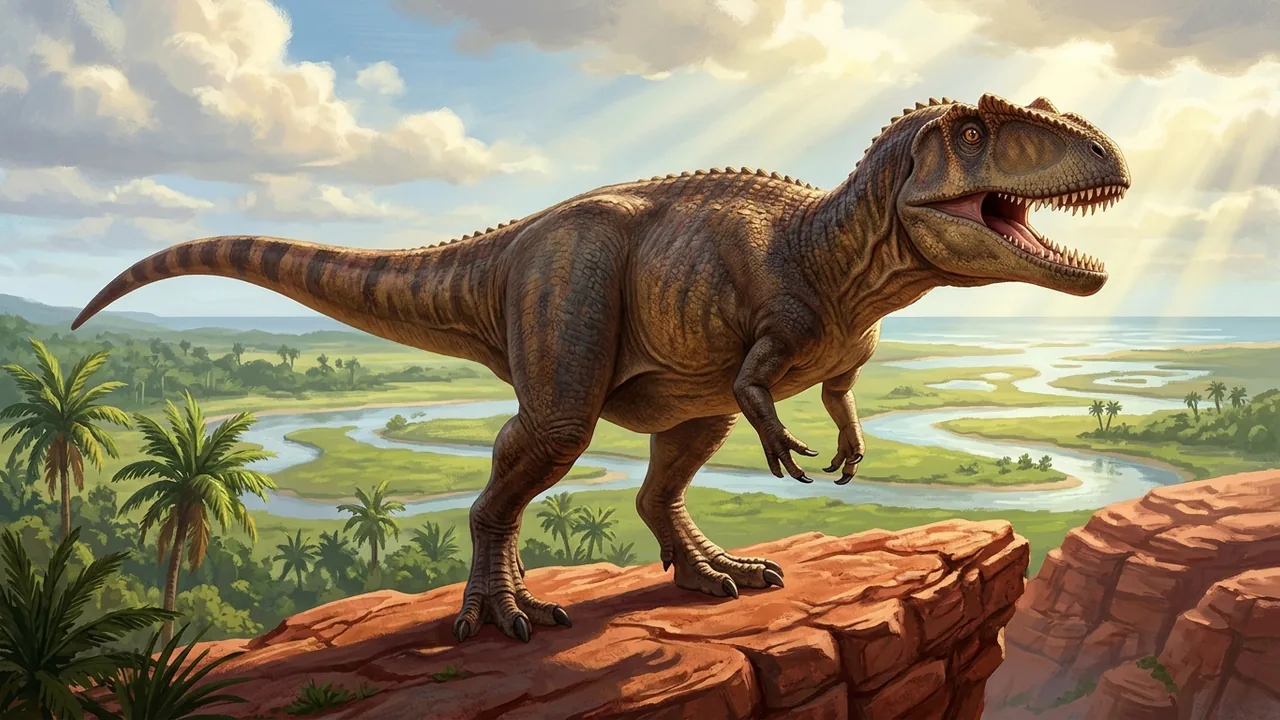
Meet the Legend: Jaws Like a Great White Shark
One hundred million years ago, a forty-two-foot strode across ancient North Africa! Longer than a city transit bus and weighing as much as four pickup trucks, Carcharodontosaurus ruled dry floodplains from Egypt to Morocco. Scientists named it after Carcharodon—the scientific name for the great white shark!
Why name a land dinosaur after an ocean shark? Inside its narrow five-foot-three-inch skull sat rows of flat, six-inch triangular teeth with razor-sharp edges! Scaly lips kept those blades protected when its mouth closed, while three-clawed hands faced inward below muscular shoulders and a horizontal balancing tail.
Lost World Habitat: Where Sahara Sands Were Green
If you visited Morocco or Egypt during the Mid-Cretaceous Period, you would not see endless dry sand dunes! Instead, warm tropical breezes blew across lush coastal plains, braided rivers, and sunlit fern savannas draining northward into the ancient Tethys Sea.
Towering tree ferns, horsetails, and conifers bordered muddy lagoons packed with giant sawfish, lungfish, and armored crocodiles. Out on firmer upland trails, giant long-necked sauropods munched high branches while duck-snouted plant-eaters browsed riverside bushes. Carcharodontosaurus claimed those firm, open floodplains as its royal hunting ground.
What's on the Prehistoric Menu?
Unlike fish-hunting Spinosaurus down in the river channels, Carcharodontosaurus was a pure land-hunting ! Its menu featured twenty-three-foot sail-backed plant-eaters like Ouranosaurus, mid-sized rebbachisaurid sauropods, and young individuals of giant Paralititan—the massive 'tidal giant' of ancient Egypt.
Charging out from streamside palms on long, athletic legs, Carcharodontosaurus swung its lightweight skull fast to slice with blades. Engineering studies of muscle marks on its hips and neck show this powerhouse could hoist prey weighing nearly nine hundred pounds—about as heavy as a concert grand piano—right off the ground!
Superpowers, Senses & Anatomy
How did Carcharodontosaurus carry a five-foot-long head without tipping forward? Large open windows and hollow air pockets carved through its skull bones, keeping its jaws light and speedy while bony brow ridges shaded its eyes from bright African sun!
Hospital CT scanners peered inside its fossilized braincase and revealed a brain shaped much like a giant alligator's—with huge scent bulbs up front to sniff out herds miles away across the . Inner-ear balance tubes showed it walked with its snout tilted slightly downward to watch every step during fast chases.
Flight vs. Fight Arena!
North Africa's ancient hosted fascinating survival matchups! Medium plant-eaters like Ouranosaurus trusted brisk Team Flight trots to reach safety, while multi-ton sauropods stood firm on Team Fight pillar legs and whipped long tails.
What happened when Carcharodontosaurus crossed paths with fifty-foot Spinosaurus along a drying riverbank? Fighting risked dangerous injuries for both apex hunters, so nature favored smart sharing! Long-legged Carcharodontosaurus owned firm dry land, while short-legged, paddle-tailed Spinosaurus ruled deep water. Loud roars and head-high displays settled rare border standoffs without trading bites.
Fossil Detective Secrets: Desert Rescue in Morocco
In 1931, scientist Ernst Stromer described the first Carcharodontosaurus bones from Egypt, storing them in a German museum. Tragically, a World War II bombing raid in 1944 destroyed every bone—leaving behind only drawings and notes for fifty years!
Then in 1995, paleontologist Paul Sereno led a daring desert across blistering red cliffs in southeastern Morocco. High on a rocky slope, team member Stephen Brusatte's mentor spotted sunlit bone chunks eroding from sandstone—piecing together a magnificent five-foot skull that brought Africa's lost shark-toothed king back to museum halls!