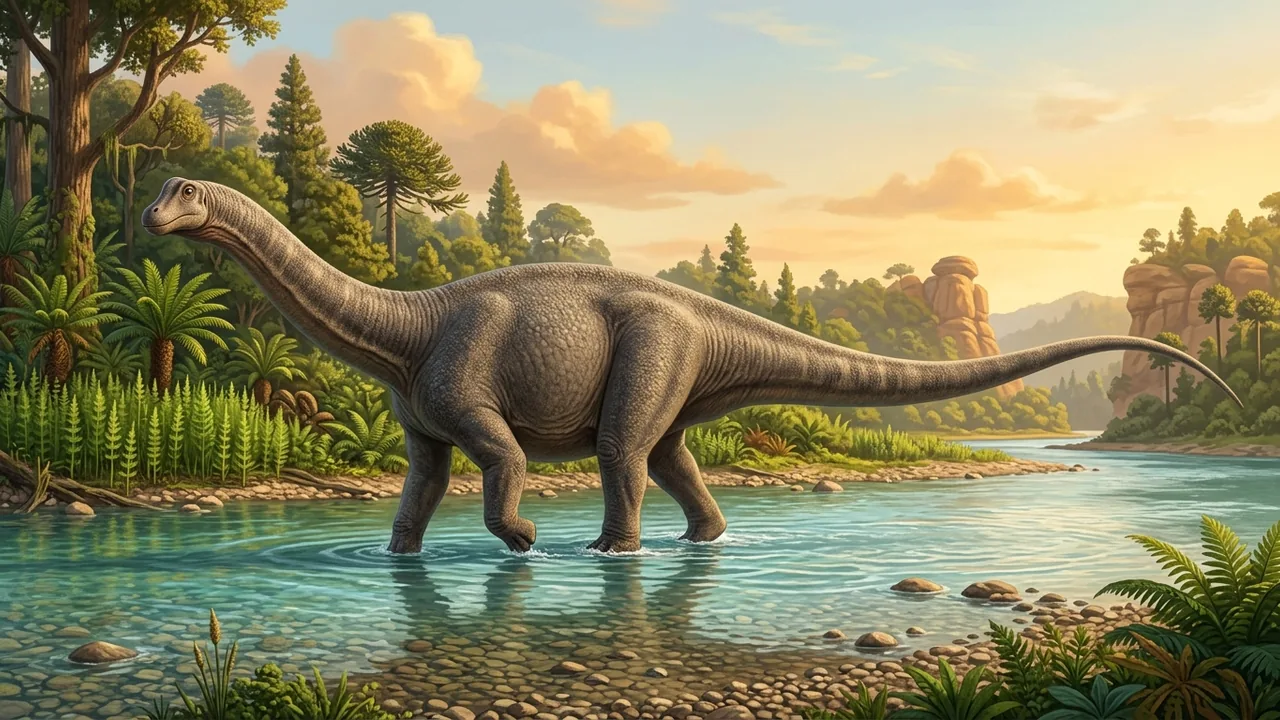
Meet the Legend: Resurrection of a Taxonomic Icon
Few episodes in vertebrate paleontology illustrate the self-correcting rigor of science more vividly than the century-long exile and triumphant resurrection of Brontosaurus excelsus. Unearthed in 1879 by collectors working for Yale paleontologist Othniel Charles Marsh at Quarry 10, Como Bluff, Wyoming, holotype YPM 1980 represented the most complete sauropod skeleton known to nineteenth-century science, inspiring its thunderous Greek name.
However, during the fierce 'Bone Wars' competition against Edward Drinker Cope, Marsh had named an incomplete juvenile sauropod from Colorado Apatosaurus ajax two years earlier in 1877. In 1903, Field Museum paleontologist Elmer Riggs re-evaluated both specimens, concluded their morphological differences reflected growth stages or species-level variation within a single genus, and placed Brontosaurus into taxonomic under the senior name Apatosaurus.
For 112 years, formal scientific literature treated Brontosaurus as an invalid junior synonym even while its evocative name endured in public imagination around the globe.
That consensus held until April 2015, when Emanuel Tschopp, Octávio Mateus, and Roger Benson published a monumental 300-page specimen-level analysis applying modern across Diplodocidae.
Measuring twenty-two meters long and weighing fourteen to fifteen-and-a-half metric tons, Brontosaurus emerged with undeniable quantitative differences separating it from Apatosaurus within the robust subfamily , reclaiming its rightful generic identity. Rather than reversing course on a whim, modern paleobiology demonstrated how expanded museum samples and high-resolution phylogenetic matrices uncover true evolutionary diversity across ancient North American floodplains while honoring careful anatomical measurement, transparent peer review, and reproducible museum specimen comparisons.
Lost World Habitat: Morrison Alluvial Wetlands
Situating Brontosaurus in deep time relies on high-resolution across the Upper Jurassic Morrison Formation of Wyoming, Utah, and Colorado. Radiometric argon-argon dates from intercalated volcanic ash horizons bracket the three recognized Brontosaurus species from the middle Salt Wash into the Brushy Basin members, spanning roughly 154 to 150 million years ago across the Kimmeridgian-Tithonian boundary.
Lithological facies at Como Bluff—alternating greenish-gray smectitic mudstones, crevasse-splay siltstones, and freshwater charophyte limestones—record low-gradient alluvial floodplains dotted with seasonal marshes, oxbow ponds, and perennial meandering channels.
Although early twentieth-century paleoart trapped Brontosaurus in permanent chest-deep swamps, modern ichnology and limb-bone cortical geometry prove members of were fully terrestrial walkers that waded across shallow waterways while foraging along lush riparian corridors.
Across these mosaic wetlands, groves of taxodiaceous and araucarian conifers, ginkgoes, cycadophytes, tree ferns, and dense Equisetum horsetail reedbeds supported an extraordinary guild of megaherbivores.
Brontosaurus shared these sunlit floodplains with slender Diplodocus, high-browsing Brachiosaurus, macronarian Camarasaurus, plated Stegosaurus, semi-aquatic goniopholidid crocodylomorphs, and giant freshwater unionid bivalves whose shell beds still pave ancient channel sandstones across the American West. Seasonal monsoon rains refreshed these wetland corridors annually, sustaining multi-ton herds even when upland interfluves baked dry under warm Mesozoic sunshine.
Carbonate paleosol chemistry and fossilized root traces confirm water tables fluctuated sharply each year, rewarding mobile sauropod herds capable of tracking permanent lakeshore oases, spring marshes, and shady river bends across vast sedimentary basins from central Wyoming south into eastern Utah and western Colorado.
What's on the Prehistoric Menu?
Understanding how Brontosaurus harvested hundreds of kilograms of daily plant biomass required first solving a famous cranial mix-up. Because Marsh's 1879 holotype lacked a skull, Marsh modeled restorations on robust, spoon-toothed macronarian skulls, leading museums for nearly a century to mount short, boxy Camarasaurus-like heads atop apatosaurine necks!
In 1978, archival quarry detective work by John McIntosh and David Berman proved that elongated, low-snouted skull CMC VP 7180 from Dinosaur National Monument lay directly associated with an apatosaurine cervical column. True members of possessed slender diplodocid skulls equipped exclusively with anterior cylindrical peg teeth, though with a slightly broader, more rounded arcade than square-jawed Diplodocus.
Tooth enamel microwear and jaw mechanics indicate Brontosaurus practiced generalized low-to-medium browsing and branch stripping from ground level up to roughly five meters—cropping lakeside horsetails, fern fronds, cycadophytes, and soft riverside conifer shoots without competing against upper-canopy macronarians.
Completely lacking posterior grinding cheek teeth, Brontosaurus swallowed coarse plant boluses directly into an expansive hindgut fermentation chamber.
Cervical kept its muscular neck metabolically economical to sweep laterally across dense wetland reedbeds while gut microbiota liberated volatile fatty acids from recalcitrant Jurassic cellulose. Rapid tooth-replacement batteries replenished worn anterior pegs every few weeks, compensating effortlessly for silica grit coating marshland Equisetum stems.
Stable oxygen and carbon isotope ratios sampled across serial enamel growth bands confirm these giants drank regularly from open freshwater rivers while cropping moist riparian vegetation along shaded woodland margins throughout changing seasonal rainfall cycles.
Superpowers, Senses & Anatomy
Anatomically, Brontosaurus bridges sleek axial lightness with astonishing cervical musculature. Like other neosauropods, invasive pulmonary diverticula sculpted deep lateral pleurocoels and internal camerate throughout its fifteen cervical and ten dorsal vertebrae, slashing skeletal mass while ventilating metabolic heat.
Paired neural spines along the neck and anterior back split into deep V-shaped troughs cradling an elastic ligamentous suspension cable. Yet beneath the centra, members of diverged dramatically from slender Diplodocinae: robust cervical ribs projected far ventrally on stout bony struts, terminating in rugose, bulbous bone bosses covered in tough fibrocartilage!
Whereas Apatosaurus developed extreme barrel-thick cervical width, Tschopp's demonstrated that Brontosaurus held a slightly higher-angled, narrower dorsal-cervical transition while retaining prominent ventral neck bosses along its mid-cervicals.
Functional morphologists Mike Taylor, Matt Wedel, and Darren Naish highlighted how those reinforced ventral ribs created massive moment arms for hypaxial flexor muscles—enabling downward and ventrolateral neck strikes akin to intraspecific neck-clubbing in bull giraffes or elephant seals!
Anchored over straight graviportal limbs with a stout, medially curved pollex claw on each tubular forefoot, Brontosaurus combined cushioned weight support with formidable forequarter leverage. Behind its fused five-vertebra sacrum, an eighty-bone tail counterbalanced the muscular neck smoothly above soft lakeshore sediments without leaving drag marks.
Together, upper-column air sacs and lower-column muscle anchors turned the Brontosaurus neck into both a lightweight foraging crane and a heavily braced biological battering beam engineered for Late Jurassic survival, long-distance herd signaling, and active predator deterrence across open floodplains.
Flight vs. Fight Arena: Riparian Defense
Riparian woodlands and marsh margins of the Morrison Formation harbored formidable mega-theropods—notably Allosaurus fragilis and the massive ten-meter megalosaurid Torvosaurus tanneri, whose robust skull and ten-centimeter ziphodont teeth specialized in tackling large riverside prey! For hatchling and juvenile Brontosaurus weighing only a few kilograms to a few hundred kilograms, concealment inside dense fern underbrush and rapid fibrolamellar osteogenesis provided the sole path past high early-life mortality.
Upon reaching fifteen to seventeen metric tons at skeletal maturity, adult Brontosaurus transitioned decisively onto Team Fight. Although biomechanical limb bone safety factors restricted locomotion to an ambling walk without an aerial running phase, adult mass exceeded Torvosaurus fourfold and Allosaurus nearly eightfold!
Behind the sacrum extended an eighty-segment caudal whip tapering down to biconvex terminal rods capable of lashing laterally at over thirty meters per second, creating a wide kinetic hazard zone across open mudflats.
Should an ambush predator press toward the forequarters, Brontosaurus could deploy downward-slashing pollex thumb claws alongside heavy ventrolateral strikes from its boss-armored neck!
Combined with cervical that kept defensive head-and-neck pivots surprisingly swift, healthy adult herds presented riparian carnivores with an unyielding wall of muscle, claw, and whip-cracking tail. Bonebed evidence confirms predators primarily scavenged drought fatalities or hunted juveniles rather than confronting prime adults head-on.
Multi-generational trackways demonstrate cohesive herd movement across exposed river fords, ensuring smaller subadults remained safely buffered inside towering defensive perimeters whenever large predators patrolled nearby muddy riverbanks during dry-season gatherings around scarce water.
Fossil Detective Secrets: Inside the 477-Trait Matrix
Why did Riggs's 1903 taxonomic stand unchallenged for more than eleven decades before falling in 2015? In 1903, only a handful of apatosaurine skeletons had been excavated from Morrison , making subtle proportional differences look like continuous growth variation between younger and older individuals.
Over the ensuing century, quarries across Wyoming, Utah, Colorado, and Oklahoma yielded dozens of additional diplodocid skeletons across multiple stratigraphic horizons. Beginning in 2010, Emanuel Tschopp personally inspected, photographed, and caliper-measured eighty-one individual diplodocoid specimens across twenty museums in Europe and the United States.
Rather than grouping fossils into pre-assumed species buckets—which can blur genuine anatomical signals—Tschopp, Mateus, and Benson coded each individual specimen separately across 477 discrete osteological characters in a landmark specimen-level analysis.
Every parsimony tree recovered two statistically robust, reciprocally monophyletic clades within separated by as many anatomical steps as divide Diplodocus from Barosaurus!
Because YPM 1980 anchored the narrower-necked, taller-shouldered clade, ICZN nomenclature rules resurrected Marsh's 1879 genus Brontosaurus alongside 1877 Apatosaurus—offering students everywhere an unforgettable lesson that scientific classification evolves dynamically whenever fuller datasets and sharper analytical tools examine the fossil record. Today both thunderous cousins stand recognized side by side in twenty-first-century paleontology.
Ongoing digital laser scans and high-precision photogrammetry of historical Como Bluff quarries continue uncovering subtle diagnostic landmarks across these celebrated Jurassic giants, ensuring future generations of curious paleobiologists can test every single bone measurement with open eyes, shared museum databases, and rigorous scientific evidence.