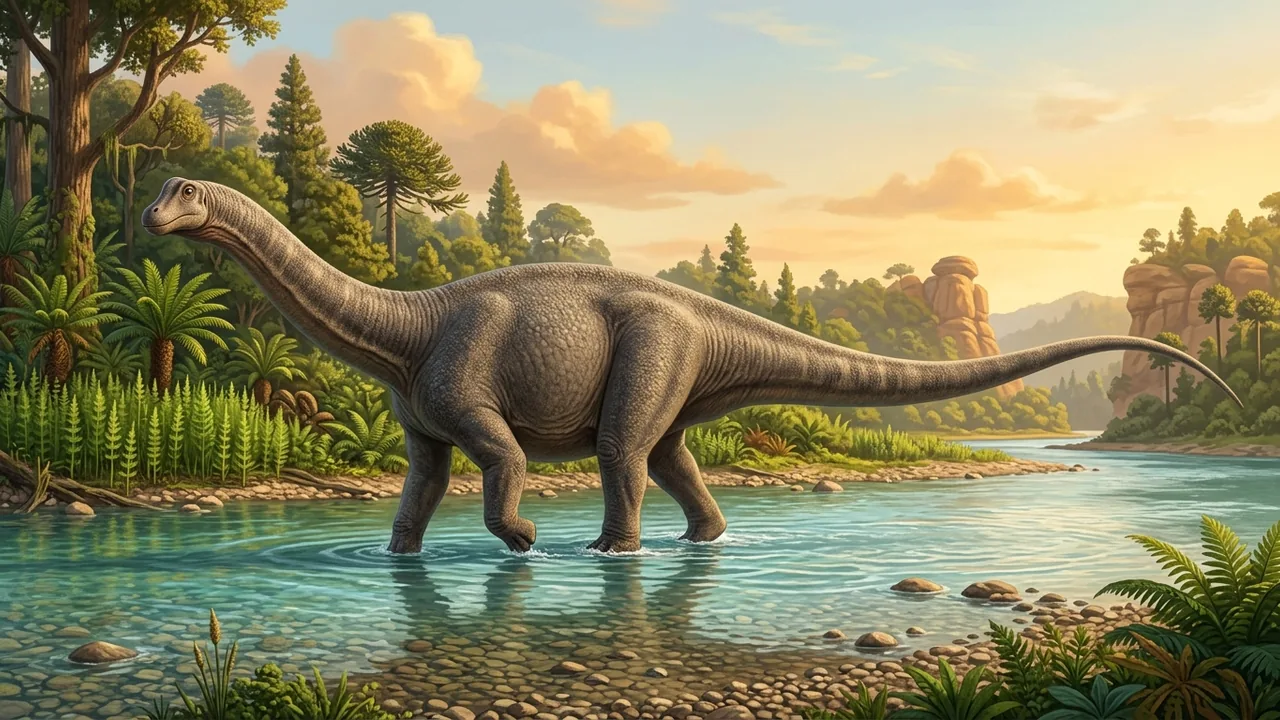
Meet the Legend: Century-Long Detective Case
Imagine being the most famous long-necked dinosaur on Earth, starring in museum halls and postage stamps, while textbooks insist your name does not officially exist! For 112 years, that strange riddle surrounded Brontosaurus excelsus, the 'noble thunder lizard' named by Yale paleontologist Othniel Charles Marsh in 1879 from Como Bluff, Wyoming.
Two years earlier, in 1877, Marsh had named a cousin skeleton Apatosaurus ajax. Under the rules of biological , if two fossils belong to the same genus, the older name wins priority. In 1903, researcher Elmer Riggs argued the two dinosaurs were too alike to split, placing Brontosaurus on the scientific shelf for more than a century.
Measuring roughly seventy-two feet long and weighing fifteen to seventeen tons, this iconic giant waited patiently in museum collections while dozens of newer diplodocid skeletons emerged from western quarries.
Then in 2015, paleontologist Emanuel Tschopp and his colleagues measured 477 skeletal traits across eighty-one fossils—proving Brontosaurus carried a narrower, higher-set neck than stockier Apatosaurus!
Overnight, rigorous quantitative evidence restored Brontosaurus to valid status around the globe, thrilling young fossil fans and veteran researchers alike.
Lost World Habitat: Marshy Morrison Waterways
Between 154 and 150 million years ago during the Late Jurassic Period, Brontosaurus inhabited seasonal floodplains, oxbow marshes, and gallery woodlands spanning ancient Wyoming, Utah, and Colorado. Runoff from rising western mountains fed wide braided rivers that spilled across warm lowlands during rainy monsoons.
Early twentieth-century murals mistakenly painted Brontosaurus submerged up to its chin in deep swamps because artists assumed sixteen-ton legs could not bear its weight on dry land. Modern trackway and limb overturned that myth completely: upright pillar legs carried Brontosaurus effortlessly across firm ground and shallow river fords!
Within this crowded Morrison landscape, Brontosaurus occupied a productive lakeshore and floodplain browsing alongside armored Stegosaurus, slender Diplodocus, and high-reaching Brachiosaurus.
Lush beds of horsetails, ferns, cycads, and riverside conifers formed the sunlit producer foundation of the food web, pumping vast energy into multi-ton herbivore herds.
In turn, sauropod footprints churned wet shoreline soils, creating sunlit shallow pools where prehistoric frogs, turtles, freshwater mussels, and lungfish thrived throughout warm dry-season afternoons across the western interior basin as herds marched onward toward fresh green bends along shimmering Jurassic streams.
What's on the Prehistoric Menu?
Meeting the daily demands of a sixteen-ton body required harvesting hundreds of pounds of fibrous Jurassic plants without pause. For nearly a century, museum visitors pictured Brontosaurus crunching woody branches with heavy, spoon-shaped teeth because mounts wore a borrowed Camarasaurus-style skull!
Once fossil detectives matched true apatosaurine skulls in the late 1970s, a sleeker feeding design emerged. Brontosaurus possessed an elongated, gently rounded snout lined solely at the front with cylindrical peg teeth—wider in jaw arch than square-muzzled Diplodocus, enabling a versatile browsing .
Clamping onto lakeside Equisetum horsetails, fern fronds, and tender conifer shoots up to fifteen feet off the ground, Brontosaurus nipped and stripped mouthfuls cleanly without chewing a single bite.
Skull kept head weight minimal at the tip of its twenty-foot neck while shifting mechanical work backward into its cavernous torso.
There, a multi-chambered hindgut fermentation vat packed with symbiotic bacteria slowly broke down tough cellulose fibers over several days, fueling steady year-round growth while rapid tooth replacement kept sharp enamel pegs lined up at the front of its jaws for non-stop riverside grazing from dawn until dusk.
Superpowers, Senses & Anatomy
Peer inside a Brontosaurus neck vertebra on a hospital CT scanner and you discover an astonishing blend of lightness and brawling brawn! Like other giant sauropods, avian-style air sacs invaded its cervical and dorsal vertebrae, sculpting honeycomb chambers that trimmed hundreds of pounds of dead weight.
Yet underneath those air-lightened neck bones hung thick, downward-projecting cervical ribs toughened with rugose bony bosses—knobby pads of dense bone unlike anything seen in slender Diplodocus!
In 2015, paleontologists Mike Taylor, Matt Wedel, and Darren Naish analyzed the of those reinforced ventral knobs and proposed a remarkable 'combat-ready neck' hypothesis. Anchored by massive flexor and lateral muscles, Brontosaurus could swing its sturdy neck downward or sideways like a weighted club during rival dominance contests or predator defense!
Supporting this muscular front end were four columnar legs ending in cushioned elephant-like foot pads, with a single large, curved inner thumb claw on each forefoot and three stout claws on each hind foot to grip slick river clay.
Meanwhile, forked neural spines cradled elastic back ligaments that balanced its long whip tail effortlessly above the floodplain.
Flight vs. Fight Arena: Thunder Against Teeth
Sharing lush riverside corridors meant crossing paths with Torvosaurus tanneri—a thirty-three-foot, four-ton megalosaurid apex predator armed with blade-like four-inch teeth and powerful clawed forearms—as well as agile packs of Allosaurus! Because sixteen-ton limb capped Brontosaurus at a brisk walking pace near twelve miles per hour, sprinting away was out of the question.
Instead, adult Brontosaurus anchored Team Fight with triple-layered defenses! Behind its hips stretched a thirty-five-to-forty-foot tapering whip tail of roughly eighty caudal segments capable of snapping sideways past highway speeds, threatening painful impacts or startling acoustic cracks.
Up front, its muscular boss-ribbed neck and sharp inner thumb claws guarded its chest and throat, while fourfold mass superiority made a healthy adult nearly impossible for a lone Torvosaurus to topple.
Vulnerable hatchlings occupied a sheltered undergrowth while racing upward in weight at several thousand pounds per year, eventually joining multi-ton adult herds whose coordinated flanks turned marshy lakeshores into no-entry zones for hungry theropods.
Even experienced riparian predators waited cautiously for sick stragglers or isolated youngsters rather than challenging an alert defensive wall of adult thunder lizards.
Fossil Detective Secrets: 477 Clues Restore a Titan
How does modern decide whether two fossil skeletons belong to one genus or two? Between 2010 and 2015, Swiss-Portuguese paleontologist Emanuel Tschopp, Octávio Mateus, and Roger Benson tackled the entire diplodocid family in a landmark 300-page investigation.
Rather than eyeing skeletons from afar, they measured 477 individual anatomical traits across eighty-one separate museum specimens—including Marsh's original 1879 Yale skeleton YPM 1980 from Como Bluff, Wyoming!
When computer algorithms mapped every fossa, shoulder blade angle, astragalus ankle joint, and cervical rib proportion without bias, a crystal-clear boundary appeared: Apatosaurus ajax and Apatosaurus louisae clustered on one sturdy, wide-necked branch, while Brontosaurus excelsus, Brontosaurus parvus, and Brontosaurus yahnahpin formed their own distinct sister branch!
Far from being an embarrassing mistake, the 112-year exile and triumphant 2015 return of Brontosaurus celebrates the heart of science: hypotheses are never carved in stone, and fresh evidence always earns the final word.
Every student who steps into Yale's Peabody Museum today gazes up at YPM 1980 wearing both its true slender skull and its proudly restored scientific genus name as a symbol of discovery.