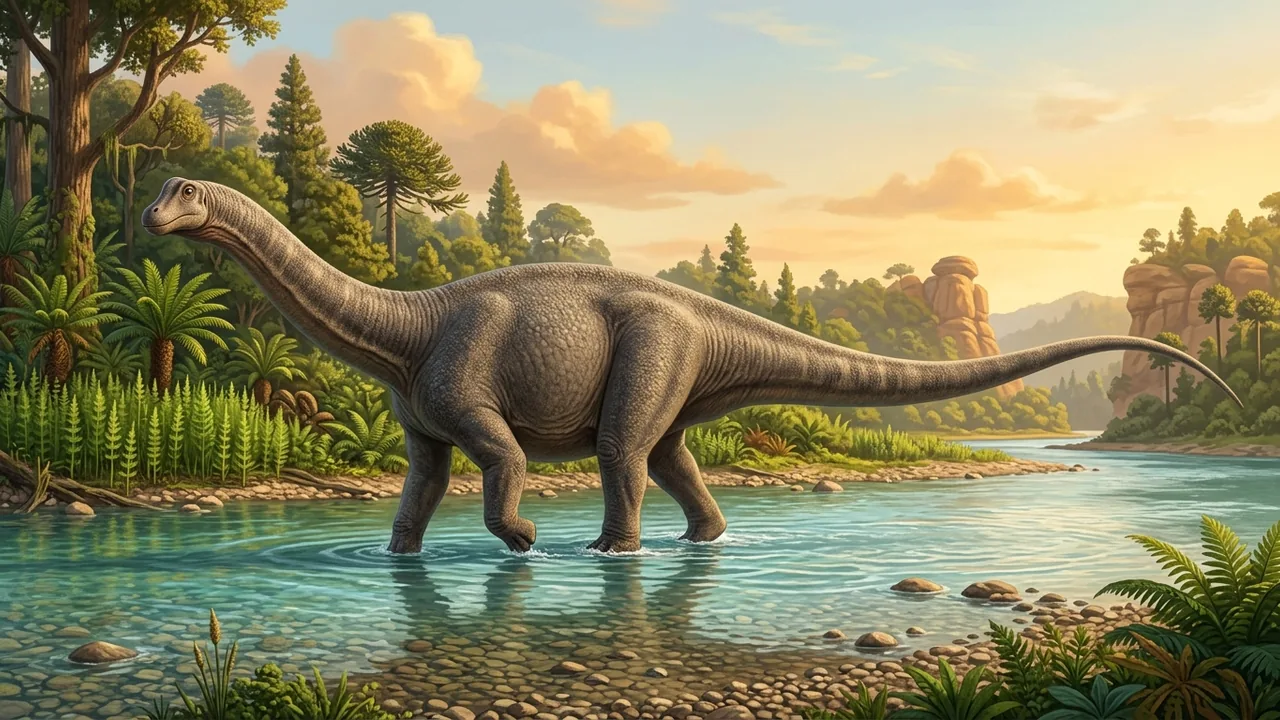
Meet the Legend: Return of a Superstar
Few dinosaurs have a cooler comeback story than Brontosaurus (BRON-toh-SOR-us), the famous thunder lizard! Stretching more than seventy feet long—as long as two yellow school buses—and weighing as much as three African elephants, this Late Jurassic amazed everyone when Othniel Charles Marsh named it in 1879.
In 1903, scientists decided it belonged inside its bulkier cousin's , Apatosaurus. Then in 2015, a giant bone-measuring study proved Brontosaurus really was different all along, bringing everyone's favorite thunder lizard roaring back into science books!
Lost World Habitat: Marshy River Valleys
Around 152 million years ago, Brontosaurus roamed across a warm, green in what is now Wyoming, Utah, and Colorado. Every rainy season, wide rivers spilled over their muddy banks, filling shallow lakes and marshy ponds lined with horsetails, tree ferns, and tall pine-like conifers.
Unlike older cartoon drawings that showed Brontosaurus swimming deep underwater all day, this heavy walked on firm ground and waded comfortably across shallow river crossings. Bright dragonflies, armored crocodiles, and spiked Stegosaurus shared those sunny riverside trails.
What's on the Prehistoric Menu?
Keeping sixteen tons of thunder lizard energized took hundreds of pounds of fresh plants every single day! Brontosaurus strolled along the lush edge, sweeping its long neck across beds of crunchy horsetails, soft ferns, and low riverside conifer branches.
At the front of its slender jaws grew rows of blunt, peg-shaped teeth that raked leaves clean off tough stems. Because this busy had zero flat back molars for chewing, it gulped mouthfuls whole and let billions of helpful belly microbes turn tough fibers into fuel.
Superpowers, Senses & Anatomy
Even though Brontosaurus looked trimmer in the neck than super-bulky Apatosaurus, its neck was still packed with power! Bony bumps along the bottom of its neck bones anchored thick muscles, while lightweight air pockets inside the spine kept this tall balanced cleanly over four tree-trunk legs.
Look closely at its front feet and you will spot another neat tool: four toes were tucked inside a cushioned pad like an elephant's foot, while the inner thumb carried a large curved ! That sturdy claw gripped slick mud along wet riverbanks.
Flight vs. Fight Arena: Guarding the Shore
Along wooded riverbanks lurked Torvosaurus—a thirty-three-foot meat eater with four-inch serrated teeth! An adult Brontosaurus could never sprint away across soft mud, so it stood its ground bravely on Team Fight.
Towering four times heavier than Torvosaurus, Brontosaurus lashed its long, whip-thin tail sideways at blinding speed to keep hunters back. If a predator crept near its front legs, this giant could rear slightly and strike downward with its sharp inner thumb while herd mates closed ranks around smaller calves.
Fossil Detective Secrets: 477 Bone Clues!
How did Brontosaurus win back its famous name after 112 years on the sidelines? Starting around 2010, paleontologist Emanuel Tschopp visited museums across America and Europe with calipers and notebooks to inspect eighty-one giant skeletons.
After comparing 477 tiny bone clues—including shoulder blades, ankles, and neck bone shapes—his team published a landmark 2015 report. Those careful measurements proved Brontosaurus had a higher, narrower neck than Apatosaurus, restoring its rightful name and showing kids everywhere that good science always stays curious!