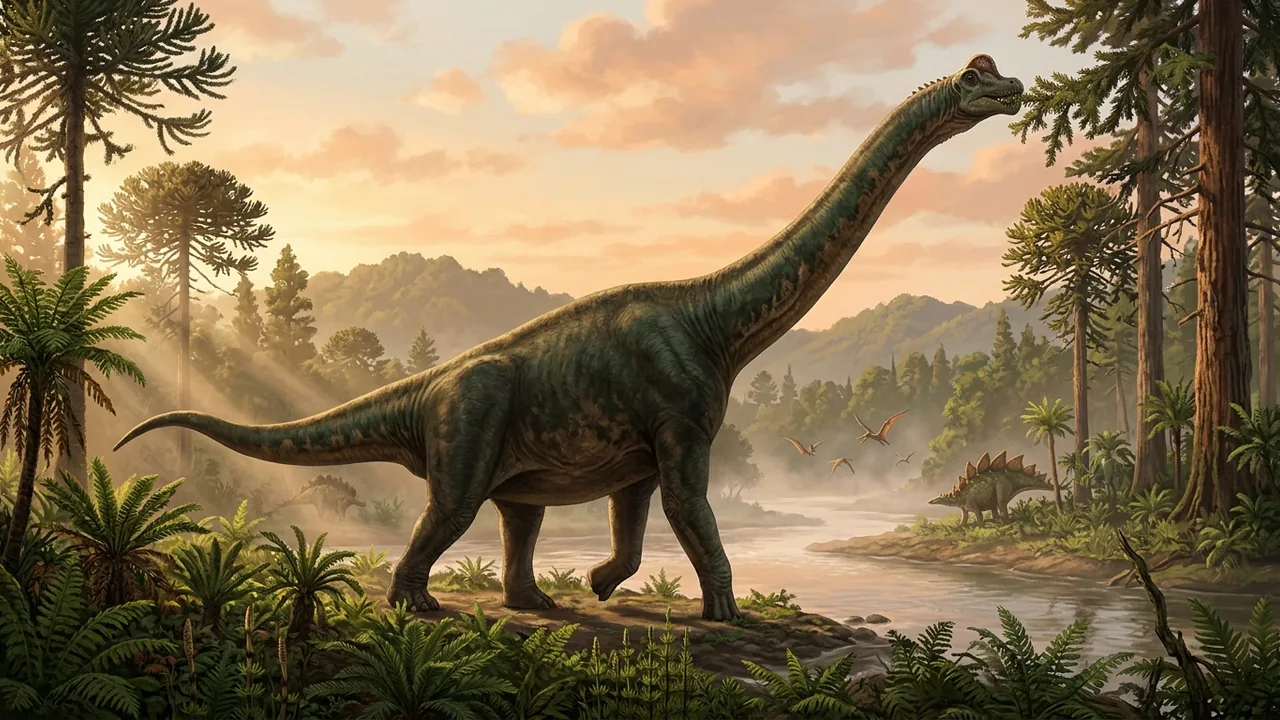
Meet the Legend: Sovereign of the Upper Canopy
Among the megafauna of the Late Jurassic Period, Brachiosaurus altithorax represents an extraordinary evolutionary experiment in vertical reach. While contemporaneous diplodocids constructed horizontal suspension-bridge bodies with elongated tails counterbalancing low-sweeping necks, Brachiosaurus engineered an ascending frame. Its humerus exceeded its femur in length, elevating the pectoral girdle above the pelvis and tilting the dorsal column upward at a natural giraffe-like angle.
Measuring roughly twenty-five meters in length, standing more than twelve meters tall at the brow, and weighing between forty-one and fifty-one metric tons, this macronarian sauropod combined towering stature with limb architecture. Straight, columnar leg bones aligned directly beneath its center of mass so passive bone compression, rather than exhausting muscle tension, bore most of its immense weight while standing.
Modern places Brachiosaurus within Brachiosauridae, a lineage of high-browsing titans that persisted from the Late Jurassic into the Early Cretaceous. Even its species epithet, altithorax—Latin for 'deep chest'—honors the cavernous ribcage discovered by Elmer Riggs in 1900 along the Colorado River, housing colossal heart and lung systems engineered to sustain life four stories above the ground.
Unlike sprawling reptiles whose bent elbows waste energy simply holding the belly clear of the soil, Brachiosaurus locked its tubular forelimbs and broad pelvic blades into an upright quadrupedal chassis. Digital volumetric models built from laser-scanned bones show its center of mass rested further forward than in almost any other sauropod, turning its forequarters into living stone columns supporting a nine-meter crane with effortless balance.
Lost World Habitat: Morrison Formation Landscapes
Reconstructing the world of Brachiosaurus begins with the of western North America's Morrison Formation, a vast sequence of mudstones, sandstones, and limestones spanning more than one million square kilometers from New Mexico to Montana. High-precision radiometric dating of volcanic ash beds (bentonites) within the Salt Wash and Brushy Basin members places Brachiosaurus between 154 and 150 million years ago during the Kimmeridgian stage.
Sedimentological clues—including carbonate soil nodules, seasonal mudcracks, and braided river channels—reveal a warm, semi-arid savanna punctuated by monsoon floods and ribbon-like gallery forests along permanent waterways. Rather than endless tropical swamps, Brachiosaurus navigated sunlit corridors of Araucariaceae conifers, ginkgoes, cycadophytes, podocarps, and tree ferns.
Because its forelimbs and elevated shoulder girdle granted exclusive access to crowns twelve meters overhead, Brachiosaurus partitioned resources cleanly above mid-browsing Camarasaurus and ground-stripping Diplodocus. Fossil pollen and silicified tree trunks confirm these alluvial corridors offered year-round evergreen canopy productivity even when open fern plains dried into dusty mudflats during seasonal droughts, allowing multiple sauropod lineages to coexist across the basin.
Paleoclimate models indicate atmospheric carbon dioxide stood higher than today, driving vigorous gymnosperm growth along high-water-table floodplains fed by ancestral Rocky Mountain uplands to the west. As herds migrated along those green river highways, they shared drinking channels with plated Stegosaurus, semi-aquatic crocodylomorphs like Goniopholis, and freshwater unionid mussels buried in sandy point bars throughout the ancient western interior. Every layer of floodplain silt preserved a detailed ecological snapshot of life beneath those towering Jurassic evergreens.
What's on the Prehistoric Menu?
Fueling a fifty-metric-ton herbivore required harvesting several hundred kilograms of tough gymnosperm foliage every twenty-four hours—yet Brachiosaurus possessed a skull tiny in proportion to its trunk. Mammalian-style chewing would have demanded heavy molar batteries and massive jaw muscles at the tip of a nine-meter neck, creating impossible rotational torque. Evolution solved that engineering paradox by relocating mechanical and chemical processing into the torso.
Brachiosaurus lined the anterior half of its robust jaws with fifty-two broad, chisel-crowned teeth that met with oblique shearing facets to sever fibrous araucaria and ginkgo shoots cleanly. Swallowed boluses traveled unchewed into a cavernous hindgut vat where symbiotic anaerobic microbes conducted multi-day of stubborn plant cellulose into volatile fatty acids.
Meanwhile, cervical kept the long foraging crane light enough to sweep wide vertical and lateral feeding envelopes from a single standing position. By harvesting thousands of calories across a three-dimensional treetop volume before taking a single step, Brachiosaurus minimized the metabolic cost of moving fifty tons between scattered woodland groves while leaving lower shrubs untouched for smaller ornithischians and juvenile sauropods.
Laboratory respirometry experiments conducted on living descendants of Jurassic flora—including modern Araucaria, Ginkgo biloba, and Equisetum horsetails—demonstrate surprisingly rich digestible energy when incubated over seventy-two hours by gut microbes, debunking older claims that Mesozoic evergreens were too nutrient-poor to sustain warm-bodied giants without flowering angiosperm plants or grass prairies, which had not yet evolved. Continuous tooth replacement ensured worn crowns dropped out smoothly as fresh enameled chisels erupted from deep alveolar sockets.
Superpowers, Senses & Anatomy
High-resolution computed tomography (CT) scans have transformed our understanding of sauropod physiology, revealing how postcranial skeletal made terrestrial gigantism possible. Membranous air-sac diverticula extending from avian-style lungs invaded each meter-long cervical and anterior dorsal vertebra, excavating internal chambers called camerae and camellae until more than sixty percent of the bone volume consisted of air. Laminated bony struts resisted bending and torsion like an aircraft wing spar while slashing neck weight by tons.
That same unidirectional respiratory system solved a hidden thermal crisis: large bodies retain immense metabolic and digestive heat, so circulating cool air through cervical air sacs acted as a biological radiator! Equally impressive were its limbs, where five vertical metacarpals formed a horseshoelike tubular colonnade cushioned by a compliant plantar pad that distributed crushing ground-reaction forces.
Supplying oxygenated blood across an eight-meter vertical column between heart and brain required extraordinary cardiovascular adaptations. Paleophysiologists estimate a four-chambered heart weighing nearly two hundred kilograms generated systolic pressures approaching 380 millimeters of mercury, assisted by muscular arterial walls, dense collagenous leg skin, and closely spaced venous valves that prevented dangerous pooling when the head dipped or rose.
Cranial CT reconstructions by Lawrence Witmer also clarified its dramatic arched skull roof: while the bony nasal openings sat high between the orbits, vascular grooves on the premaxilla indicate fleshy nostrils extended forward along a muscular snout, moistening and cooling every deep breath drawn above dusty Jurassic floodplains during warm afternoon foraging sessions.
Flight vs. Fight Arena: Ontogeny of a Living Fortress
Across its lifespan, Brachiosaurus underwent one of the sharpest survival shifts in vertebrate history. Because sauropods laid clutches of relatively small, porous-shelled eggs buried in floodplain nests, hatchlings emerged weighing mere kilograms—thousands of times lighter than their parents. Juvenile Brachiosaurus survived through cryptic forest concealment and astonishingly rapid bone growth before crossing a size threshold into Team Fight invulnerability.
Once mature, a fifty-ton Brachiosaurus dwarfed contemporary Morrison apex theropods such as Allosaurus fragilis and Torvosaurus tanneri by more than twentyfold in body mass. Although limb loading prohibited any suspended galloping gait—restricting top locomotion to brisk ambling near fifteen kilometers per hour—flight was unnecessary because skeletal and towering forelimbs placed vital cervical arteries twelve meters overhead.
In a direct confrontation, Allosaurus relied on hatchet-like skull strikes and curved manual claws suited for three-ton Stegosaurus or subadult sauropods, not a fifty-ton giant. Tough polygonal scales armored the sauropod's flanks, while its elevated pectoral girdle and stout medial thumb ungual enabled crushing downward forelimb strikes, forcing rational Jurassic predators to abandon healthy adult titans in favor of vulnerable juveniles or sick stragglers.
Bone histology thin-sections reveal fibrolamellar woven bone packed with dense vascular canals, proving young Brachiosaurus sustained elevated endothermic-like growth rates during its perilous early years so as to outgrow the Morrison predator guild as rapidly as physiology allowed, eventually joining multi-generational herds that moved across open valleys like untouchable living mountains. Few evolutionary strategies illustrate the defensive triumph of sheer body mass more dramatically.
Fossil Detective Secrets: Cladistics & Rescued Identity
For more than a century after Elmer Riggs excavated holotype specimen FMNH P 25107 from Jurassic river sandstones near Fruita, Colorado, in July 1900, popular perception of Brachiosaurus rested on two mistaken assumptions. First, early reconstructions plunged the animal neck-deep into lakes because its bony external nares opened atop a tall nasofrontal arch; biomechanical calculations by Kenneth Kermack and Lawrence Witmer later proved hydrostatic pressure would collapse submerged lungs and demonstrated that fleshy nostrils actually sat forward over the snout.
Second, because Riggs's Colorado holotype lacked a skull and complete neck, museums worldwide modeled Brachiosaurus on skeletons unearthed between 1909 and 1913 in Tanzania's Tendaguru beds. In 2009, paleontologist Michael Taylor applied rigorous comparative anatomy and to show the Tendaguru taxon differed in twenty-six osteological characters—possessing a shorter dorsal trunk and lighter tail.
Taylor's research revalidated Giraffatitan brancai for the East African material while revealing North America's Brachiosaurus altithorax as an even longer-bodied, deeper-chested colossus whose remains uniquely tied to the Morrison Formation. Additional referred skulls and limb elements from Utah and Wyoming continue refining how this iconic high-browser engineered life at the absolute upper limit of Jurassic forests.
Today, Riggs's original quarry hills outside Grand Junction stand protected as a paleontological landmark, reminding researchers everywhere that careful re-measurement of century-old museum fossils can overturn long-standing textbook myths, clarify continental biogeography, and uncover entirely distinct evolutionary giants hidden in plain sight. Digital photogrammetry now lets paleontologists compare multi-ton vertebrae across oceans without lifting a single fragile fossil.