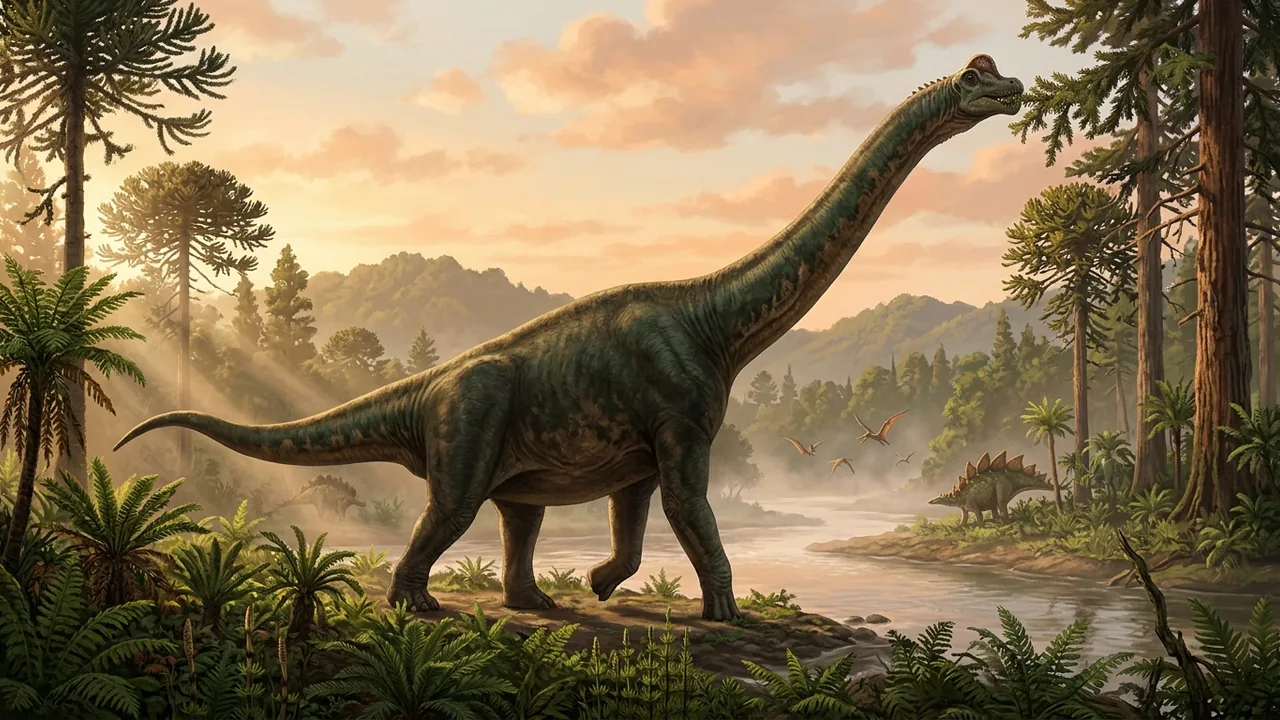
Meet the Legend: Four-Story Giraffe
Imagine looking out a fourth-floor classroom window and meeting a dinosaur eye to eye! That giant neighbor is Brachiosaurus (BRAK-ee-oh-SOR-us), whose name means arm lizard. Most long-necked dinosaurs had longer back legs, but this amazing built its body differently.
Its pillar-like front legs stood taller than its hind legs, sloping its back upward like a modern giraffe. Stretching over eighty feet from nose to tail—longer than two yellow school buses parked end to end—this fifty-ton was a gentle skyscraper on four feet!
Lost World Habitat: River Woodlands
About 152 million years ago during the Late Jurassic Period, western North America looked very different. Dry seasons alternated with rainy floods across broad plains crisscrossed by winding rivers. Tall trees, leafy ginkgoes, and giant tree ferns grew thick along the muddy banks.
Brachiosaurus shared these sunny woodlands with spiked Stegosaurus, whip-tailed Diplodocus, and speedy little plant eaters. Because each species ate at a different height, many kinds of giants could live side by side without running out of greens.
What's on the Prehistoric Menu?
Powering a fifty-ton body took serious snacking! Every single day, an adult Brachiosaurus gobbled roughly eight hundred pounds of fresh needles, cycad fronds, and ginkgo leaves—enough greens to fill the bed of a pickup truck.
Instead of flat grinding molars, this tall grew fifty-two spoon-shaped teeth near the front of its jaws. It clamped onto high branches, raked off mouthfuls of needles, and swallowed them whole without chewing. Helpful microbes inside its giant stomach broke down the tough wood and needles into energy.
Superpowers, Senses & Anatomy
Lifting a thirty-foot neck looks exhausting, yet Brachiosaurus did it with ease. Inside each huge neck bone sat honeycombed chambers filled with air sacs linked to its lungs. Those spaces trimmed tons of extra weight while keeping every bone sturdy as a steel bridge!
On top of its skull arched a tall bony crest framing large nasal openings. Meanwhile, thick, column-shaped legs with cushioned heel pads absorbed the thud of every step as this colossal strolled between forest groves.
Flight vs. Fight Arena: Untouchable Titan
When sharp-toothed Allosaurus prowled the fern plains, Brachiosaurus could never sprint away. Top speed for this heavy was a calm ten-mile-per-hour power walk across the valley. Instead, Brachiosaurus belonged squarely on Team Fight through sheer colossal size!
Young calves stayed tucked safely behind older giants while traveling between tall groves. Once an adult reached fifty tons, its vital neck towered far out of predator reach, and one heavy stomp from its tree-trunk front legs kept even bold hunters at a respectful distance.
Fossil Detective Secrets: Snorkel Myth Busted
Paleontologist Elmer Riggs uncovered the first Brachiosaurus skeleton in western Colorado in 1900. Because its skull had high nostril openings and bones seemed puzzling, early textbook paintings showed this standing at the bottom of deep lakes using its head like a submarine snorkel!
Later scientists tested that idea using math and physics. Thirty feet underwater, heavy water pressure would crush the dinosaur's chest so its lungs could not expand at all! Today we know Brachiosaurus marched proudly across dry river floodplains.