Meet the Legend: Engineering a Living Crane
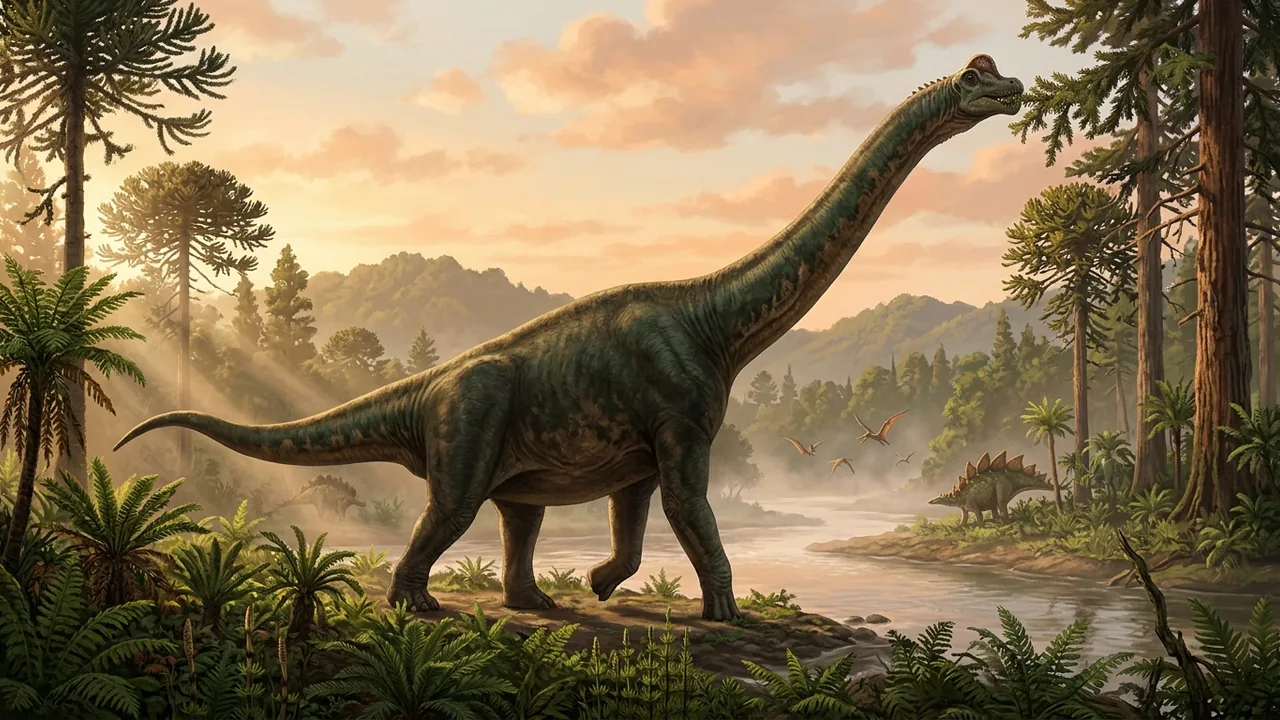
Standing beside an adult Brachiosaurus altithorax would feel like standing next to a moving four-story building. Stretching eighty to eighty-five feet long and weighing roughly fifty tons, this Late Jurassic titan broke the standard sauropod body blueprint. While cousins like Diplodocus and Apatosaurus held their backs nearly level on taller hind limbs, Brachiosaurus evolved forelimbs longer than its hind legs.
When paleontologist Elmer Riggs measured its nearly seven-foot humerus in 1903, he named the dinosaur 'arm lizard.' Studying its reveals why that upward-tilted shoulder girdle mattered so much. By angling the spine skyward right from the hips, Brachiosaurus elevated its skull more than forty feet above the floodplain without straining neck muscles to fight gravity every second of the day.
Equally important were its neck bones, which housed lightweight air pockets inside sturdy outer walls. Combined with straight, column-like legs stepping cleanly beneath its deep ribcage, Brachiosaurus marched across western North America as a masterpiece of living architecture.
Fossilized trackways show its narrow-gauge footsteps stayed close to the midline of its body, preventing wasteful side-to-side swaying as herds cruised smoothly from one towering evergreen grove to the next.
Lost World Habitat: Morrison Niche Partitioning
Roughly 152 million years ago, the Morrison ecosystem stretched from New Mexico north to Montana across a warm, seasonally dry basin. Braided rivers fed ribbons of lush gallery woodland packed with araucaria monkey-puzzle conifers, ginkgoes, cycads, and giant tree ferns. Paleontologists once wondered how a seasonal landscape could support half a dozen multi-ton sauropod species simultaneously without stripping every forest bare.
The answer lies in partitioning—nature's way of dividing resources by height and jaw design. Low-slung Stegosaurus cropped ground ferns below three feet, peg-toothed Diplodocus raked soft shoots up to twelve feet, and stocky Camarasaurus tackled mid-story shrubs. Towering above them all, Brachiosaurus claimed the thirty-to-forty-foot upper canopy niche!
At the base of this prehistoric food web, sunlit conifers captured solar energy, transferring massive energy into herds of giants. As Brachiosaurus pruned high branches, extra sunlight reached young saplings below, while tons of nutrient-rich dung fertilized floodplain soils across the entire ecosystem.
Freshwater lungfish, armored crocodiles, small leaping mammals, and gliding pterosaurs shared those shady river corridors too, thriving inside sunlit forest gaps sculpted every single day by passing sauropod herds as they migrated along winding western waterways.
What's on the Prehistoric Menu?
Sustaining a fifty-ton metabolism required enormous intake—scientists calculate an adult Brachiosaurus consumed between four hundred and eight hundred pounds of fibrous foliage daily. Because evergreen araucaria needles and leathery ginkgo leaves wore down enamel, Brachiosaurus grew sturdy teeth shaped like broad, bevel-edged spoons. Unlike Diplodocus, whose slender peg teeth only stripped soft fronds at the very tip of the snout, Brachiosaurus arrayed twenty-six upper and twenty-six lower teeth deeper along robust jaws.
Microscopic wear facets prove its upper and lower tooth rows sheared past one another to sever thumb-thick woody twigs. Rather than wasting precious foraging hours chewing, Brachiosaurus swallowed whole mouthfuls down its muscular throat. Inside its barrel-shaped torso sat a colossal hindgut fermentation chamber extending several yards long.
Billions of symbiotic bacteria and protozoa slowly digested stubborn cellulose cell walls over several days, releasing steady chemical energy. That massive microbial furnace also generated gentle internal warmth that helped stabilize the giant's core body temperature day and night.
Because an upright thirty-foot neck swept a wide three-dimensional arc across surrounding treetops, Brachiosaurus could harvest dozens of pounds of evergreen shoots before lifting a single heavy foot.
Superpowers, Senses & Anatomy
How did Brachiosaurus swing a thirty-foot neck without tipping forward or snapping bone? CT scans reveal its thirteen elongated neck vertebrae were intensely —hollowed out by air sacs branching directly from the lungs until over sixty percent of each vertebra's volume was open air! Thin internal bone struts arranged along exact stress lines kept the neck rigid yet light.
Cardiovascular posed an equally dramatic challenge. Lifting arterial blood more than twenty feet vertically from the chest to the brain demanded systolic blood pressure around 350 to 400 millimeters of mercury—roughly triple human blood pressure and nearly double a giraffe's! Dense, inelastic skin sheaths wrapped its lower legs like compression socks so blood would not pool around its feet.
High atop its skull sat a tall nasal arch that once puzzled anatomists. Modern soft-tissue reconstructions show fleshy nostrils actually opened near the front of a bulbous snout, rich with blood vessels that cooled inhaled desert air and detected distant pine scents.
Beneath its five short forefoot toes, a thick wedge of elastic cartilage cushioned each multi-ton footfall, protecting ankle joints across thousands of miles of seasonal migration.
Flight vs. Fight Arena: Size as Ultimate Shield
In the Late Jurassic survival arena, speed was never an option for adult Brachiosaurus. models show that lifting two feet simultaneously into an airborne running phase would exert bone-cracking forces on fifty-ton limbs, capping its top pace around ten miles per hour. Instead, Brachiosaurus conquered predator threats on Team Fight by growing beyond attack range!
Life began dangerously: grapefruit-sized eggs hatched ten-pound youngsters that occupied a hidden forest-floor and faced hungry Allosaurus, Ceratosaurus, and Torvosaurus. Rapid growth fueled by continuous feeding pushed surviving subadults past danger within roughly fifteen years. Against a thirty-foot, two-ton Allosaurus, a healthy fifty-ton Brachiosaurus weighed twenty-five times more!
With its vulnerable throat soaring forty feet overhead and thick polygonal scales shielding its sides, a grown titan was practically a walking cliff. If a bold theropod pressed too close, elevated seven-foot forelimbs armed with stout inner thumb claws could slam downward with tens of thousands of Newtons of force.
Calculations show a single defensive stomp carried enough kinetic energy to shatter any predator's jaws or ribs instantly, convincing smart hunters to retreat before contact ever occurred.
Fossil Detective Secrets: Two Continents, Two Titans
Fossil detectives have solved two major mysteries surrounding Brachiosaurus since Elmer Riggs excavated the original skeleton along Colorado's Grand River Valley in 1900. First, early twentieth-century artists submerged Brachiosaurus in deep lakes, imagining buoyancy supported its weight while arched skull openings worked like a periscope snorkel. In 1951, Kenneth Kermack applied fluid to prove water pressure thirty feet down exerts roughly thirteen extra pounds per square inch on the chest—far too high for rib muscles to draw a single breath!
Second, for nearly a century, museums modeled Brachiosaurus after complete skeletons excavated in Tanzania, East Africa. In 2009, paleontologist Michael Taylor compared every bone side by side and demonstrated the African cousin had a shorter trunk, narrower tail, and distinct jaw proportions.
Taylor's landmark study restored the separate genus name Giraffatitan for the African dinosaur while proving North America's true Brachiosaurus altithorax carried an even longer, deeper chest across Late Jurassic Colorado and Utah!
Every newly scanned fossil quarry bone from Utah, Wyoming, and Oklahoma continues sharpening our detailed three-dimensional portrait of North America's signature high-browsing sauropod and how its herds shaped ancient riverside woodlands.