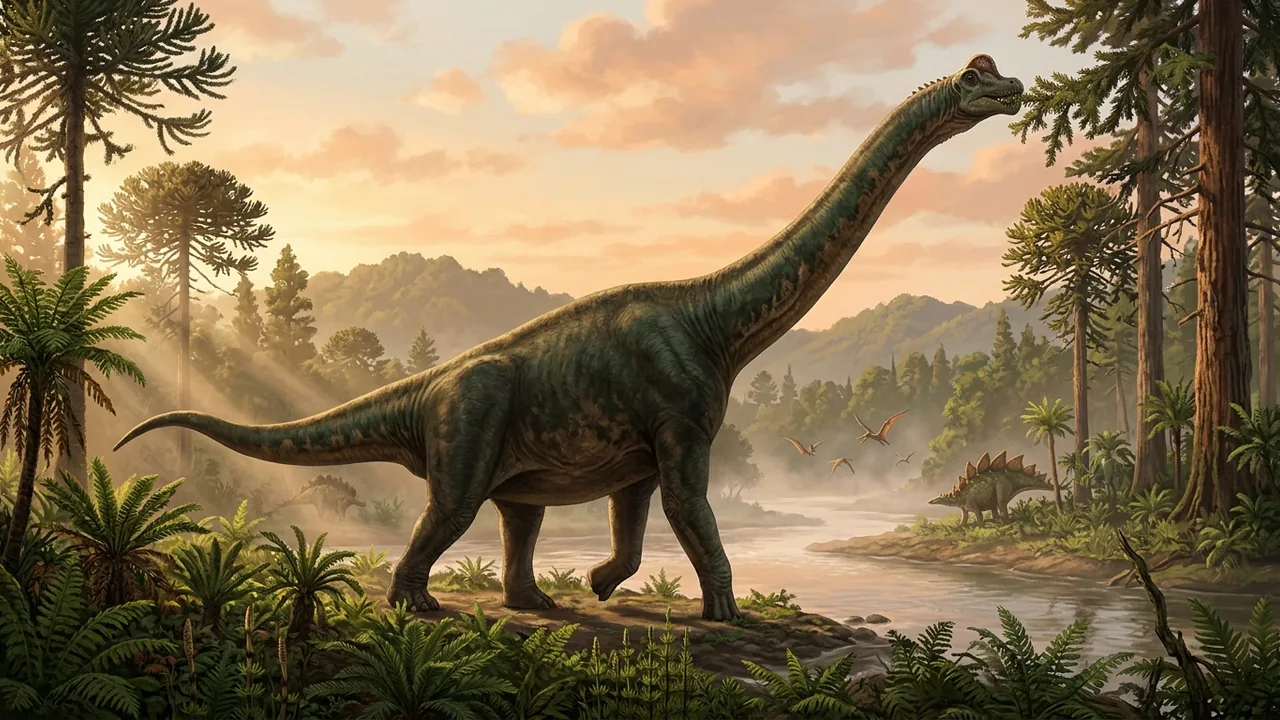
Meet the Legend: Living Skyscraper
Towering above the Late Jurassic treetops stood Brachiosaurus, a colossal plant eater whose scientific name means arm lizard. Unlike most four-legged dinosaurs whose hips stood higher than their shoulders, Brachiosaurus grew extra-long upper arm bones. That physical tilted its torso upward like a modern giraffe and lifted its skull more than forty feet into the air.
From snout to tail tip, an adult stretched roughly eighty-five feet and weighed nearly fifty tons! Every massive in its thirty-foot neck locked together into a sturdy crane. As a gentle , Brachiosaurus used its remarkable height not to chase prey, but to harvest sunlit treetop leaves far above every neighbor on the plain.
Imagine ten African elephants standing on a giant scale—that equals one full-grown Brachiosaurus! Its round footprints pressed deep bowls into muddy riverbanks wherever herds traveled across ancient western North America.
Lost World Habitat: Sharing the Floodplain
Between 154 and 150 million years ago, Brachiosaurus roamed seasonal floodplains across what are now Colorado, Utah, and Wyoming. Winding rivers nourished groves of towering araucaria conifers, ginkgo trees, cycads, and carpets of horsetails. Dozens of dinosaur species shared this warm landscape, yet they avoided starving by dividing up food into separate levels.
Ecologists call an animal's specific job and feeding zone its ecological . Armored Stegosaurus munched ferns near its ankles, whip-tailed Diplodocus swept mid-level bushes, and Brachiosaurus owned the uppermost canopy niche! Millions of years earlier on the East Coast, early dinosaurs left thousands of footprints in Virginia's Culpeper Basin sandstones before giants like Brachiosaurus ruled western river valleys.
During dry months when shallow streams shrank, tall riverside evergreens still tapped deep underground water. Because Brachiosaurus could reach those evergreen crowns, drought seasons rarely left these giants hungry.
What's on the Prehistoric Menu?
In a Jurassic food chain, green conifers and ginkgoes acted as sunlit producers, while Brachiosaurus served as a giant primary consumer. Keeping fifty tons of muscle moving required around eight hundred pounds of tough plant matter every day! If this stopped to chew each bite the way cows or horses do, its relatively small head could never gather enough calories before sunset.
Instead, Brachiosaurus evolved a clever feeding : twenty-six spoon-shaped teeth lined its upper jaw and twenty-six lined its lower jaw. Those sturdy teeth snipped thick evergreen shoots whole. Swallowed foliage dropped into an enormous digestive chamber where billions of helpful gut microbes fermented tough plant fibers over several days.
Standing in one spot beside a tall grove, Brachiosaurus could sweep its long neck sideways and up and down, harvesting dozens of branches without wasting energy moving its heavy body.
Superpowers, Senses & Anatomy
How could bones support a neck longer than a city bus without snapping? Inside each three-foot neck , air sacs branching from the lungs carved out lightweight honeycomb pockets. This brilliant skeletal cut neck weight dramatically while thick bone struts carried heavy bending forces.
Pumping oxygen-rich blood forty feet uphill from chest to brain required extraordinary circulation too. Scientists estimate Brachiosaurus had a muscular heart weighing hundreds of pounds, generating blood pressure twice as high as a giraffe's! Tightly wrapped skin and one-way vein valves in its legs prevented blood from pooling around its ankles. Meanwhile, broad front feet with cushioned pads spread its crushing weight evenly across soft riverbank mud.
High on its forehead sat a smooth bony arch framing large nasal passages. Keen senses of smell and high-angle eyesight helped Brachiosaurus spot fresh conifer groves and approaching predators from afar.
Flight vs. Fight Arena: Fortress on Four Legs
When fierce predators like Allosaurus or Torvosaurus patrolled the woods, adult Brachiosaurus never relied on speed. Sprinting on fifty-ton legs would shatter ankle bones, so fleeing was impossible. Instead, this powerful survival placed Brachiosaurus firmly on Team Fight!
Young hatchlings began life tiny and vulnerable, hiding inside dense forest cover to fill a cautious survival while growing rapidly. Once an adult reached full height, its vital throat towered far above any hunter's jump. Thick, pebbled skin protected its flanks, and its muscular seven-foot forelimbs could deliver earth-shaking defensive stomps. Herd members traveled together across open floodplains, forming a living wall around younger giants.
Even a hungry pack of Allosaurus knew better than to challenge a healthy fifty-ton adult. Most predators waited along forest edges for weak stragglers rather than risking a crushing forelimb blow.
Fossil Detective Secrets: Reading Stone Clues
In July 1900, paleontologist Elmer Riggs and his Field Museum team spotted immense bones weathering out of rock cliffs near Fruita, Colorado. Excavating a single six-foot rib and giant humerus took weeks of careful chiseling and plaster wrapping before mules hauled the crates to a train.
For decades, museum murals painted this wading neck-deep in lakes because its skull featured high nasal openings. In the 1970s, paleontologist Kenneth Kermack proved that water pressure against a submerged chest would block breathing completely! Careful study of narrow, weight-bearing feet and dry floodplain rocks confirmed Brachiosaurus strode across firm land—showing how science improves whenever researchers test old ideas.
Today, fossil trackways pressed into ancient western riverbeds confirm herds walked side by side across sun-baked floodplains, leaving stone trail maps for modern students and scientists to measure.