Meet the Legend: Type Genus of Baryonychinae
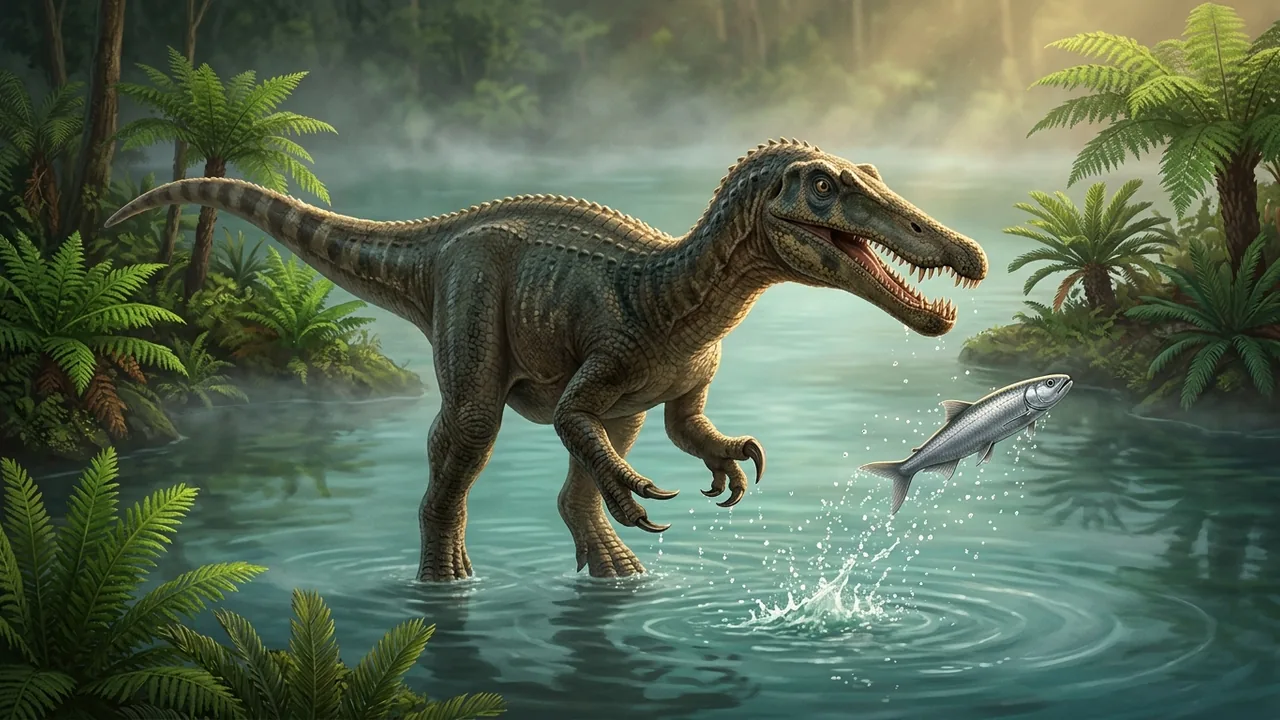
Among Mesozoic theropods, few discoveries reshaped evolutionary trees more dramatically than Baryonyx walkeri. Reaching 8.5 to 10 meters (28 to 33 feet) in length and weighing 1,200 to 1,900 kilograms, this Early Cretaceous tetanuran stands as the foundational type genus of —one of the two major clades within Spinosauridae.
Unlike derived Cenomanian spinosaurines such as North African Spinosaurus—which evolved towering neural-spine sails, smooth non-serrated conical teeth, and reduced hind limbs—baryonychines retained strong terrestrial walking proportions alongside sophisticated semi-aquatic hunting weaponry.
Its elongated, laterally compressed rostrum fused the paired premaxillae and maxillae around a spoon-shaped terminal rosette, complemented dorsally by a modest median nasal crest just anterior to the orbits.
Most diagnostic of all were its extraordinarily robust pectoral girdles and forelimbs: massive deltopectoral crests on the humerus anchored powerful flexor musculature driving a recurved manual digit-I ungual measuring thirty-one centimeters along its bony curve.
Faced inward rather than pronated downward, those muscular three-fingered hands combined grappling stability with lethal hooking leverage.
Histological sampling across spinosaurid limb shafts further demonstrates elevated cortical bone compactness——providing natural ballast while wading through swift deltaic currents.
Bridging ancestral megalosauroid land predators and hyper-specialized Late Cretaceous river giants, Baryonyx illustrates step by step how terrestrial theropods invaded freshwater ecosystems. From its fluted conical crowns and subtle extra-oral lip tissue to its horizontal balancing tail, every anatomical system harmonized terrestrial mobility with amphibious precision across Early Cretaceous European river basins and brackish coastal lagoons. Few dinosaurs demonstrate transitional functional evolution more vividly.
Lost World Habitat: Wealden & Iberian Stratigraphy
Reconstructing the paleoenvironment of Baryonyx centers on the Lower Cretaceous of northwestern Europe—specifically the Upper Weald Clay Formation of southern England's Weald Basin and contemporaneous Barremian–Aptian units across Burgos and La Rioja in northern Spain.
Biostratigraphic correlation using freshwater ostracods, palynomorph spores, and paleomagnetic reversals dates the Smokejacks Pit horizon to the early Barremian stage, approximately 128 to 125 million years ago.
During this greenhouse interval, rifting of the North Atlantic and Bay of Biscay surrounded European massifs with broad alluvial plains, anastomosing river deltas, and shallow, variable-salinity lagoons.
Across the young proto-Atlantic seaway along eastern North America, analogous Early Cretaceous fluvial-deltaic clays accumulated simultaneously within Virginia's Potomac Group—recording warm, humid coastal river corridors on both sides of the widening ocean basin.
Within the Wealden mudstones, siderite ironstone concretions preserve horsetail reedswamps (Equisetites), tree ferns, bennettitaleans, conifers, unionid freshwater mussels, hybodontid sharks, turtles, goniopholidid crocodylomorphs, and abundant ginglymodian fishes such as Scheenstia mantelli.
Periodic monsoonal runoff flushed nutrient plumes into calm backwater lagoons while episodic droughts concentrated fish biomass inside deep deltaic channels.
This dynamic interplay of muddy channels and vegetated levees created an ideal semi-aquatic corridor for baryonychine spinosaurids across western Europe. Fine-grained claystone bedding planes preserve ripple marks, rootlet horizons, and tridactyl footprints showing where giant piscivores patrolled misty lagoon shorelines year after year, tracking migrating schools of ganoid-scaled fish between freshwater rivers and coastal estuaries whenever warm seasonal tides shifted across southern Britain and Iberia during Early Cretaceous monsoons.
What's on the Prehistoric Menu?
Before 1986, hypotheses proposing fish-eating dinosaurs relied entirely on indirect anatomical comparisons. Baryonyx walkeri shattered that uncertainty by preserving an indisputable in-situ —specifically a cololite mass of fossilized stomach contents—sealed inside its articulated ribcage.
Microscopic and chemical inspection of that abdominal concretion revealed dozens of shiny, diamond-shaped ganoid scales and button-like pharyngeal crushing teeth belonging to meter-long Scheenstia mantelli, etched unmistakably by gastric hydrochloric acid!
Yet mixed directly among those fish remains lay acid-corroded, histologically identifiable limb-bone splinters of a juvenile Iguanodon alongside rounded quartz gastroliths—demonstrating opportunistic trophic generalism rather than exclusive piscivory.
Craniodental mechanics explains how one predator harvested both slippery aquatic prey and small terrestrial vertebrates. Ninety-six sub-conical teeth—bearing fine denticles (~7 per millimeter) and longitudinal enamel flutes—packed its elongated jaws, with sixty-four tightly spaced crowns lining the dentaries.
Digital conducted by Emily Rayfield's team proved the fused tubular palate and interlocked symphysis of Baryonyx matched the torsional stress resistance of modern fish-eating Indian gharials (Gavialis gangeticus).
Rapid, low-drag jaws impaled fast-moving Scheenstia underwater, while muscular forelimbs and thirty-one-centimeter thumb hooks pinned heavy fish or tore manageable meat strips from shoreline ornithopod carcasses.
Such dietary versatility insulated Baryonyx against seasonal fluctuations in river water levels and fish migrations. Strong gastric acids—comparable in strength to modern crocodilian digestion—dissolved tough enamel fish scales and small bones rapidly inside its muscular gizzard, extracting rich calcium and protein from every lagoon catch along the Wealden delta while fueling multi-ton growth.
Superpowers, Senses & Anatomy
High-resolution X-ray micro-CT scanning of the Baryonyx snout and braincase has illuminated a suite of sensory and skeletal adaptations tailored for turbid deltaic waters. Inside the premaxillae and anterior dentaries, branching neurovascular canals connect the ophthalmic and maxillary divisions of the trigeminal nerve to dozens of external foramina dotting the snout tip.
Just like dome pressure receptors lining crocodilian jaws today, this mechanosensory array registered subtle hydrodynamic pressure waves generated by unseen fish darting through silt-clouded lagoons.
Posteriorly retracted external nares allowed uninterrupted aerial respiration while the sensitive terminal rosette remained submerged, and an extensive secondary bony palate isolated the nasal airway from mechanical forces during underwater bites.
Reconstruction of the inner-ear floccular recess and semicircular canals further indicates rapid vestibulo-ocular gaze stabilization and a slightly downturned alert head posture optimized for scanning water surfaces.
Postcranially, sigmoidal cervical vertebrae acted as a coiled striking spring, while robust scapulocoracoids, broad humeral deltopectoral crests, and stout olecranon processes on the ulnae delivered extraordinary downward torque through the first manual digit.
Combined with limb-bone that countered upward water buoyancy, Baryonyx operated as a stable, bottom-walking ambush platform.
Every sensory nerve, respiratory passage, and forelimb lever functioned in concert to conquer low-visibility aquatic hunting grounds. Even when monsoon silt turned Wealden lagoons opaque brown, hydrodynamic snout receptors guided pinpoint strikes before startled Scheenstia could dart away into submerged horsetail thickets or tangled driftwood roots lining deep delta channels and shaded backwater sloughs across the flooded coastal plain.
Flight vs. Fight Arena!
Ecological coexistence across the Wealden floodplain depended on sharp biomechanical boundaries—evident whenever nine-meter Baryonyx encountered herds of ten-meter, four-ton Iguanodon bernissartensis or shared river basins with carcharodontosaurian Neovenator salerii.
Evolutionary engineering always imposes trade-offs, and makes the trade-off inside the Baryonyx skull crystal clear. Elongating the rostrum into a narrow, tubular cylinder maximized jaw-tip closing velocity and minimized hydrodynamic drag underwater, but sacrificed dorsoventral bending strength compared to deep-skulled terrestrial ziphodont hunters.
Against an isolated hundred-kilogram juvenile Iguanodon drinking carelessly beside horsetail reeds, Baryonyx held overwhelming superiority—launching a heron-fast neck strike and hooking the youngster off balance with its massive manual unguals.
Confronting a defensive phalanx of mature, four-ton Iguanodon armed with ossified conical pollex thumb spikes, however, inverted the risk-reward calculus completely!
Clamping slender, gharial-like jaws onto a thrashing multi-ton ornithopod risked catastrophic rostral fracture or a puncturing counter-strike to the neck.
Consequently, Baryonyx practiced behavioral niche partitioning: yielding dry-land megaherbivore hunts to broad-skulled allosauroids like Neovenator while retreating smoothly into chest-deep lagoon channels whenever adult Iguanodon herds closed ranks.
Through this elegant balance of riverside opportunism and structural caution, baryonychines dominated Early Cretaceous wetlands for millions of years. Depleted oxygen isotope values across European spinosaurid teeth confirm they spent far more of every day immersed in river shallows than contemporaneous land predators, partitioning food webs cleanly across land and water without costly territorial collisions along busy drinking banks or drought-shrunk delta pools where multi-ton ornithopods gathered.
Fossil Detective Secrets
Modern spinosaur paleobiology owes an extraordinary debt to observant citizen science. On January 7, 1983, plumber and amateur fossil collector William J. Walker prospected Barremian clays at Smokejacks Brickworks in Surrey, splitting open a siderite ironstone nodule to reveal the keratin-grooved core of a giant theropod claw.
Alerted immediately by Walker, Natural History Museum paleontologists Alan J. Charig and Angela C. Milner directed a meticulous May–June 1983 excavation that mapped and jacketed two tons of concretionary blocks across the muddy quarry floor.
Years of delicate mechanical and weak-acid preparation yielded holotype NHMUK VP R9951—approximately sixty-five percent of an associated skeleton—formally described in Nature in 1986 and monographed exhaustively in 1997.
Until Walker's find, enigmatic jaws like African Spinosaurus (destroyed in Munich during 1944) had routinely been reconstructed atop generic Allosaurus-style bodies.
Baryonyx overturned those assumptions simultaneously through , cladistics, and direct evidence: revealing crocodile-like snouts, ninety-six fluted teeth, massive thumb hooks, osteosclerotic wading bones, and acid-etched fish scales inside a single individual!
Subsequent discoveries—from Suchomimus tenerensis in Niger (1998) to Iberian Baryonyx material and Wessex Formation cousins Ceratosuchops and Riparovenator (2021)—built directly upon the anatomical foundation laid in Surrey clay.
One rainy afternoon's curiosity forever expanded our vision of Mesozoic dinosaur diversity. Mounted prominently in London today, Walker's heavy-clawed fisherman stands as timeless proof that careful observation in muddy quarries, paired with modern laboratory CT imaging and finite-element modeling, can rewrite evolutionary history for generations of young scientists exploring Earth's ancient past.