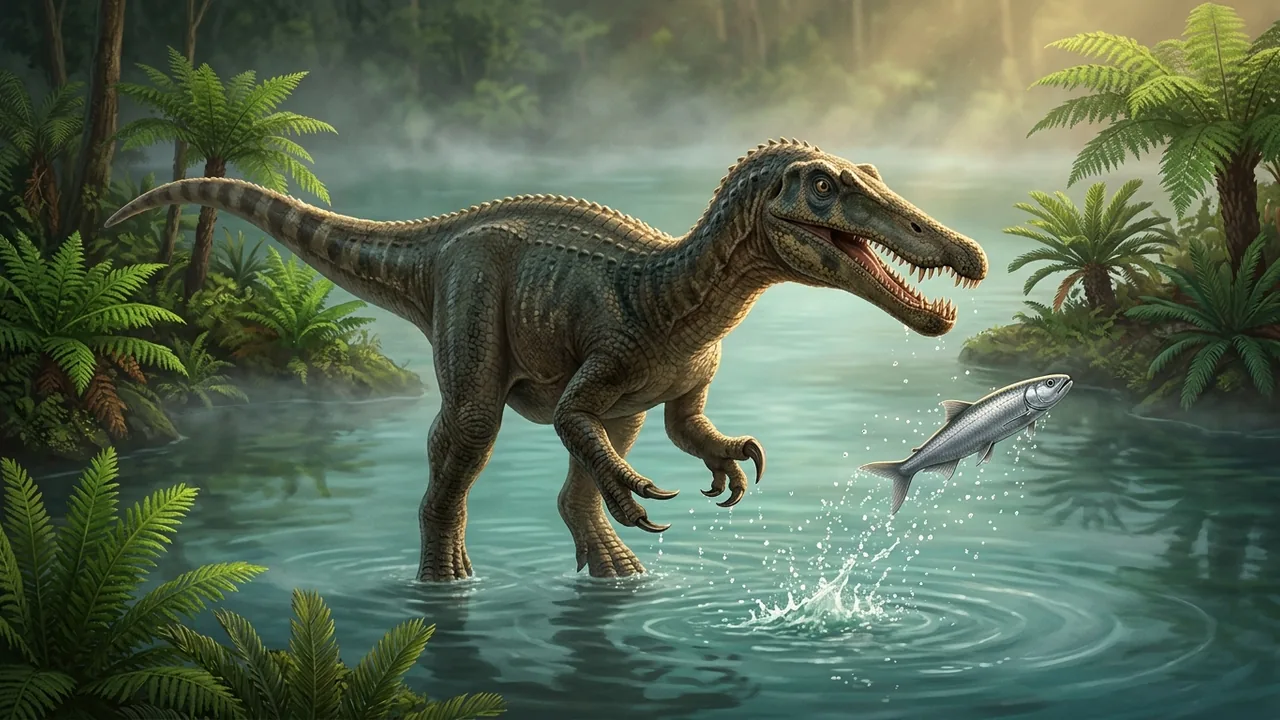
Meet the Legend: Blueprint of the Spinosaurids
Before the 1980s, paleontologists knew almost nothing about spinosaurid body proportions because earlier specimens from North Africa had been fragmentary or lost. Everything changed when Baryonyx walkeri emerged from Early Cretaceous English clay—revealing a thirty-foot, 1.7-ton predator engineered unlike any terrestrial theropod previously mounted!
Stretching nearly three feet long, its narrow, crocodile-like flared at the front into a spoon-shaped terminal rosette packed with tall, conical teeth, while a low, triangular nasal crest accented its midline ahead of the eyes.
Behind an S-curved, muscular neck sat remarkably stocky shoulders and forelimbs. Whereas many large theropods shrank their arms over evolutionary time, Baryonyx fortified its humerus and forearm bones to wield a massive, thirty-one-centimeter curved bone on each inward-facing thumb!
Sheathed in tough horn during life, that hook stretched even longer, pairing precision jaw snaps with formidable grappling power.
Together, dense limb bones, ninety-six grippy teeth, subtle lip scales, a horizontal balancing tail, and semi-aquatic sensory wiring established Baryonyx as the classic European pioneer of dinosaurian —demonstrating how natural selection remodeled bipedal land hunters into specialized masters of muddy lagoons and river channels.
Lost World Habitat: The Early Cretaceous Wealden
During the Barremian stage of the Early Cretaceous, roughly 130 to 125 million years ago, high global temperatures and rising seas transformed western Europe into an archipelago bordered by expansive freshwater mudflats and brackish lagoons.
Across southern England's Wealden Basin and Spain's Iberian rift valleys, meandering rivers carried mineral-rich silt down from weathered uplands, nourishing dense marshlands of horsetails, ferns, cycadophytes, and towering araucarian conifers.
This productive wetland mosaic fueled a multi-layered aquatic and shoreline food web. Freshwater bivalves, snails, and crustaceans fed hybodont sharks, amiiform bowfins, and meter-long Scheenstia—deep-bodied ray-finned fish armored in thick, diamond-shaped ganoid enamel scales.
Turtles, small crocodylomorphs, pterosaurs, armoured Polacanthus, and herds of thumb-spiked Iguanodon crowded surrounding floodplains alongside land-stalking allosauroid Neovenator.
By specializing in turbid delta channels, oxbow sloughs, and lagoon margins through , Baryonyx harvested abundant aquatic protein without clashing daily over dry-ground territories. Seasonal rains periodically flooded wide mudflats into shallow spawning nurseries, drawing schools of armored fish right into knee-deep ambush zones patrolled by wading spinosaurids.
Soft gray clay layers preserved every ripple mark, driftwood log, and three-toed dinosaur track left along those misty riverbanks.
What's on the Prehistoric Menu?
Transitioning from terrestrial meat-slicing to active required a complete overhaul of theropod jaw . Typical land predators carried forty to sixty laterally flattened, coarsely serrated blades designed to shear muscle from struggling herbivores.
Baryonyx doubled that dental count to ninety-six slender, sub-conical crowns—thirty-two in the upper jaws and sixty-four closely spaced teeth along the lower dentaries—bearing microscopic serrations and fine vertical ridges called flutes.
When paleontologist Emily Rayfield and colleagues tested CT digital models of the Baryonyx using engineering finite-element analysis, its fused, tubular palate resisted bending and twisting forces almost identically to the fish-trapping snout of a living Indian gharial!
Slashing sideways or downward through shallow water minimized hydrodynamic drag while interlocking rosette fangs pierced slick Scheenstia armor scales.
Yet fossil gut contents prove Baryonyx was no picky specialist: alongside acid-etched fish scales lay digested limb bones of a juvenile Iguanodon, confirming this river giant eagerly ambushed or scavenged shoreline dinosaurs too! That flexible menu kept Baryonyx well fed whether delta channels ran clear during summer or swelled muddy during winter floods, turning every shallow sandbar into an abundant hunting ground.
Superpowers, Senses & Anatomy
Cloudy river deltas hid bottom-feeding fish from eyesight alone, so Baryonyx relied on tactile snout engineering. High-resolution CT scans of its premaxillae revealed a dense network of internal canals exiting through dozens of external neurovascular around the tip of the .
Wired directly into the trigeminal cranial nerve, these sensory pits detected faint water-pressure waves whenever fish darted past its submerged jaws—enabling reflex snaps in zero-visibility mud!
External nostrils sat retracted well behind the terminal rosette so Baryonyx could inhale calmly while keeping its sensory snout tip underwater, while a secondary bony palate reinforced the roof of its mouth against struggling catches.
Once jaws or forelimbs made contact, heavily muscled shoulders and wide elbow joints drove the massive first-digit downward like a fisherman's gaff.
Meanwhile, thickened, compact cortical walls in its hind-limb bones reduced unwanted buoyancy, helping Baryonyx plant steady three-toed feet on slick clay riverbeds without floating off balance. Inner-ear balance canals simultaneously held its gaze steady while watching silvery ripples dart beneath overhanging horsetail reeds, uniting keen touch, sight, and leverage into one seamless wetland predator.
Flight vs. Fight Arena!
Whenever drought shrank Wealden channels into narrow pools, thirty-foot Baryonyx inevitably stood face-to-face with herds of thirty-three-foot, four-ton Iguanodon bernissartensis crowding the muddy margin to drink.
Against a wandering, unguarded juvenile Iguanodon, Baryonyx acted as a swift Team Apex Hunter—lunging from streamside horsetails to seize light prey with its and curved thumb unguals before dragging the meal into shallow water.
Confronting a vigilant pod of multi-ton adult Iguanodon, however, shifted every biomechanical equation! Finite-element skull modeling shows that while the slender, tubular rostrum of Baryonyx excelled at rapid fish capture, clamping onto a thrashing four-ton herbivore risked severe torsional stress.
Worse still, adult Iguanodon braced on sturdy hind legs and swung lethal conical thumb spikes driven by muscular forelimbs.
Reading those odds instantly, Baryonyx chose tactical restraint—hissing a warning while wading calmly back into deeper lagoon currents where heavy terrestrial browsers refused to follow, preserving its specialized fishing machinery intact while leaving dangerous adult ornithopod hunts to broad-skulled land predators patrolling drier Wealden conifer ridges. Smart energy conservation kept river specialists thriving year-round along muddy Wealden waterways without risking unnecessary injuries against armored or spike-thumbed neighbors.
Fossil Detective Secrets
One winter afternoon in January 1983, amateur collector William J. Walker cracked open an ironstone concretion in Smokejacks Brickworks clay pit near Walliswood, Surrey, and stared in disbelief at an enormous curved bone. Recognizing its scientific importance, Walker contacted London's Natural History Museum.
Paleontologists Alan Charig and Angela Milner organized an urgent springtime dig, recovering roughly sixty-five percent of a single skeleton encased in hard siderite mudstone nodules before naming Baryonyx walkeri in 1986.
Careful acid-and-air-scribe preparation inside the museum laboratory uncovered unmistakable bromalite gut contents inside the ribcage: shiny, acid-corroded ganoid scales and crushing teeth of Scheenstia alongside etched juvenile Iguanodon bones and smooth quartz pebbles.
That discovery revolutionized spinosaur paleontology overnight! By linking elongated crocodile-like jaws with heavy-clawed arms and proven , Baryonyx gave researchers the anatomical Rosetta Stone needed to reconstruct cousins such as African Suchomimus and sail-backed Spinosaurus across Cretaceous river systems worldwide. Today, CT scans of its neurovascular and dense limb bones continue revealing new secrets about how theropods adapted to life along ancient waterlines across Europe and Gondwana while inspiring fossil hunters everywhere.