Meet the Legend: Europe's Giant River Fisherman
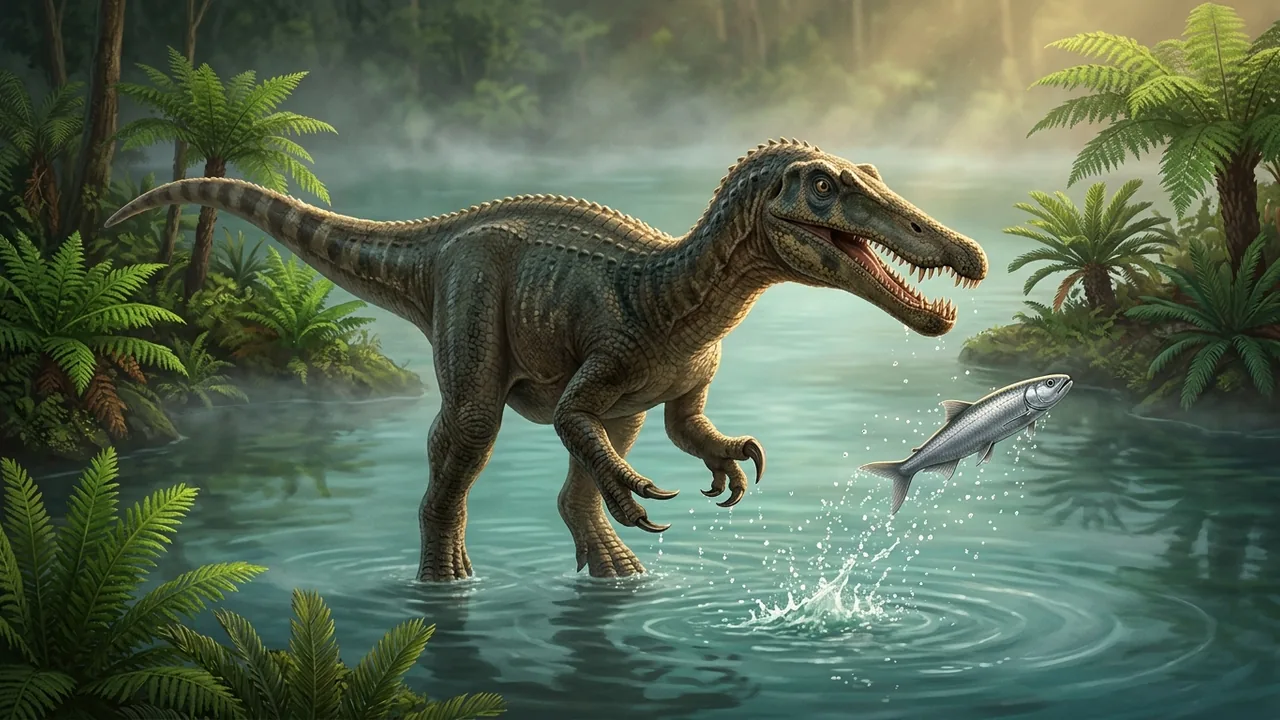
Imagine peering through morning mist across an ancient marsh and spotting a thirty-foot theropod wading quietly through the shallows like an oversized heron! Baryonyx walkeri—pronounced bair-ee-ON-iks, meaning 'heavy claw'—weighed nearly two tons yet moved with practiced grace along muddy waterways.
Instead of the deep, boxy skull seen in land-hunting carnivores, Baryonyx evolved an elongated, narrow jaw lined with ninety-six finely serrated cone-shaped teeth and topped by a low bony nasal crest.
Even more startling were its muscular forelimbs: each inward-facing three-fingered hand carried a massive, sickle-curved first-finger claw measuring twelve inches along its outer curve!
As an iconic early member of the spinosaur family, Baryonyx showed scientists that meat-eating dinosaurs did not just chase herds across dry plains—some evolved specialized adaptations to rule rivers, lagoons, and misty coastal floodplains as expert prehistoric piscivores.
Lost World Habitat: Deltas Across Two Coasts
Between 130 and 125 million years ago during the Early Cretaceous Period, braided rivers swept sand, silt, and gray mud across England and Spain into a sprawling coastal known to geologists as the Wealden Basin.
Lush horsetail marshes, tree ferns, cycads, and conifer woods bordered warm freshwater lagoons. Across the widening young Atlantic Ocean during this same Early Cretaceous chapter, remarkably similar muddy river deltas flowed right across eastern Virginia, depositing the Potomac Group clays and sandstones where paleontologists find fossil conifers, early flowering plants, crocodile teeth, and dinosaur footprints today!
In Baryonyx's European wetlands, sunlit waters supported snails, mussels, freshwater sharks, turtles, and meter-long armored fish called Scheenstia.
By hunting inside flooded channels rather than dry uplands, Baryonyx avoided crowded land competition and tapped a rich aquatic habitat.
What's on the Prehistoric Menu?
Energy in the Wealden flowed from aquatic algae and marsh plants into shellfish and insects, feeding thick-scaled Scheenstia fish that grew over three feet long. Baryonyx stood at the top of that watery food chain as a specialized !
Catching slick, armor-scaled fish required custom jaw tools. As Baryonyx snapped its slender snout shut underwater, water rushed effortlessly sideways past its narrow cheeks while its spoon-shaped front tooth rosette impaled wriggling prey so it could not slip free.
For heavier fish—or when murky floods hid schools from view—Baryonyx swept its muscular forelimbs through the shallows like a grizzly bear hooking salmon with its twelve-inch thumb claws!
Opportunistic as well as specialized, Baryonyx also patrolled muddy banks to ambush or scavenge juvenile Iguanodon and small swift ornithopods whenever easy shoreline meals appeared.
Superpowers, Senses & Anatomy
Every detail of Baryonyx's front half worked like a precision fishing kit. Look closely at the tip of its fossilized snout: dozens of tiny pits opened into branching nerve canals inside the bone! Just like modern crocodiles and alligators, Baryonyx used these pressure sensors to detect invisible underwater vibrations from fish tails flicking through muddy water.
Meanwhile, its nostrils sat retracted halfway back along its snout rather than at the tip, allowing Baryonyx to breathe air comfortably while keeping its toothy rosette submerged.
Its S-curved neck coiled backward like a great blue heron's before launching lightning-fast downward strikes.
Even its ribcage held a helpful : swallowed smooth pebbles called gastroliths helped grind tough fish scales in its stomach and added gentle belly weight that steadied Baryonyx while wading chest-deep through swirling currents.
Flight vs. Fight Arena!
What happened when river-wading Baryonyx met a herd of plant-eating Iguanodon drinking along a Wealden sandbar? In nature's Flight versus Fight arena, smart predators measure their own adaptations carefully before picking a battle!
Computer tests on the long, narrow skull of Baryonyx show its jaws matched the twisting strength of modern fish-eating gharials—superb for snapping fish and small prey, yet vulnerable to bending stress if locked onto a bucking four-ton adult herbivore.
Full-grown Iguanodon stood heavier than an elephant seal and wielded sharp, six-inch conical thumb spikes capable of delivering fierce defensive jabs.
Rather than risking a broken jaw against healthy adult herds, Baryonyx practiced clever caution—backing down into deeper lagoon channels when big Iguanodon closed ranks, while saving its apex strikes for isolated youngsters and abundant three-foot river fish.
Fossil Detective Secrets
On a chilly January afternoon in 1983, amateur collector William Walker spotted a rock nodule jutting from gray clay at Smokejacks Pit in Surrey, England. Tapping it with his hammer revealed the giant curved thumb claw that soon made headlines around the globe!
Paleontologists Alan Charig and Angela Milner led a three-week museum excavation, hauling two tons of heavy clay blocks back to London for painstaking microscope preparation.
Inside the ribcage, preparators uncovered a paleontological treasure: shiny Scheenstia fish scales and teeth etched by stomach acid, mixed right alongside acid-worn juvenile Iguanodon bones and smooth quartz gastroliths!
Named Baryonyx walkeri in 1986—and joined later by cousins discovered in Spain and Niger—this landmark skeleton solved decades of mystery surrounding enigmatic spinosaur jaws and proved beyond doubt that theropod dinosaurs conquered freshwater ecosystems alongside rivers and lakes.