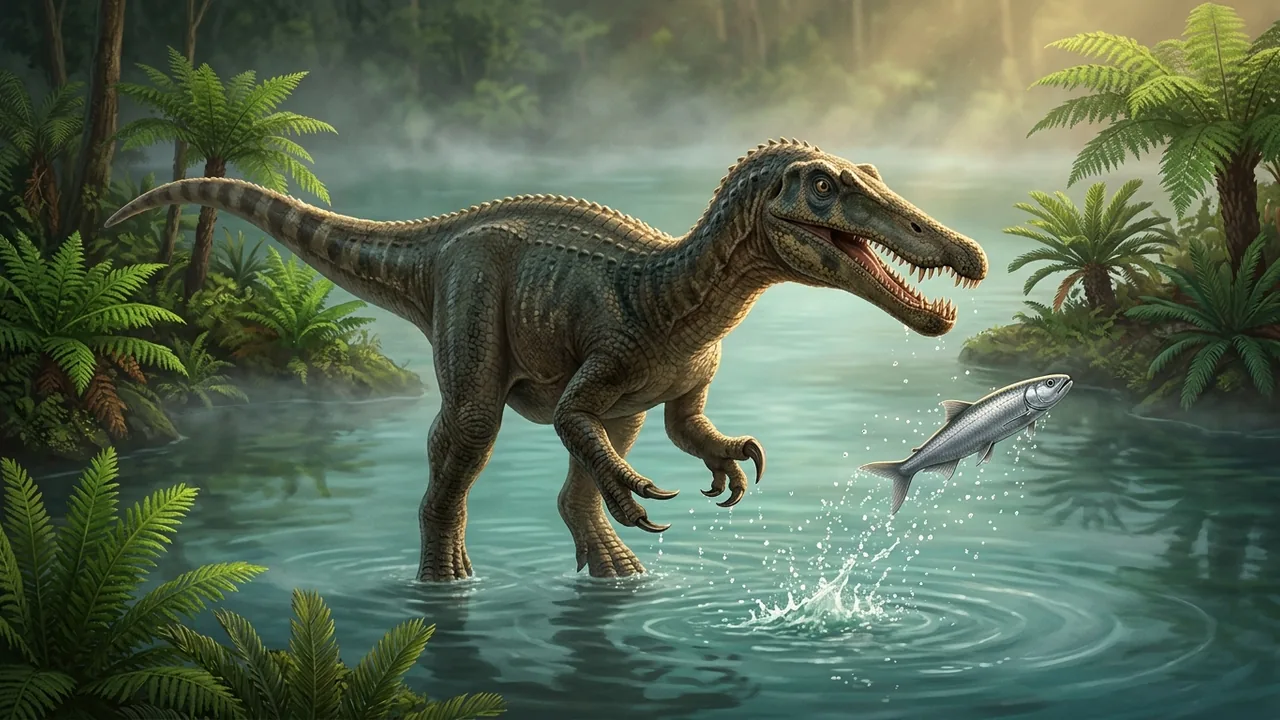
Meet the Legend: Crocodile-Snouted Fisherman
Picture a dinosaur as long as a school bus and as heavy as a family SUV, standing quietly in knee-deep river mist. Meet Baryonyx (bair-ee-ON-iks), whose name means heavy claw! Unlike round-headed meat-eaters, Baryonyx had a long, narrow snout shaped remarkably like a crocodile's jaw.
Even more impressive were its muscular arms. Most two-legged hunters had fairly small hands, yet Baryonyx grew thick, powerful shoulders and a curved twelve-inch claw on each thumb! Built like a cross between a heron and a grizzly bear, this Early Cretaceous ruled European waterways.
Lost World Habitat: Wealden River Deltas
Between 130 and 125 million years ago, southern England and northern Spain looked nothing like modern towns. Instead, warm rivers fanned out across a giant muddy dotted with calm lagoons, sandy islands, and winding creeks.
Horsetail reeds carpeted the muddy banks while tree ferns and tall conifers shaded the water. Beneath the surface swam three-foot-long fish covered in gleaming armor scales alongside freshwater sharks, turtles, and crocodiles. Baryonyx patrolled these shallow channels all year long, stepping across soft clay bars where fish gathered in big schools.
What's on the Prehistoric Menu?
Most meat-eating dinosaurs grew flat, steak-knife teeth for slicing land prey, but Baryonyx packed ninety-six round, cone-shaped teeth into its slender jaws! Right at the front tip of its snout, its longest fangs fanned out in a spoon-shaped that locked around slippery fish like a living fish basket.
Standing motionless like a giant wading bird, Baryonyx waited until a yard-long Scheenstia fish glided close. Snap! Its jaws clamped tight while its curved thumb hooks gaffed heavy fish onto shore—and when hungry, it also scavenged or caught young land dinosaurs.
Superpowers, Senses & Anatomy
Hunting fish in muddy water takes special tools. At the tip of its snout, tiny nerve pits connected to sensitive branches inside the jawbone. Whenever a hidden fish flicked its tail nearby, Baryonyx felt the water ripples right through its nose!
Meanwhile, its sat several inches back from the tip of its snout, allowing Baryonyx to breathe smoothly while keeping its front teeth underwater. An S-curved neck coiled like a spring to dart its head downward, while sturdy three-fingered hands facing inward pinned wiggly catches against the riverbank.
Flight vs. Fight Arena!
Along the muddy shore, thirty-foot Baryonyx often crossed paths with herds of plant-eating Iguanodon. A baby or young Iguanodon wandering alone near dense reeds made fair game for a hungry hunter, but a full-grown four-ton adult was a completely different story!
Adult Iguanodon towered heavier than two pickup trucks and carried sharp, cone-shaped spikes on both thumbs for defense. Because the narrow jaws of Baryonyx were built for snapping fish rather than wrestling multi-ton giants, wise Baryonyx stepped aside from alert Iguanodon herds and splashed back to its fishing lagoon.
Fossil Detective Secrets
In January 1983, plumber and fossil collector William Walker visited a muddy brick-clay in Surrey, England. Splitting open a round rock nodule, he uncovered a massive curved dinosaur claw! Scientists from London's Natural History Museum rushed to excavate over two tons of surrounding clay blocks.
Naming the dinosaur Baryonyx walkeri in his honor, researchers discovered acid-worn fish scales and teeth right where its stomach once sat. That exciting quarry find gave science its very first proof that spinosaur dinosaurs waded into rivers as specialized prehistoric fishermen!