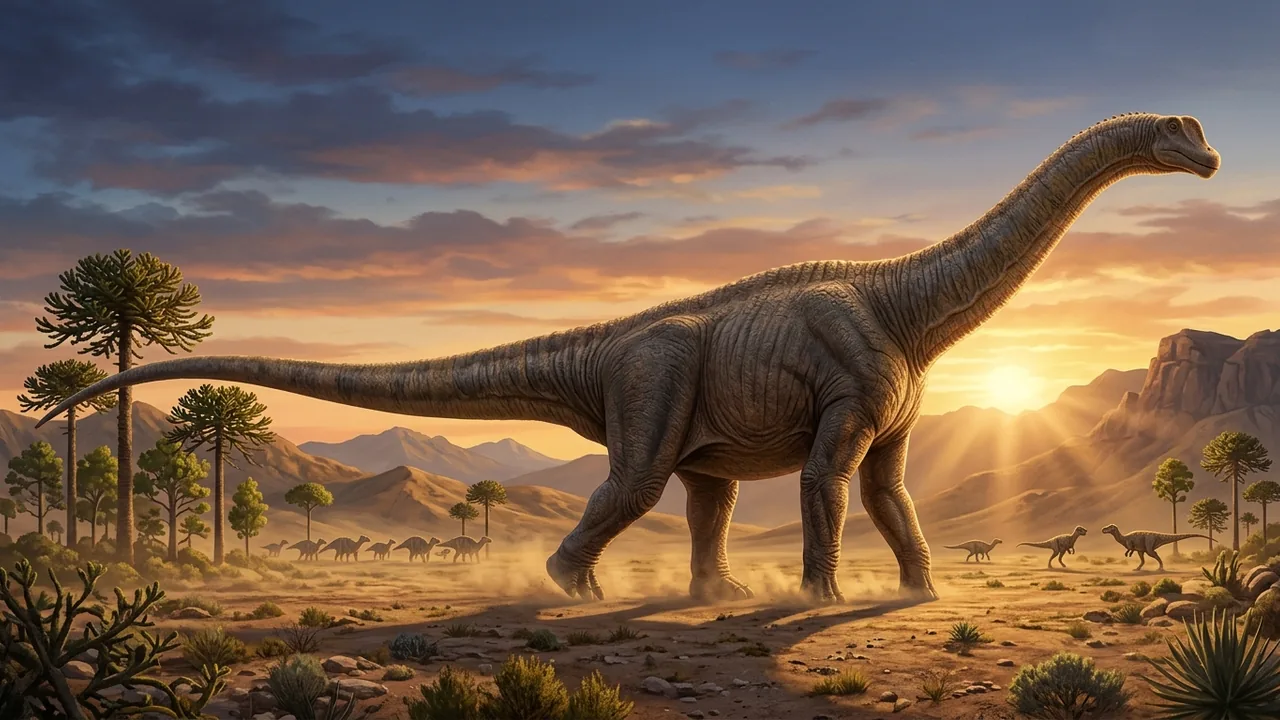
Meet the Legend: Pinnacle of Terrestrial Gigantism
Long after Late Jurassic diplodocids declined across northern continents, Gondwanan members of the macronarian clade ignited a second, even grander wave of sauropod gigantism across Cretaceous South America. Formally named Argentinosaurus huinculensis in 1993 by Argentine paleontologists José Bonaparte and Rodolfo Coria from holotype specimen MCF-PVPH-1 in Neuquén Province, this lognkosaurian colossus reached roughly thirty-three to thirty-five meters in length while yielding modern volumetric and allometric mass estimates between sixty-five and eighty metric tons!
To grasp that biological scale, a single mature Argentinosaurus equaled the combined body mass of twelve adult bull African savanna elephants—and outweighed the largest terrestrial mammal ever discovered, Oligocene Paraceratherium, more than fourfold.
How did dinosaurian evolution shatter mammal size limits so dramatically? Comparative vertebrate credits an unrepeatable anatomical synergy: non-mastication of plant food kept the skull tiny at the distal tip of an elongated neck, oviparous egg-laying reproduction bypassed maternal gestation limits, and invasive avian-style skeletal replaced heavy bone marrow with structural honeycomb air cells.
Individual dorsal vertebrae of MCF-PVPH-1 measure 159 centimeters from centrum base to neural spine apex, pairing monumental load capacity with astonishingly low skeletal density.
Paleobiologist Martin Sander and international research teams demonstrated that this evolutionary cascade freed sauropods from the metabolic and mechanical ceilings constraining placental mammals across Cenozoic eras.
Standing high above Late Cretaceous Patagonian conifer woodlands, Argentinosaurus represents the supreme engineering triumph of terrestrial vertebrate anatomy across Earth's four-billion-year history of complex animal life on solid continents.
Lost World Habitat: Huincul Formation Alluvial Plains
Regional Neuquén Basin and radiometric zircon dates from interbedded volcanic tuffs place Argentinosaurus huinculensis within the lower Huincul Formation of northern Patagonia, spanning approximately ninety-six to ninety-two million years ago across the Cenomanian-Turonian greenhouse thermal maximum. Braided and meandering fluvial sandstones, overbank mudstones, and paleosol calcretes record warm, seasonally wet alluvial plains draining eastward from nascent Andean volcanic uplands toward Atlantic epicontinental seas.
Paleobotanical assemblages preserved as silicified trunks and palynomorphs reconstruct towering canopies of Araucariaceae and Podocarpaceae conifers alongside Cheirolepidiaceae evergreens, tree ferns, horsetails, and rapidly radiating early angiosperm shrubs colonizing disturbed riverbanks.
Within this productive Gondwanan ecosystem, members of coexisted alongside smaller rebbachisaurid diplodocoids such as Cathartesaura and Limaysaurus, basal iguanodontian ornithopods like Chakisaurus, fast-running elaphrosaurine ceratosaurs, abelisaurid carnivores including Skorpiovenator and Ilokelesia, and apex carcharodontosaurid theropod Mapusaurus roseae!
Ichnological applied to wide-gauge Titanopodus trackways demonstrates that migrating titanosaur herds exerted profound ecological engineering effects—trampling dense understory thickets, excavating ephemeral floodplain pools, and recycling mineral nutrients across vast river valleys.
Global greenhouse warmth kept polar latitudes completely ice-free during the Cenomanian stage, while elevated atmospheric carbon dioxide stimulated rapid gymnosperm canopy regeneration year-round across southern Gondwana.
Consequently, lush evergreen river corridors flourished far across southern South America and sustained Earth's heaviest megaherbivore guild across millions of years of Late Cretaceous time, leaving behind oxidized red cliff exposures rich in mineralized dinosaur bone across Neuquén Province today for field geologists and paleobotanists to map layer by layer.
What's on the Prehistoric Menu?
Fueling seventy-five metric tons of active sauropod tissue required harvesting well over four hundred to five hundred kilograms of coarse gymnosperm and early angiosperm foliage every single day. Although the cranium of MCF-PVPH-1 was not preserved, articulated skulls of related lithostrotian members of —such as Sarmientosaurus and Tapuiasaurus—reveal elongated, moderately broad snouts armed anteriorly with procumbent, chisel-faceted cylindrical teeth suited for high-force branch stripping and woody stem cropping across a massive vertical and lateral feeding envelope.
Crucially, evolutionary barred oral chewing: housing heavy dental batteries and masseter-like adductor muscles at the distal tip of a twelve-meter cervical beam would have multiplied cantilever torque beyond vertebral safety limits! Instead, cervical lightened the sweeping neck crane while unchewed plant boluses plunged straight into a cavernous multi-ton hindgut.
Inside that vast fermentation vat, symbiotic cellulolytic microbes digested tough araucaria cuticles and lignified fibers across multi-day retention intervals, aided by stable internal core temperatures maintained through thermal inertia ('gigantothermy').
Experimental fermentation assays conducted on living Araucaria foliage confirm that although conifer needles ferment slowly during the first twenty-four hours, extended multi-day digestion yields rich metabolic energy comparable to modern browse.
Across , dietary breadth shifted dramatically: five-kilogram hatchlings cropped tender ground-level ferns and nitrogen-rich flowering herbs along damp streamsides, whereas mature eighty-ton adults harvested entire upper-canopy conifer crowns without spending extra muscular energy walking between every mouthful along sunny Patagonian river corridors throughout mild southern winters and warm flood seasons year after year across ancient South America.
Superpowers, Senses & Anatomy
Supporting seventy-five metric tons on dry land required radical architectural innovations across the skeleton of derived . Internally, invasive pulmonary air-sac diverticula transformed massive presacral vertebrae into fine spongy honeycombs of millimeter-scale bony struts—an advanced camellate that maximized structural stiffness per gram while providing massive internal surface area for respiratory evaporative cooling!
Uniquely among advanced somphospondylans, giant dorsal vertebrae of Argentinosaurus retained robust accessory hyposphene-hypantrum interlocking joints below the zygapophyses, stiffening the trunk girder above a six-vertebra fused sacrum and flared iliac blades.
Appendicular diverged sharply from earlier Jurassic sauropods: outward-beveled femoral heads and broadened sternal plates created a stable 'wide-gauge' stance that distributed colossal body weight evenly across four columnar limbs.
Most remarkably, the titanosaurian manus completely lost all finger phalanges and ungual claws! Five elongated, vertically bundled metacarpals formed a rigid, U-shaped horseshoe colonnade cushioned directly upon a fibrous plantar pad, eliminating fragile toe joints entirely under multi-ton compressive loads.
Meanwhile, rapid fibrolamellar bone deposition documented across titanosaurian pumped dense vascular networks through growing limb shafts, building nearly two-point-five-meter femora capable of enduring millions of heavy footsteps across firm floodplain soils.
Cardiovascular scaling models further indicate a muscular four-chambered heart worked alongside elastic arterial walls, tight leg skin, and rhythmic skeletal muscle pumps to maintain steady oxygenated blood perfusion from pillar feet all the way up to its elevated canopy head across hours of continuous foraging in warm Patagonian sunshine beside broad winding rivers and shady evergreen groves every single day.
Flight vs. Fight Arena: Ontogeny Against Mapusaurus
Ecological interactions between Argentinosaurus huinculensis and sympatric twelve-meter carcharodontosaurid Mapusaurus roseae hinged completely on sauropod ! Because avian-like eggshell gas conductance caps maximum shell thickness near two to three millimeters, even eighty-ton members of laid clutches of fifteen-to-twenty-centimeter porous spheres buried in colonial floodplain nesting grounds—meaning hatchlings emerged at roughly five kilograms, facing a 15,000-fold size gap before reaching adult invulnerability!
Monodominant bonebed excavations led by Rodolfo Coria and Philip Currie in the Huincul Formation uncovered at least seven Mapusaurus individuals spanning juvenile to adult sizes, suggesting gregarious aggregations capable of targeting subadult sauropods with laterally compressed, blade-serrated ziphodont dentition.
To survive this severe predatory bottleneck, young titanosaurs combined cryptic woodland foraging with explosive metabolic growth rates exceeding ten to fifteen kilograms per day during peak adolescence.
Once individuals surpassed fifty to seventy-five metric tons, however, adult placed Argentinosaurus inside an impregnable Team Fight citadel! Outweighing an adult six-ton Mapusaurus more than twelvefold, a prime adult wielded earth-shaking forelimb stomps and sweeping procoelous caudal strikes that rendered frontal or flank attacks biomechanically impossible for even coordinated theropod groups.
Reproductive strategy thus favored laying numerous clutches of dozens of eggs annually rather than investing years of parental care into single helpless calves.
Consequently, predator-prey coexistence across Patagonia depended on high juvenile turnover balanced against virtually immune, multi-decade reproductive elders anchoring lush Cretaceous river ecosystems across northern Neuquén floodplains where giant trackways still cross hardened river siltstones under clear southern skies today.
Fossil Detective Secrets: Scaling & Supercomputers
When rancher Guillermo Heredia stumbled upon a weathered 155-centimeter fibula protruding from Huincul Formation on his farm east of Plaza Huincul in 1987, Rodolfo Coria and José Bonaparte led a meticulous Museo Carmen Funes excavation that recovered six giant posterior cervical and dorsal vertebrae, five fused sacral centra, hollow dorsal ribs, and a massive femoral shaft.
How do paleontologists reconstruct body dimensions reliably when fluvial currents dispersed part of holotype MCF-PVPH-1 ninety-four million years ago? Researchers apply rigorous comparative phylogenetic bracketing within Lognkosauria—scaling preserved axial and appendicular landmarks against articulated cousin skeletons such as Futalognkosaurus dukei and Patagotitan mayorum alongside stylopodial shaft-circumference equations!
In October 2013, biomechanical engineer Bill Sellers collaborated with Argentine paleontologists to laser-scan Museo Carmen Funes's thirty-nine-meter skeletal reconstruction, wrap digital muscles and camellate bone densities onto a 3D mesh, and run evolutionary machine-learning gait optimization across thirty thousand computer cores.
Without pre-programmed animal templates, physics-based converged on a stable terrestrial walk at two meters per second (~4.5 mph) across level floodplain ground!
Intriguingly, joint torque and muscular recovery margins showed little spare mechanical capacity when standing up from rest—demonstrating quantitatively that seventy-to-eighty-ton Argentinosaurus stood right near the ultimate gravitational boundary that terrestrial bone and muscle physiology can sustain on planet Earth.
Continuing discoveries of giant Patagonian lognkosaurians refine these digital models every decade, turning incomplete desert outcrops into high-precision laboratories of evolutionary engineering and inspiring future paleontologists across every continent to explore South America's rich Cretaceous rocks with modern digital tools.