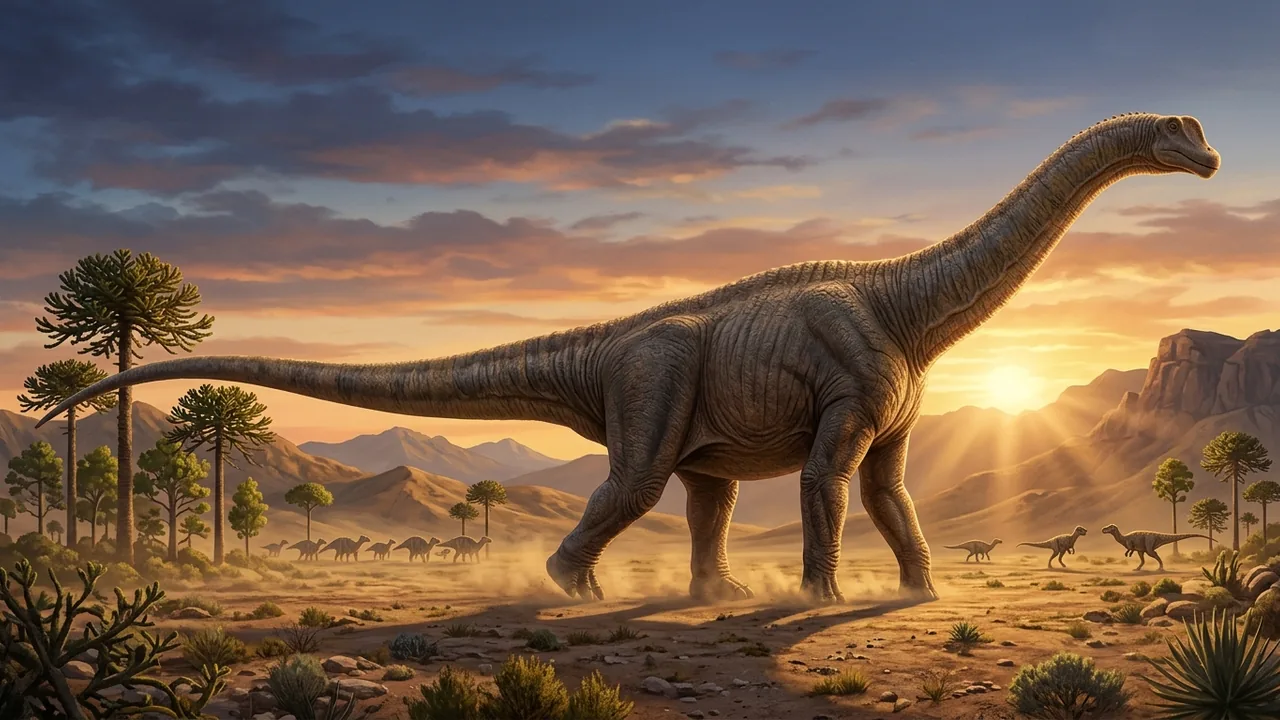
Meet the Legend: Pushing Physics to the Limit
Long after North America's famous Late Jurassic sauropods vanished, an evolutionary branch of wide-chested macronarians in the Southern Hemisphere pushed terrestrial size to its absolute physical ceiling! Described in 1993 by Argentine paleontologists José Bonaparte and Rodolfo Coria, Argentinosaurus huinculensis stretched roughly 110 to 115 feet long and tipped modern volumetric estimates between seventy and eighty tons—rivaling a loaded commercial jetliner in sheer mass.
As a flagship member of the Cretaceous radiation, Argentinosaurus dwarfed even fifty-ton Brachiosaurus! Its individual dorsal vertebrae towered more than five feet high, while its restored thighbone reached over eight feet from hip socket to knee joint.
How could living flesh and bone carry seventy-five tons against Earth's gravity without collapsing? Studying skeletal reveals an extraordinary partnership between wide-stanced pillar limbs below and ultra-lightweight honeycomb vertebrae above.
Every square inch of bone architecture balanced colossal compression loads with feather-light respiratory engineering and rapid adolescent growth.
Standing high atop sunny Patagonian floodplains ninety-four million years ago, Argentinosaurus proved just how grand vertebrate life walking across solid ground could truly become across ancient South America.
Lost World Habitat: Patagonia's Huincul Floodplains
Roughly ninety-six to ninety-two million years ago during the early Late Cretaceous, Patagonia lay under a warm greenhouse climate far milder than today's windswept Argentine steppe. Fast-flowing seasonal rivers drained emerging Andean highlands eastward across the Neuquén Basin, depositing oxidized red and yellowish sandstones, floodplain mudstones, and volcanic ash beds of the Huincul Formation.
Across those fertile valleys towered groves of spiky-leaved araucaria conifers, podocarps, ginkgoes, cycads, and lush understories of tree ferns alongside rapidly diversifying angiosperm—flowering plant—shrubs! Within that vibrant ecosystem, adult Argentinosaurus occupied the mega-canopy browsing , harvesting wide swaths of evergreen crowns untouched by smaller ground herbivores.
Sharing the floodplain food web were medium-sized rebbachisaurid sauropods like Limaysaurus, fleet-footed ornithopods, armored abelisaurids such as Skorpiovenator, freshwater turtles, and giant carcharodontosaurid theropods.
Applying trackway to wide-set Cretaceous footprints shows every passing herd churned damp floodplain soils, opening sunny forest clearings where fast-growing ferns and flowering bushes sprouted fresh shoots.
Like modern African elephants multiplied twelvefold in mass, these wandering South American titans acted as powerful landscape architects across ancient river basins from season to sunny season throughout southern Gondwana.
What's on the Prehistoric Menu?
Powering an eighty-ton endothermic or gigantically insulated body demanded harvesting well over one thousand pounds of fibrous plant matter every single day! Based on preserved skulls of close relatives like Sarmientosaurus and Tapuiasaurus, Argentinosaurus carried an elongated snout lined with sturdy, chisel-beveled cylindrical teeth capable of stripping tough araucaria conifer branches, seed cones, ferns, and woody angiosperm stems across a broad vertical .
Because chewing half a ton of resinous needles would have required massive molar batteries far too heavy to suspend forty feet ahead of the shoulders, Argentinosaurus swallowed mouthfuls completely unchewed. Once foliage entered its cavernous barrel-shaped torso, multi-day microbial took full command!
Billions of specialized gut bacteria and protozoa digested stubborn plant cellulose over three to four days, releasing steady streams of energy-rich fatty acids while stable internal body warmth accelerated chemical breakdown.
Meanwhile, air-sac channels threading its forty-foot neck kept sweeping lateral head movements remarkably light and energy-efficient.
By parking its four pillar legs in one shady grove and swinging its neck across wide arcs, Argentinosaurus cleared entire conifer crowns before taking another calm step.
Superpowers, Senses & Anatomy
Examining an Argentinosaurus vertebra in cross-section reveals an engineering marvel that rivals modern aerospace wings! Rather than simple side hollows, invasive respiratory air sacs filled nearly the entire vertebral interior with thousands of tiny, thin-walled honeycomb cells—an advanced bone texture called camellate tissue that trimmed tons of dead weight while resisting steep bending forces.
Along its towering dorsal vertebrae, extra interlocking bony joints called hyposphene-hypantrum articulations locked neighboring spine bones firmly together so its massive back could not twist out of alignment above its six-vertebra fused hip sacrum!
Down below, wide-angled thighbones and broad chest plates gave this a stable 'wide-gauge' stance very different from narrow-tracking Jurassic sauropods.
Even more remarkably, limb turned its forefeet into pure vertical weight columns: finger bones and claws disappeared completely, leaving five vertical metacarpal bones arranged in a cushioned horseshoe ring!
Combined with a massive gut and efficient one-way bird-style lung airflow that dumped excess body heat with every breath, Argentinosaurus stood engineered from head to tail for unmatched terrestrial scale, cool core temperatures, and steady daily endurance across wide Patagonian valleys.
Flight vs. Fight Arena: Living Mountain vs. Mapusaurus
Sharing the Huincul Formation with Earth's heaviest herbivore was one of history's largest meat-eating theropods: Mapusaurus roseae, a forty-foot, six-ton cousin of Giganotosaurus armed with laterally flattened, flesh-slicing teeth! Excavations by Rodolfo Coria and Philip Currie uncovered at least seven Mapusaurus individuals of different ages buried together, pointing toward gregarious group behavior near migration corridors.
Why didn't eighty-ton parents simply guard single giant calves like modern whales or elephants? Physics dictated that eggshells stay thin enough for oxygen diffusion, meaning every baby hatched weighing barely ten pounds and entered a perilous ground-level forest !
Youngsters relied on dense fern cover and astonishingly rapid bone growth—gaining up to forty pounds per day during teenage growth spurts—while many juveniles fell prey to swift predators.
Once an adult passed fifty to seventy-five tons, however, limb placed it invincibly on Team Fight! Towering more than twelve times heavier than an adult Mapusaurus, a healthy mature Argentinosaurus shook the floodplain with crushing pillar forelimbs and sweeping tail blows that deterred even coordinated packs.
Sheer adult body mass turned mature herds into living fortresses across Late Cretaceous Patagonia.
Fossil Detective Secrets: Rebuilding a 75-Ton Puzzle
When Patagonian rancher Guillermo Heredia reported a giant 'petrified tree trunk' near Plaza Huincul in 1987, Rodolfo Coria and José Bonaparte uncovered thirteen colossal bones—including five-foot dorsal vertebrae studded with honeycomb cells, a fused sacrum, hollow ribs, and a massive five-foot outer shinbone (fibula) initially mistaken for a tibia!
Because river currents scattered parts of the skeleton ninety-four million years ago, paleontologists use phylogenetic bracketing—scaling preserved bones against more complete cousin skeletons such as Patagotitan mayorum and Futalognkosaurus—to estimate total length and body mass rigorously.
In 2013, paleontologist Bill Sellers teamed with Argentine museums to laser-scan a full thirty-nine-meter skeletal mount at Museo Carmen Funes and feed 3D bone meshes into an evolutionary supercomputer simulator.
Without human guesswork, machine-learning algorithms taught the virtual seventy-five-ton dinosaur to coordinate virtual leg muscles and walk stably at 4.5 miles per hour!
Their digital test also showed joints approaching maximum mechanical safety limits—suggesting Argentinosaurus stood right near the heaviest land body Earth's gravity and bone strength can ever support across millions of years of vertebrate evolution on solid land anywhere on our planet.