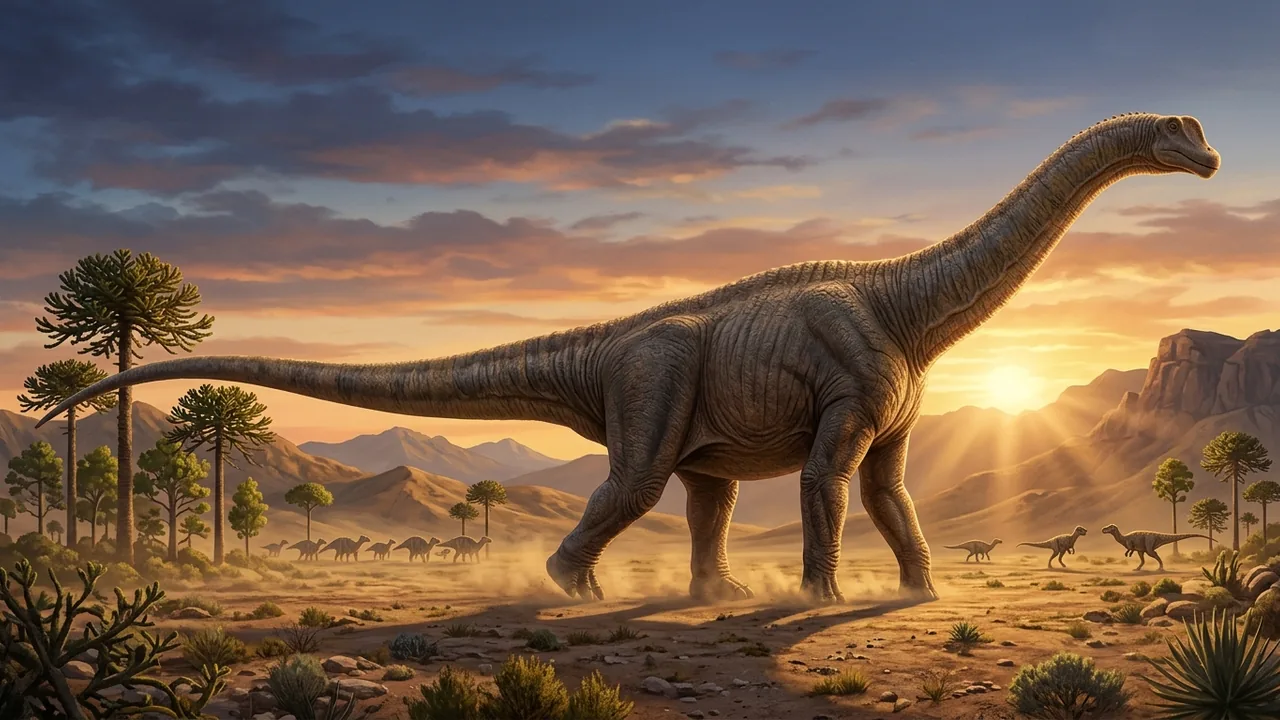
Meet the Legend: Heavy as a Passenger Jet!
Picture three yellow school buses parked bumper to bumper on your playground—now imagine one living dinosaur stretching even longer! Argentinosaurus (ar-jen-TEE-noh-SOR-us), meaning Argentina lizard, reached up to 115 feet long and weighed seventy to eighty tons. That equals twelve African elephants or a loaded passenger airplane!
Belonging to a wide-chested family of giants called sauropods, Argentinosaurus holds the world crown as the heaviest land animal scientists have ever measured from real stone bones, towering high above green South American forests.
Lost World Habitat: Monkey-Puzzle Forests
Ninety-four million years ago during the Late Cretaceous Period, Patagonia in southern Argentina looked nothing like today's windy desert scrubland. Broad, warm rivers wound across sunny floodplains shaded by tall araucaria forests—spiky evergreens nicknamed monkey-puzzle trees that grew thick beside lush green ferns!
Every passing herd left wide, bathtub-sized footprints in damp river mud while early flowering bushes, horsetails, freshwater turtles, lungfish, and armored land crocodiles shared the warm South American sunshine all year long along sparkling streams.
What's on the Prehistoric Menu?
Feeding a seventy-five-ton body was a full-time daytime job! Every single day, Argentinosaurus harvested more than a thousand pounds of prickly araucaria branches, tree ferns, and riverside shrubs—enough fresh green salad to fill a pickup truck bed right to the brim.
Instead of chewing mouthfuls with flat back molars, this giant snipped leafy twigs with pencil-like front teeth and swallowed them whole, letting billions of tiny gut microbes ferment tough plant fibers into steady energy over several days.
Superpowers, Senses & Anatomy
How could bones hold up eighty tons without snapping in half? Each five-foot back was filled with airy honeycomb pockets connected to bird-like breathing sacs, keeping the spine surprisingly light while four thick leg pillars stood wide apart for rock-solid balance!
Even more amazing, every giant started out as a tiny ten-pound curled inside a grapefruit-sized egg! If eggshells grew any thicker, fresh air could not pass through the tiny shell pores for the growing baby inside.
Flight vs. Fight Arena: Giant vs. Pack Hunters
Patagonian forests also sheltered Mapusaurus—a forty-foot meat eater with shark-sharp teeth that often hunted in groups! Small and teenage titanosaurs had to grow super fast and stay near watchful elders among shady trees so hungry packs could not corner them.
Once an adult reached seventy-five tons, however, it stood unbeaten on Team Fight! Towering stories above Mapusaurus, one thunderous front-leg stomp or heavy sweep of its muscular tail kept even bold predators at a very respectful distance.
Fossil Detective Secrets: Laser-Scanning a Giant!
After sheep rancher Guillermo Heredia spotted a giant shinbone on his farm near Plaza Huincul in 1987, Argentine paleontologists José Bonaparte and Rodolfo Coria carefully excavated colossal leg bones, hollow ribs, and a five-foot back —officially naming Argentinosaurus huinculensis in 1993!
Twenty years later in 2013, scientists laser-scanned its 130-foot museum skeleton into a powerful supercomputer, proving with real engineering physics that this mighty walked smoothly and steadily across ancient South American floodplains at nearly five miles per hour without losing balance!