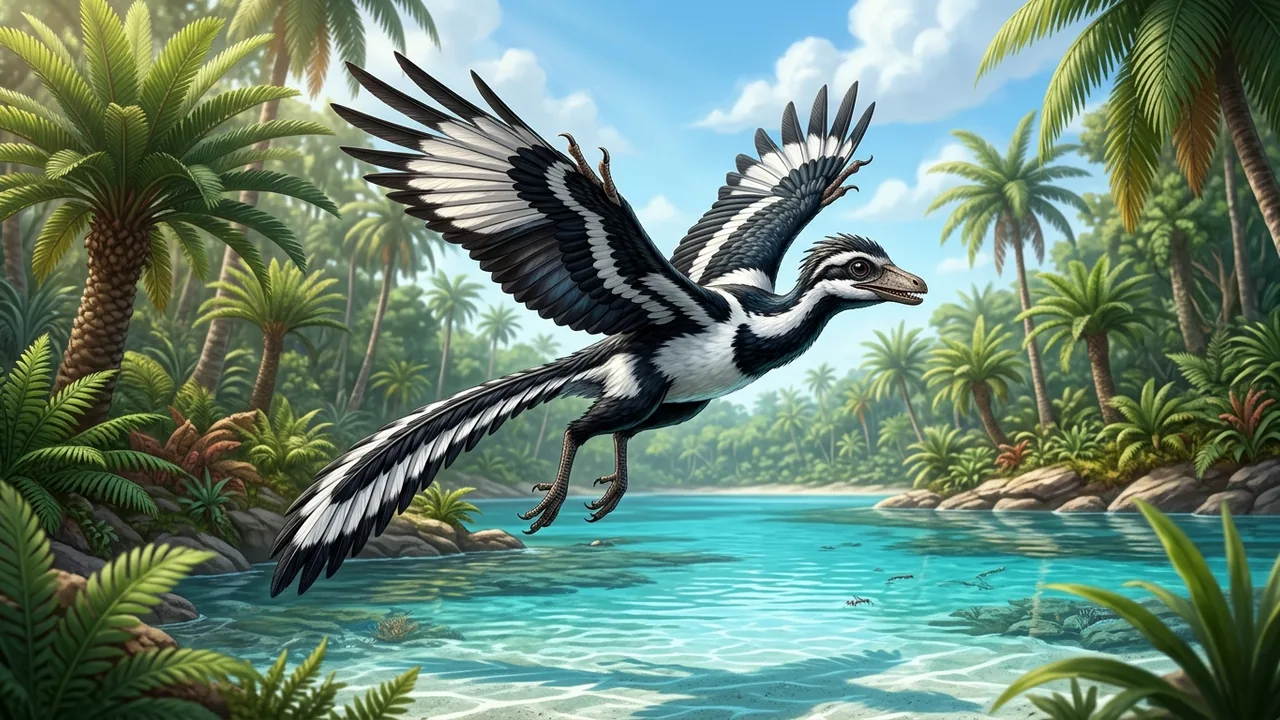
Meet the Legend: Mosaic Icon of Avian Origins
In the entire chronicle of vertebrate paleontology, few fossils command greater scientific renown than Archaeopteryx lithographica. Inhabiting southern Germany during the Tithonian stage of the Late Jurassic Period approximately 150 million years ago, this raven-sized creature—roughly 0.5 meters long and weighing 0.8 to 1.0 kilogram—captures the evolutionary transition from ground-running theropods to flying birds in exquisite stone detail.
Biologists describe Archaeopteryx as a textbook mosaic organism because ancestral and derived features coexisted side by side within one skeleton. On the ancestral theropod ledger, it retained premaxillary and maxillary jaws armed with roughly fifty non-serrated conical teeth, three unfused clawed manual digits on each forelimb, gastralia (belly ribs), and an elongate bony tail of more than twenty caudal vertebrae.
On the derived ledger, however, stood unmistakable flight machinery: a robust boomerang-shaped (wishbone), partially retroverted pubis, hyper-extendable second pedal claw like dromaeosaurs, and layered arrays of asymmetrical pennaceous primary and secondary flight feathers.
Rather than standing alone as an isolated curiosity, 21st-century discoveries of feathered paravians in China—such as Anchiornis, Microraptor, and Xiaotingia—confirm that Archaeopteryx belonged to a vibrant Jurassic radiation experimenting with aerial locomotion.
Even within that crowded family tree, Archaeopteryx remains the earliest undisputed Mesozoic taxon combining true aerodynamic wing proportions with powered burst-flight capability.
Its semilunate wrist carpals, elongated coracoids, and stiffened tail frond show step by step how terrestrial predatory mechanics were repurposed by natural selection to conquer Earth's skies, turning quick forearm prey-seizing strokes into coordinated flapping downstrokes that bridged non-avian maniraptorans and living birds.
Lost World Habitat: Solnhofen Lagoon Stratigraphy
The paleogeography of Late Jurassic Europe bore little resemblance to today's continental landmass. Positioned around 30 degrees north paleolatitude along the northern margin of the tropical Tethys Ocean, southern Bavaria formed a warm epicontinental sea dotted by the Solnhofen Archipelago—a patchwork of low carbonate islands, coral shoals, and siliceous sponge-microbial reefs.
Detailed of the Solnhofen and Altmuehltal formations reveals rhythmically bedded, sub-micron micritic limestones known in German as Plattenkalk ('platy limestone'). Because offshore reef barriers restricted open-marine circulation while intense subtropical evaporation concentrated salinity, dense hypersaline brines pooled inside deep back-reef lagoon depressions.
Devoid of vertical mixing, these bottom brines became strictly and hostile to benthic scavengers, bioturbating worms, and aerobic bacteria. Meanwhile, nearby emerged islands supported low xerophytic shrublands of conifers (Brachyphyllum), bennettitaleans, and seed ferns.
Whenever seasonal monsoonal squalls swept terrestrial insects, lizards, rhamphorhynchoid and pterodactyloid pterosaurs, or island-hopping Archaeopteryx out over open lagoons, carcasses sank swiftly into those stagnant anoxic traps.
Veiled immediately by bacterial biofilms and powdery lime mud precipitates, soft tissues, claw sheaths, and microscopic feather barbules fossilized without distortion—creating one of Earth's premier Konservat-Lagerstaetten.
Along side-by-side quarry horizons, fossil detectives recover delicate dragonfly wings, soft-bodied medusae, horseshoe crab death marches, and articulated vertebrates that reconstruct every layer of this Late Jurassic archipelago ecosystem—from coral shoals to shrubby island ridges. Few rock units anywhere on Earth match the millimeter-scale fidelity with which these quiet Bavarian lime muds recorded life, weather, and sea-level shifts across shallow subtropical basins.
What's on the Prehistoric Menu? Paravian Trophic Role
Across the semi-arid islands preserved in Solnhofen , absence of tall canopy trees and permanent rivers shaped a compact, insect-rich trophic web. Halophytic and drought-adapted gymnosperms sustained abundant orthopterans, coleopterans, blattodeans, neuropterans, and giant Odonata dragonflies, alongside small sphenodontian reptiles and swift scleroglossan lizards.
Archaeopteryx exploited this archipelago as an agile, diurnal secondary consumer hunting both on the ground and through dense shrub thickets. High-resolution X-ray computed tomography of the London Specimen's braincase reveals expanded optic lobes displaced laterally—a hallmark sensory reorganization delivering acute binocular overlap and rapid motion tracking during aerial or arboreal pursuit.
Cranial morphology reinforced that precision-snatching diet. Unlike ziphodont dromaeosaurids engineered to slice muscular vertebrate prey, Archaeopteryx possessed slender, lightly built jaws bearing small, peg-like teeth with bulbous crowns, smooth carinae, and waisted roots ideal for puncturing chitinous arthropod cuticles and holding small lizards.
Neurovascular foramina clustered near the premaxillary tip suggest tactile sensitivity for probing crevices and foliage, while three mobile manual digits bearing strongly curved unguals aided branch grappling and prey restraint.
By foraging among waist-to-head-high cycadophytes and reef wrack lines, Archaeopteryx partitioned island insectivory away from strictly cursorial beach predators and pelagic fish-skimming pterosaurs.
Scleral ossicle ring ratios measured across well-preserved Bavarian skulls confirm photopic, daylight-adapted vision—proving this early avialan hunted actively beneath bright subtropical sunshine rather than waiting for dusk. Meanwhile, delicate semicircular ear canals mapped inside its skull matched agile arboreal hunters that tracked darting insects cleanly through tangled branches without losing visual focus.
Superpowers & Anatomy: Biomechanics & Melanosomes
For over a century, paleobiologists debated whether Archaeopteryx merely glided downward from shrubs or achieved active powered flight. Because it lacked an ossified, deeply keeled sternum and lacked a fully modern supracoracoideus pulley canal (triosseal canal) for rapid wing upstrokes, its flight stroke clearly differed from living pigeons or falcons.
Breakthrough synchrotron microtomography published in 2018 resolved much of this puzzle by examining cross-sectional bone geometry inside the humerus and ulna without damaging fossils. Thin cortical bone walls and high polar moments of torsional resistance matched living volant birds that employ brief, explosive burst-flapping—such as pheasants, tinamous, and roadrunners—supported by elastic recoil across its robust .
Aerodynamic stability in this early came from four-wing-style plumage: overlapping asymmetrical primaries on the forelimbs, long symmetrical frond feathers flanking the bony tail, and elongate pennaceous contour feathers ('hindlimb trousers') along the tibiotarsus that added auxiliary lift.
Equally transformative were scanning electron microscope and synchrotron X-ray trace-metal studies of preserved feather organelles! Elongate, rod-shaped eumelanosomes revealed matte-black distal primary tips paired with lighter covert patterning.
Beyond visual signaling, dense melanin deposition measurably stiffened outer wingtip keratin against shear stress and wind-driven abrasion among thorny island shrubs.
Coupled with recently imaged propatagial soft-tissue membranes spanning the shoulder-to-wrist angle, these biomechanical traits confirm that Archaeopteryx generated genuine aerodynamic lift during short, energetic island flights. Even before a deep bony breastbone keel evolved in later Cretaceous birds, feather geometry, hollow limb walls, and elastic shoulder mechanics had already unlocked active Mesozoic flight.
Flight vs. Fight Arena: Evolutionary Escape Dynamics
In the Flight-versus-Fight arena of the Solnhofen Archipelago, two small coelurosaurian theropods shared coastal island habitats: roughly one-kilogram Archaeopteryx lithographica and three-kilogram Compsognathus longipes. Comparing their skeletons illuminates how natural selection split closely related dinosaurs along radically different survival trajectories.
Compsognathus optimized cursorial terrestrial pursuit: elongated distal hindlimbs, compact two-fingered hands, and fine filamentous protofeathers enabled rapid straight-line sprints across coral sandflats, evidenced by an intact Bavarisaurus lizard skeleton preserved inside its gut. Against a predator three times its mass with sharper slicing teeth, close-quarters combat was biomechanically untenable for hollow-boned Archaeopteryx—cementing its place on Team Flight!
Yet flat-ground top speed was not Archaeopteryx's trump card; three-dimensional spatial escape was. Flapping asymmetrical wings while dashing up inclined shrub trunks (wing-assisted incline running) generated aerodynamic traction forces that drove its clawed feet securely upward, aided by strongly curved manual unguals gripping bark.
Once elevated or sprinting across open ground, powerful pectoral-deltoid downstrokes braced by its springy launched this early airborne.
Gliding across hypersaline lagoon channels or vaulting between island thickets, Archaeopteryx pioneered an aerial refuge that permanently reshaped vertebrate predator-prey coevolution.
While ground theropods competed for footing along narrow coral beaches, early avialans unlocked canopy perches, offshore islets, and airborne foraging routes—launching an evolutionary radiation that outlived the end-Cretaceous extinction itself. Whenever ground predators closed in along Solnhofen beaches, upward climbing claws and asymmetrical primary feathers turned open air into a decisive survival shield that carried feathered pioneers safely over shimmering reef lagoons.
Fossil Detective Secrets: Darwin's Timely Witness
Timing in scientific history is rarely as dramatic as the unveiling of Archaeopteryx. When Charles Darwin published On the Origin of Species in November 1859, critics pointed to the apparent absence of fossil intermediates bridging major vertebrate classes such as reptiles and birds.
Less than two years later in 1861, quarrymen splitting Solnhofen Plattenkalk near Langenaltheim in Bavaria uncovered a single carbonized primary feather, followed almost immediately by the headless London Specimen (BMNH 37001). Naturalist Thomas Henry Huxley soon spotlighted the uncanny anatomical kinship between Compsognathus and Archaeopteryx, proposing bold dinosaurian origins for birds.
When Jakob Niemeyer discovered the breathtaking Berlin Specimen around 1874—preserving an articulated toothed skull alongside spread wings, , and fronded tail—skeptics could no longer dismiss the link. Across the ensuing 165 years, roughly a dozen skeletal specimens recovered from Bavarian lagoon beds have transformed paleobiology.
Today, non-destructive synchrotron X-ray fluorescence, UV laser-stimulated fluorescence, and electron microscopy extract chemical signatures invisible to 19th-century eyes.
From plumage maps and inner-ear semicircular flight canals to recently studied Chicago Specimen soft tissues, Archaeopteryx continues to serve as science's touchstone witness that dinosaurs never truly vanished—they took wing.
Every robin on a neighborhood branch and every eagle riding mountain thermals carries forward the hollow bones, springy furcula, and pennaceous feathers first tested over Bavarian lagoons 150 million years ago, reminding curious observers everywhere that living birds are direct, feathered heirs of the Age of Dinosaurs whose evolutionary story still unfolds in museum laboratories around the globe.