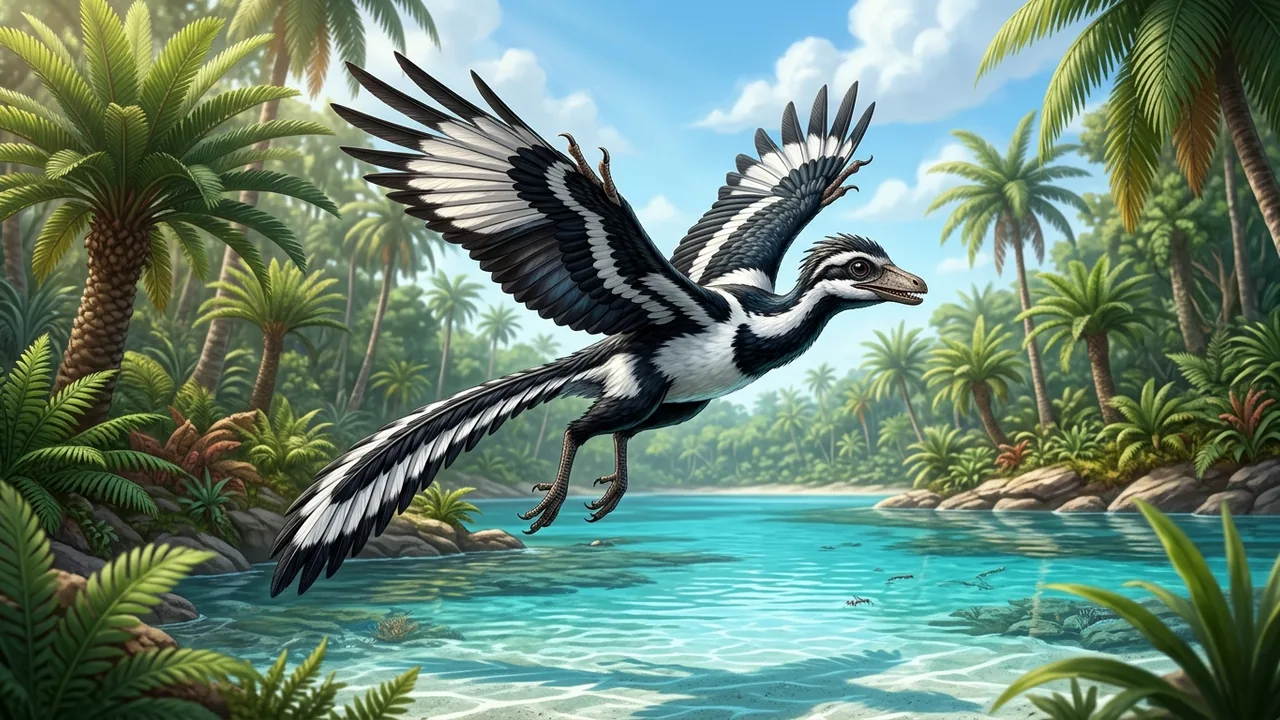
Meet the Legend: The Dinosaur That Took Wing
Imagine looking into a Late Jurassic shrub and meeting a creature that looks like a magpie—until it opens a snout lined with tiny, sharp dinosaur teeth! Say hello to Archaeopteryx, whose Greek name translates to ancient wing. Living 150 million years ago during the Late Jurassic Period, this raven-sized pioneer weighed just two pounds and measured roughly twenty inches from snout to tail.
Why does every museum celebrate Archaeopteryx? Because its skeleton captures evolution in action! Like small meat-eating theropods, it possessed three clawed fingers on each hand, sharp teeth, and a long bony tail.
At the very same time, sleek black-and-white flight feathers and a boomerang-shaped revealed unmistakable bird adaptations—linking ancient dinosaurs directly to the songbirds, hawks, and eagles soaring overhead today. Every museum visitor who sees its skeleton witnesses one of nature's clearest bridges between earthbound runners and masters of the sky!
Lost World Habitat: Germany's Coral Archipelago
During the Late Jurassic, Europe looked nothing like the cool forests and mountains we know today. Warm, shallow tropical seas flooded the continent, leaving southern Germany dotted with low islands called the Solnhofen Archipelago. Ringed by sponge mounds and coral reefs, quiet turquoise lagoons sparkled beneath sunny skies.
In this coastal island , scarce rainfall and salty sea breezes kept vegetation low and tough. Instead of towering redwoods, seed ferns, drought-hardy conifers, and palmlike cycads carpeted sandy ridges where insects and quick lizards thrived.
Calm lagoon bottoms collected powdery white carbonate mud that slowly hardened into smooth Solnhofen . Just as fine-grained Mesozoic lake shales in Virginia's Culpeper and Danville basins preserved delicate fossil insects and fish scales, Bavaria's silky limestone locked away fragile Late Jurassic wings in stone for curious young scientists to explore millions of years later!
What's on the Prehistoric Menu?
Energy flowed briskly through the warm Solnhofen island food chain. Tough coastal shrubs and cycad cones acted as producers, capturing bright tropical sunlight. Swarms of beetles, lacewings, grasshoppers, and cockroaches munched on those plants, while shimmering dragonflies patrolled the lagoon shore.
Enter Archaeopteryx as a sharp-eyed and small-prey hunter! Large forward-angled eyes helped it judge exact distances through tangled twigs, while slender legs let it dart across sandy clearings or leap into short bursts of flapping flight to intercept airborne bugs.
Once jaws snapped shut, rows of tiny peg-like teeth gripped slippery beetles and small tree lizards so prey could not wriggle free. Meanwhile, three curved hand claws helped pin larger insects against branches within this bustling island , passing vital solar energy from green island shrubs all the way up the coastal food chain.
Superpowers & Anatomy: Engineering Early Flight
Getting off the ground requires remarkable physical adaptations that balance strength with ultra-light weight. Like its theropod cousins, Archaeopteryx had hollow, thin-walled bones that kept its entire twenty-inch body down to roughly two pounds. Across its chest sat a sturdy, V-shaped that acted like a springy strut to brace its shoulders as wings beat the air.
Its primary wing feathers carried another vital flight : uneven vanes! Each outer feather was narrow and stiff along the front edge, allowing the wing to cut cleanly through breezes and generate upward lift without twisting.
Unlike modern pigeons that launch straight up using giant breastbone muscles, Archaeopteryx had a flatter chest and long, frond-feathered bony tail. Using three sharp wing claws to scramble up cycad trunks, it flapped in energetic bursts and glided skillfully between island perches!
Flight vs. Fight Arena: Vertical Escape!
Life on small tropical islands meant predators were never far away! Swift, chicken-sized Compsognathus sprinted across Solnhofen beaches on long hind legs, while hungry crocodyliforms and large predatory fish lurked in coastal shallows. Weighing just two pounds with fragile hollow bones and zero body armor, Archaeopteryx belonged 100 percent to Team Flight!
On flat coral sand, long-legged Compsognathus held the top-speed advantage. Yet Archaeopteryx possessed a three-dimensional escape that ground hunters simply could not match.
At the first sign of danger, Archaeopteryx dashed up an inclined branch flapping its wings for traction, hooked bark with its three hand claws, and launched skyward! Supported by its broad wings and stabilizing feathered tail frond, it glided across open water channels to a safe neighboring island in this sunny coastal while hungry beach sprinters watched harmlessly from below.
Fossil Detective Secrets: The 1861 Breakthrough
For centuries, quarry workers in Bavaria split smooth Solnhofen into flat slabs used for printing maps and illustrations. In 1861, workers uncovered a single dark fossil feather pressed into cream stone—followed weeks later by a headless skeleton surrounded by crisp wing and tail feather impressions!
Sixteen years later, quarrymen unearthed the breathtaking Berlin Specimen, complete with a toothed dinosaur skull, three-clawed wings, a , and fanned plumage. Scientists realized they were looking at direct fossil proof that birds evolved from small theropod dinosaurs.
Today, fossil detectives study those priceless limestone slabs using high-tech X-ray beams and electron microscopes without harming the rock. Tiny fossilized pigment capsules even revealed that Archaeopteryx wore handsome matte-black and white wing feathers 150 million years ago, proving stone fossils still hold colorful secrets when modern science looks closely!