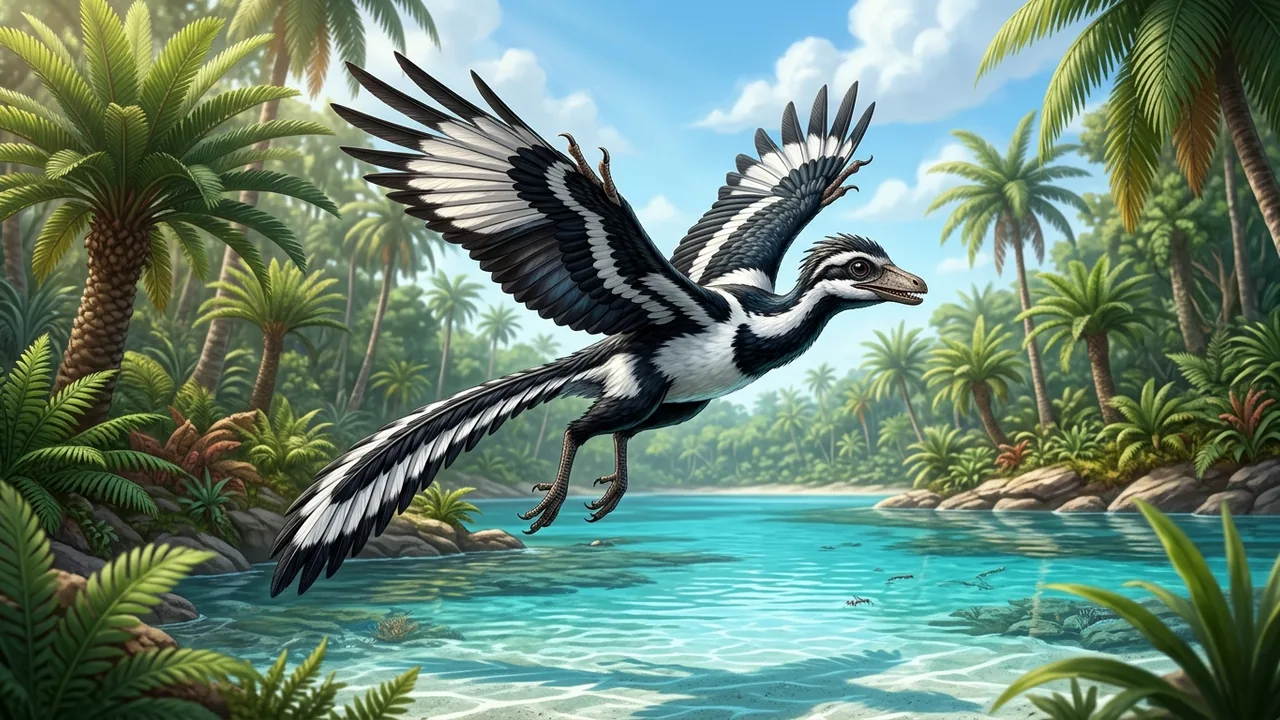
Meet the Legend: Half Dino, Half Bird!
Next time you spot a crow or raven hopping across your neighborhood lawn, picture it with tiny sharp teeth, clawed hands on its wings, and a long bony tail! That real Late Jurassic pioneer was Archaeopteryx, whose name means ancient wing.
Measuring about twenty inches long—roughly one and a half school rulers—Archaeopteryx weighed only two pounds, about as light as a fresh pineapple. Scientists celebrate it as a classic creature because it blended dinosaur bones with sleek black-and-white bird .
Lost World Habitat: Tropical Island Lagoons
One hundred and fifty million years ago, southern Germany looked like a sunny tropical vacation spot! Instead of snowy mountains, chains of low, warm islands floated across a turquoise sea. Sponge and coral reefs blocked big ocean waves, creating calm, salty pools between white beaches.
Because fresh rainwater was scarce on those islands, giant forest trees could not grow there. Instead, Archaeopteryx fluttered among waist-high cycads, seed ferns, and spiky conifer bushes while long-tailed pterosaurs skimmed over shimmering lagoon shallows floored with fine mud.
What's on the Prehistoric Menu?
Island shrubs and sandy beaches buzzed with crunchy meals for an agile two-pound hunter! Unlike modern birds that peck seeds with smooth beaks, Archaeopteryx still carried jaws lined with about fifty tiny, cone-shaped dinosaur teeth built for gripping slippery prey.
Darting through sunlit branches or hopping briskly on slender legs, Archaeopteryx snapped up giant dragonflies, beetles, lacewings, cockroaches, and tiny lizards. Along the edge of the , it also plucked small crustaceans washed onto coral sand by gentle tides before fluttering back into shady cover with sleek tucked neat and dry.
Superpowers & Anatomy: Built for Lift-Off
How do scientists know Archaeopteryx could actually get airborne instead of only running? The secret lies in its wing ! Just like modern flying birds, each outer wing feather had a narrow, stiff front edge and a wider back edge to slice air smoothly.
Archaeopteryx also had a springy wishbone and three sharp claws on the front bend of each wing. Those claws helped this climber scramble up rough shrub trunks before launching into short flapping bursts and graceful island glides!
Flight vs. Fight Arena: Up and Away!
Sharing small islands with speedy ground hunters meant Archaeopteryx needed fast reflexes! Chicken-sized Compsognathus patrolled the exact same coral beaches on long sprinting legs, chasing lizards and anything else it could catch. Weighing just two pounds without armor, Archaeopteryx chose Team Flight every time!
While Compsognathus could outrun most prey on flat sand, it could not follow Archaeopteryx upward. One quick leap, a burst of wing beats, and a smooth glide over a channel carried Archaeopteryx safely out of reach!
Fossil Detective Secrets: Limestone Time Capsules
Normally, delicate hollow bones and soft feathers rot away long before turning to stone. At Solnhofen in Germany, however, silky mud settled into ultra-smooth slabs that printers once used like stone stamps to print detailed pictures!
When quarry workers split open that cream-colored limestone in 1861, they discovered a single fossilized feather—and soon complete skeletons showing unmistakable wing attached to a toothed dinosaur! Archaeopteryx became world-famous proof that modern birds in our backyards today are living, singing feathered dinosaurs!