Meet the Legend: Bridging Dinosaurs and Birds
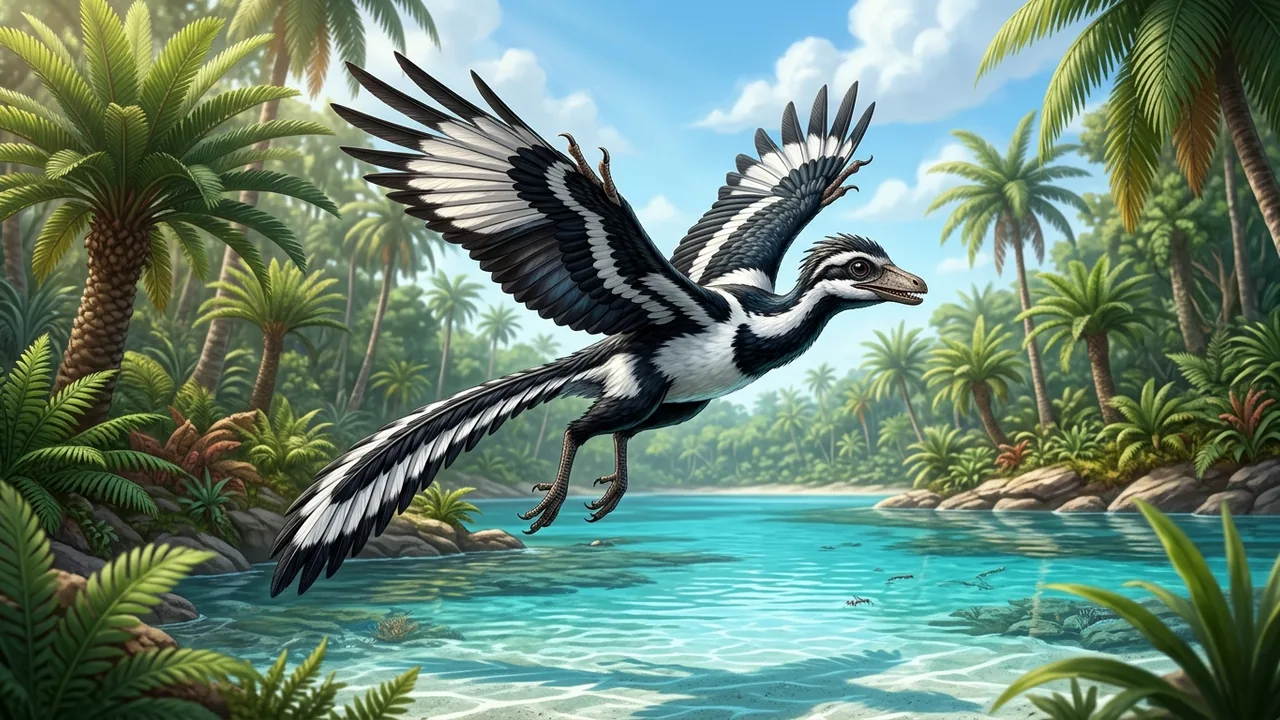
One hundred and fifty million years ago, a sleek black-and-white creature the size of a raven launched from a coastal cycad bush and glided silently over a turquoise German lagoon. Named Archaeopteryx lithographica—Greek for ancient wing etched in printing stone—this iconic Late Jurassic pioneer stands at one of the greatest crossroads in the history of life.
Measuring roughly 20 inches (50 centimeters) long with a 20-inch wingspan and weighing barely two pounds, Archaeopteryx looks wonderfully avian at first glance. Broad, layered flight feathers fanned across its arms and along both sides of its tail, while hollow bones kept its frame feather-light.
Look closer at its skeleton, however, and classic meat-eating theropod dinosaur traits leap into view! Instead of a smooth horny beak, slender jaws carried about fifty tiny, pointed teeth.
Three separate fingers tipped with curved claws projected from the front bend of each wing, and twenty-plus tail vertebrae formed a long bony rod rather than a stubby bird tail—capturing the exact evolutionary moment non-avian dinosaurs conquered the air.
Even its color was strikingly modern: fossilized capsules show bold dark wingtips contrasting with bright body feathers, built for both island display and durable .
Lost World Habitat: Island Lagoon Food Webs
During the Late Jurassic Period, rising seas turned central Europe into a sunlit tropical archipelago positioned near the latitude of modern Florida. Across southern Germany's Solnhofen region, rings of sponge mounds and coral reefs partitioned shallow waters into calm lagoons flanked by low, breezy islands.
Freshwater streams were absent on these small carbonate islands, creating a dry, sun-baked shoreline climate where towering conifers could not take root. Instead, drought-tolerant seed ferns, scaly-leaved conifers called Brachyphyllum, and stout cycads formed scrubby thickets three to ten feet high.
Within this coastal ecosystem, terrestrial and marine food webs interlocked across multiple levels. Island shrubs fueled primary consumers including wood-boring beetles, grasshoppers, cockroaches, and lacewings, while nutrient-rich lagoon edges supported shrimp, crabs, and darting fish.
Secondary consumers partitioned those prey niches cleanly: lizards like Bavarisaurus hunted insects on rocks, nimble Archaeopteryx worked shrub canopies, swift Compsognathus patrolled beaches, and long-tailed pterosaurs like Rhamphorhynchus skimmed fish from glittering lagoon surfaces.
Warm sea breezes and open coral channels rewarded animals with strong , allowing winged foragers to hop from island to island whenever droughts shrank food supplies on smaller sandbars.
What's on the Prehistoric Menu? Precision Snatcher
Operating as an agile secondary consumer in the island web, Archaeopteryx burned energy rapidly to fuel its warm-blooded metabolism and active lifestyle. Rather than tackling large prey, it specialized in high-protein arthropods and small vertebrates hidden among tangled coastal brush and coral wrack.
High-resolution skull scans reveal sensory equipment tailored for split-second hunting. Large bony eye rings supported wide eyes capable of sharp depth perception, while enlarged optic lobes inside its brain processed fast-moving targets like darting dragonflies, cicadas, beetles, and juvenile lizards.
Unlike dromaeosaur raptors whose blade-like teeth carried saw-like serrations for slicing muscle, Archaeopteryx grew tiny, smooth-edged conical teeth with slightly constricted bases and sharp tips. Spaced neatly along slender jaws, those peg-like teeth punctured brittle chitin insect exoskeletons without shattering.
Meanwhile, three flexible, sharp-clawed fingers on each forelimb helped Archaeopteryx hook twigs, pry loose bark, or pin squirming prey before tossing snacks backward down its throat.
Even without a deep keeled for marathon hovering, short airborne pounces from low branches gave this nimble hunter a huge surprise advantage over unsuspecting coastal insects, fueling rapid wing beats across sunny lagoon islands from dawn until dusk.
Superpowers & Anatomy: Flight Physics & Pigments
How well did Archaeopteryx actually fly? Biomechanical engineers answer that question by testing wing and bone geometry together! Each primary wing feather of Archaeopteryx was distinctly —built with a stiff, narrow front vane and a broader trailing vane that generated stable upward lift without fluttering apart.
Including its long frond-feathered tail and hindlimb 'trouser' feathers, Archaeopteryx enjoyed generous surface area and low wing loading, meaning each square inch of wing supported very little weight during smooth, controlled glides.
Powered flapping, however, worked differently than in modern songbirds. Living birds anchor massive pectoral muscles to a deep bony keel on their , whereas Archaeopteryx lacked an ossified keeled sternum! Instead, X-ray scans of its thin-walled arm bones show twist-resistance matching modern pheasants and roadrunners—proving Archaeopteryx launched into vigorous short-distance flapping bursts!
Electron microscopes even revealed rod-shaped pigment structures inside fossilized feathers. Packed with matte-black melanin along outer wingtips, those melanosomes strengthened keratin fibers against wind abrasion during rocky island landings.
Together, flexible half-moon wrists, hollow limb bones, and four-winged feather surfaces formed a transitional flight package that turned low shrub thickets into bustling Late Jurassic runways.
Flight vs. Fight Arena: Mastering 3D Space!
On tight Solnhofen islands, two nimble theropods crossed paths along sandy shrub lines: two-pound Archaeopteryx and six-pound Compsognathus longipes! Both dinosaurs had hollow bones, quick reflexes, and big eyes, yet their survival strategies diverged dramatically in the Flight-versus-Fight arena.
Built like a miniature sprinter with long shin bones and reduced two-fingered hands, Compsognathus dominated flat beach sprints at speeds approaching 25 miles per hour. Against a heavier, faster ground hunter, standing to fight with fragile hollow wing bones would have spelled disaster for Archaeopteryx—putting our dino-bird squarely on Team Flight!
What saved Archaeopteryx was vertical . Sprinting toward the nearest cycad trunk or limestone ledge, it beat its wings to press its clawed feet firmly against steep inclines—a clever maneuver called wing-assisted incline running.
Using three curved wing claws to scramble to the crown, Archaeopteryx vaulted skyward in an explosive burst of wingbeats and glided smoothly across turquoise channels where land-bound predators could never follow!
Once safely perched across the lagoon, Archaeopteryx tucked its feathered wings neatly against its sides using bird-like wrist joints, conserving energy until the coast was clear to forage again.
Fossil Detective Secrets: Scanning Ancient Stone
Why did Solnhofen preserve delicate wing feathers when almost every other Late Jurassic fossil bed left only bare bone? The answer lies in lagoon chemistry! Storms occasionally swept island insects, pterosaurs, and tired Archaeopteryx out over deep back-reef basins.
At the bottom of those calm basins sat hypersaline—extra-salty—water stripped of dissolved oxygen. Because scavengers such as crabs and worms could not breathe there, fallen bodies rested undisturbed while microscopic lime mud blanketed every feather shaft.
Discovered in 1861 just two years after Charles Darwin predicted transitional fossils must exist in rock layers, Archaeopteryx electrified science worldwide. Over the next century and a half, Bavarian quarries yielded twelve precious skeletal specimens.
Today, paleontologists beam high-energy synchrotron X-rays through those slabs to map trace chemicals and shapes without chipping a grain of stone—revealing bone growth rates, inner-ear flight balance, and striking black-and-white plumage across 150 million years!
Laser-stimulated fluorescence scans have even illuminated soft wing-skin membranes along its elbows that smoothed airflow and improved lift , proving ancient Bavarian limestone still yields brand-new breakthroughs in 2026 as museum scientists pair classic fossil hunting with cutting-edge physics!