Welcome to Earth's Deadliest Eras
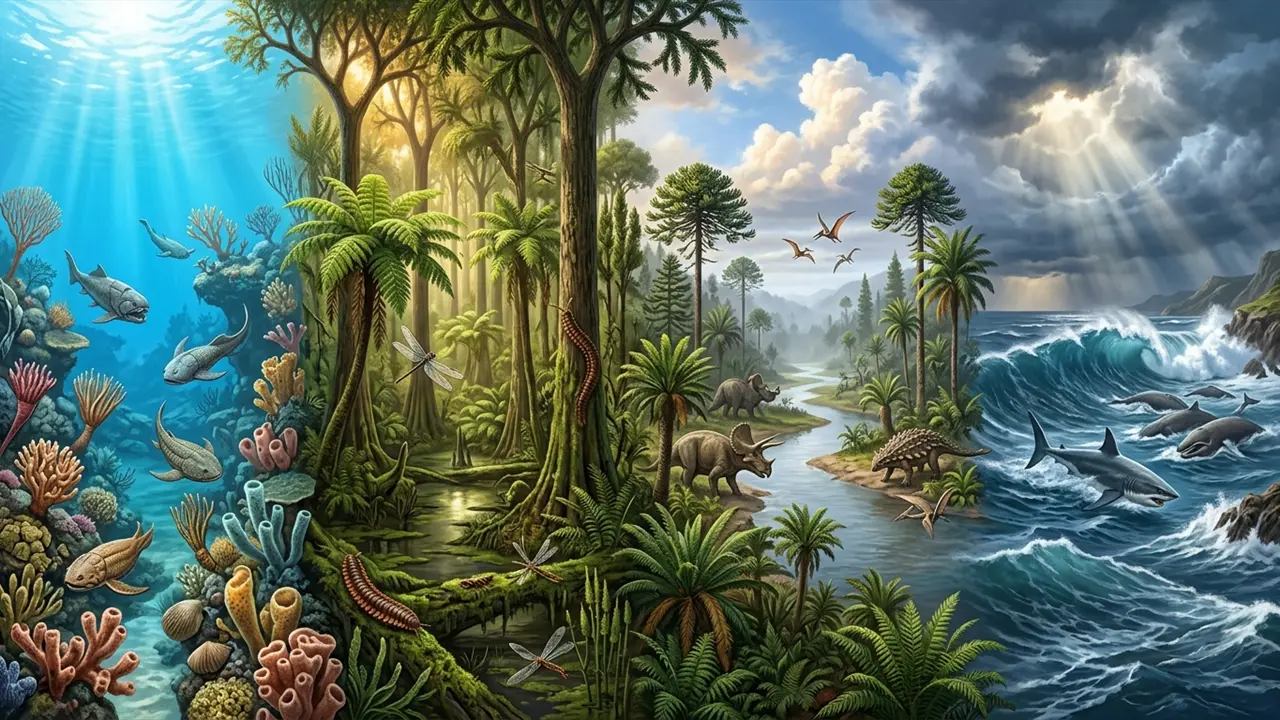
To understand the most formidable predators and armored giants ever to inhabit planet Earth, you have to erase every familiar map. Across the past four hundred million years, tectonic plates collided and split apart, global sea levels rose hundreds of feet over inland continents, and atmospheric oxygen and greenhouse gases surged and plunged. Each environmental transformation sparked evolutionary arms races across water, swamp, floodplain, and sky.
Long before the earliest dinosaurs evolved, the ancient Era produced nightmarish pioneers: eight-foot predatory sea scorpions stalking Devonian river mouths, thirty-foot bone-plated fish snapping blade-like jaws in twenty milliseconds, and car-sized armored millipedes gliding through oxygen-drenched Carboniferous coal forests. Next, the Mesozoic Era crowned forty-foot river crocodilians capable of dragging multi-ton dinosaurs underwater while giraffe-tall pterosaurs patrolled Late Cretaceous skies on fighter-jet wingspans.
Even after an asteroid impact reshaped global food webs sixty-six million years ago, the Cenozoic Era unleashed fifty-foot Paleocene rainforest boas, rival fifty-ton Miocene whale hunters, and giant Pleistocene mountain eagles in New Zealand! None of these astonishing creatures come from folklore or exaggeration; every measurement in this book rests on peer-reviewed paleontological evidence pulled directly from sedimentary rock formations on six continents.
By excavating mineralized skeletons, scanning skulls with high-resolution computed tomography, analyzing isotopic chemistry inside tooth enamel, and running finite-element biomechanical simulations, researchers calculate ancient body mass, bite pressure, and hunting strategy. Trace marks such as punctured vertebrae, crushed turtle carapaces, and ancient nursery beds preserve split-second encounters frozen in deep time. Step across three geological eras as stone clues resurrect eight real-life titans—and reveal how every prehistoric mastered, and ultimately lost, its vanished world.
Extreme size and specialized weaponry made these eight animals supreme masters of their ecosystems, yet rock layers also prove that giant specialists are often the most vulnerable when climates and food webs rapidly shift!
Megalodon: The Sixty-Foot Shark King
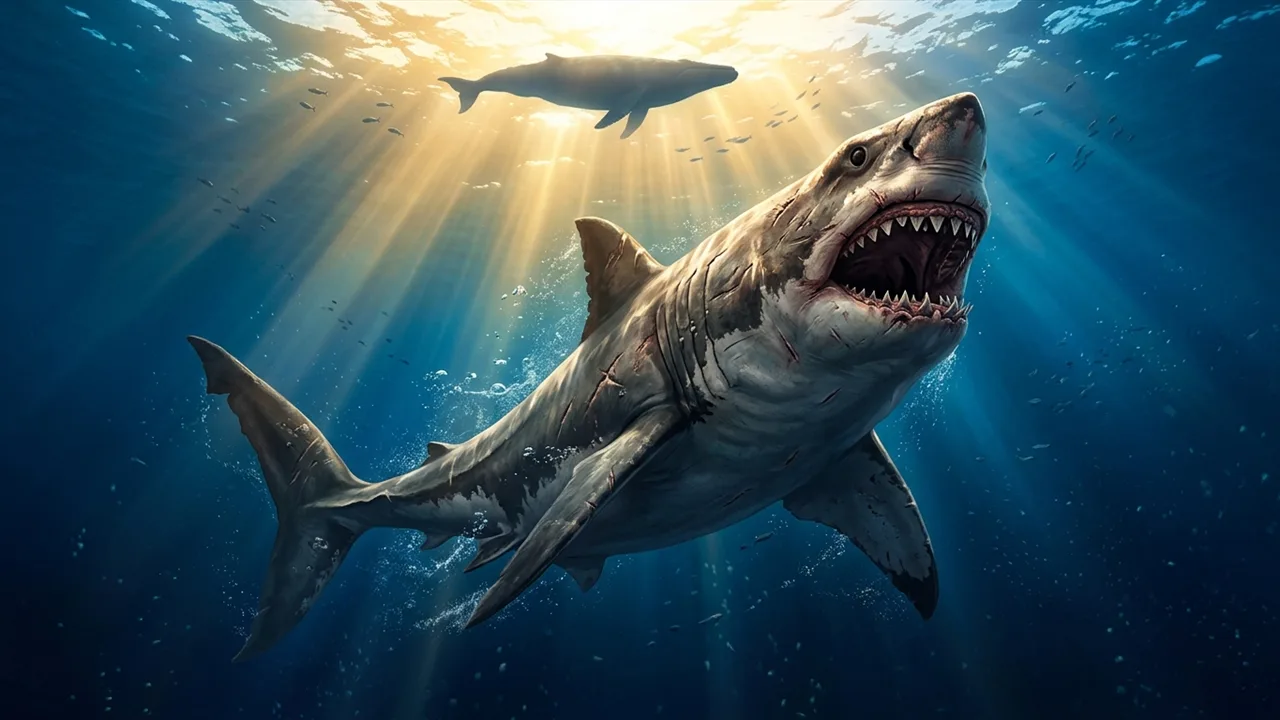
From the Early Miocene through the Pliocene Epoch—roughly twenty-three million to three point six million years ago—warm global oceans answered to a single super-predator: Otodus megalodon. Once grouped directly alongside modern great white sharks, this colossal megatooth mackerel shark is now classified in its own extinct family, Otodontidae. Scaling from rare preserved vertebral columns and thousands of stone teeth indicates mature females reached fifty-nine to sixty feet in length and weighed fifty to sixty-five tons!
Because elasmobranch skeletons are composed of lightweight cartilage rather than mineralized bone, skulls and fins seldom survive decay on the ocean floor. Teeth, however, are coated in ultra-hard enameloid and shed continuously throughout a shark's life. Megalodon's jaws spanned six and a half to nearly nine feet across—wide enough to engulf a compact automobile—and housed roughly two hundred seventy-six thick, heart-shaped teeth arranged in five active conveyor-belt rows.
Reaching over seven inches in diagonal slant height, each tooth combined a robust root with fine cutting edges built to shear dense blubber and splinter solid bone without snapping. Biomechanical simulations estimate a maximum posterior bite force near forty thousand pounds-force, or roughly one hundred eighty thousand newtons—the highest bite force calculated for any animal in Earth's history.
Isotope analyses and gouged whale bones show this warm-bodied marine targeted baleen whales, sea cows, and pinnipeds, launching high-speed vertical strikes from deep water to smash rib cages and immobilize tail flukes. Shallow tropical nurseries documented in Panama and South Carolina once sheltered six-foot newborn pups safe from open-ocean hazards. Only when Pliocene ocean currents cooled, coastal nurseries shrank, and agile pack-hunting killer whales emerged did the sixty-foot shark king finally vanish.
Combining a car-swallowing jaw gape, two hundred seventy-six seven-inch serrated blades, and a forty-thousand-pound bite, Megalodon disabled multi-ton whales in a single upward collision!
Titanoboa: Monster Snake of the Swamp
Six million years after the end-Cretaceous asteroid impact wiped out non-avian dinosaurs, northern South America blossomed into Earth's earliest documented Neotropical rainforest. Preserved inside the Paleocene rock layers of Colombia's Cerrejón coal mine, giant palm fronds, legume leaves, and aquatic reptiles record a humid greenhouse climate averaging eighty-six to ninety-three degrees Fahrenheit year-round. Because snakes are ectothermic reptiles whose maximum body size scales with ambient warmth, those steamy swamps forged a monster: Titanoboa cerrejonensis.
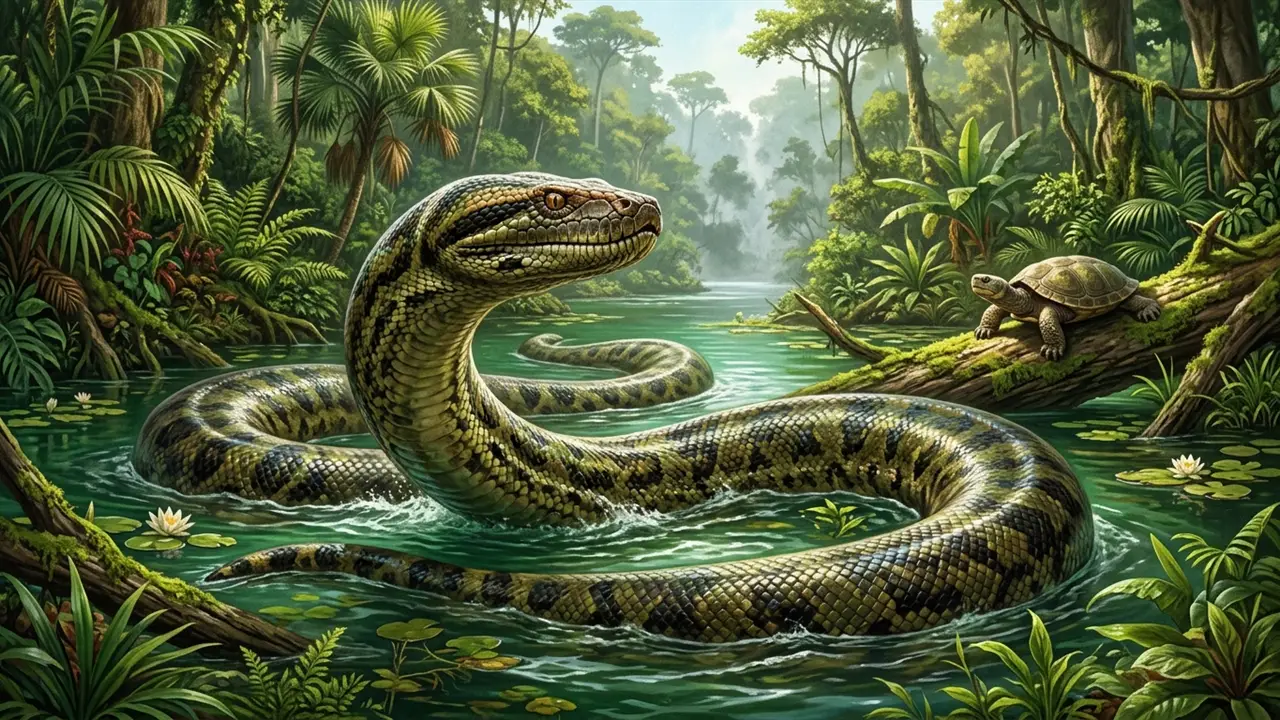
Unearthed across expeditions announced in 2009, stone vertebrae from twenty-eight individual snakes astonished vertebrate paleontologists when placed beside modern green anaconda bones. Reconstructions revealed an adult stretching forty-two to fifty feet from snout to tail tip, measuring nearly three feet across its muscular trunk, and weighing well over two thousand five hundred pounds! Each massive dorsal vertebra measured over five inches wide with distinctive T-shaped neural spines that anchored thick bands of interlocking back muscle along its forty-eight-foot spine.
Heaving over a ton of muscle across dry forest litter would have been exhausting, so Titanoboa lived semi-aquatically like a bus-sized anaconda buoyed by warm river channels and flooded peat marshes. Rare cranial bones bearing numerous recurved palatine and marginal teeth revealed a surprise: alongside ambushing giant lungfish, this stealthy swamp tackled five-foot Carbonemys river turtles and twelve-foot dyrosaurid crocodylomorphs.
Possessing zero venom glands, Titanoboa relied on explosive underwater lunges followed by overwhelming . Within seconds of clamping its curved teeth onto startled prey, heavy coils looped tight and exerted hundreds of pounds of pressure per square inch—halting blood flow to the brain and crushing armored ribs beneath murky rainforest waters before global cooling eventually shrank tropical snakes.
Buoyed silently inside murky Paleocene swamps, a fifty-foot, ton-plus constrictor thicker than a grown human's waist could erupt from shallow water and crush twelve-foot crocodiles!
Sarcosuchus & Deinosuchus: The Super-Crocs
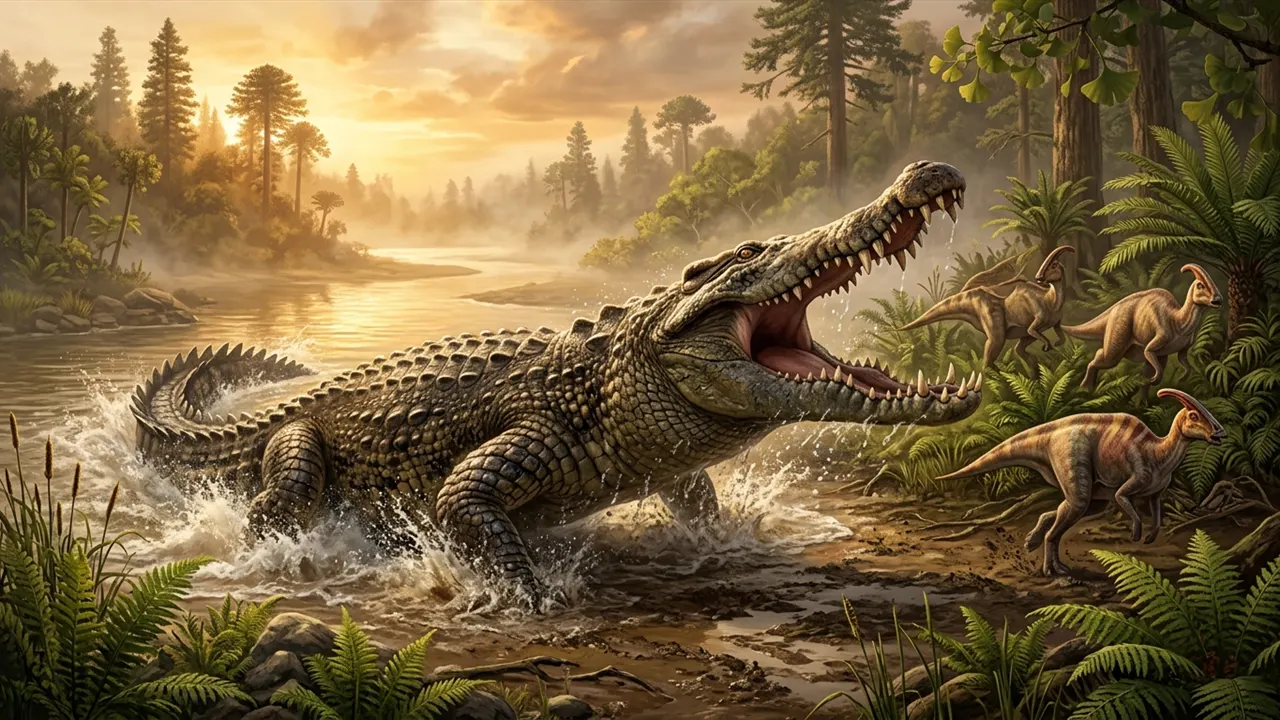
Throughout the Cretaceous Period, even multi-ton dinosaurs approached murky riverbanks and coastal lagoons with extreme caution. Separated by roughly thirty million years and the widening Atlantic Ocean, two distinct lineages of crocodyliforms independently evolved convergent giant bodies nearly double the length of modern saltwater crocodiles: North Africa's Early Cretaceous Sarcosuchus imperator and North America's Late Cretaceous Deinosuchus riograndensis. Mature individuals of both giants stretched thirty-five to forty feet long and weighed between eight and ten tons!
Despite sharing the nickname super-crocs, their skull anatomy reflected different evolutionary branches and menus. Inhabiting lush inland river systems across what is now Niger's Sahara Desert around one hundred twelve million years ago, pholidosaurid Sarcosuchus sported a slender five-and-a-half-foot snout tipped with a bulbous vascular bulla and more than one hundred sturdy conical teeth ideal for gripping giant coelacanths, lungfish, and riverside dinosaurs like Ouranosaurus.
Roughly eighty-two to seventy-three million years ago along the Western Interior Seaway, alligatoroid Deinosuchus patrolled winding deltas and brackish coastal channels from Montana and Texas to Georgia. Its broad, heavily reinforced skull generated bite forces estimated between eighteen thousand and twenty-three thousand pounds, pairing piercing front fangs with blunt, banana-thick rear teeth engineered to pulverize marine turtle shells and dinosaur limb bones.
Cloaked beneath overlapping dorsal osteoderms with only periscopic eyes and nostrils breaking brown water, each patient waterway launched explosive shoreline lunges. Punctured and partially healed hadrosaur and theropod tail vertebrae confirm that these armored giants clamped onto drinking dinosaurs and dragged them beneath the current in violent, hydro-powered rolls. Growth rings preserved inside cross-sectioned osteoderms suggest these armored river rulers grew steadily for over thirty-five years to reach full dinosaur-hunting proportions.
Virtually invisible beneath muddy river and estuary surfaces, ten-ton armored super-crocs ambushed thirsty dinosaurs with twenty-thousand-pound jaws and inescapable underwater rolls!
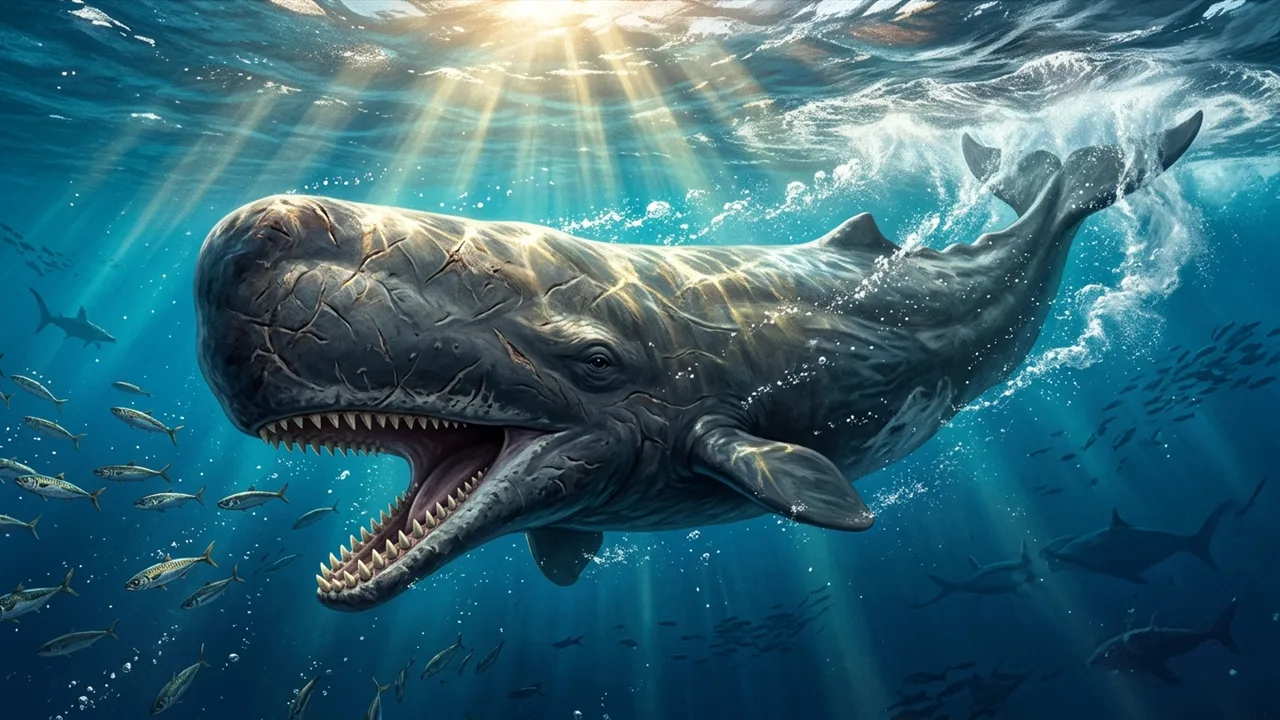
Livyatan: The Whale-Eating Leviathan
Roughly nine point nine to eight point nine million years ago during the Late Miocene Epoch, cold nutrient-rich upwelling currents along the coast of Peru fueled one of the densest marine food webs in Earth's history. Vast populations of penguins, seals, dolphins, and medium-sized cetotheriid baleen whales supported two rival fifty-ton super-predators in the exact same waters: Otodus megalodon and a terrifying macroraptorial sperm whale named Livyatan melvillei!
Excavated in 2008 from dry desert cliffs of Peru's Pisco Formation, Livyatan's three-meter stone skull transformed how paleontologists view ancient whale evolution. Modern sperm whales dive nearly a mile into pitch-black abyssal zones to suction-feed on soft-bodied squid, retaining modest peg-like teeth solely in a narrow, rod-shaped lower jaw. Livyatan, stretching fifty to fifty-nine feet long and weighing roughly fifty tons, was anatomically built to tear apart giant warm-blooded mammals near the sunlit surface.
Anchored deeply inside heavy, robust upper and lower jaws sat twenty-two interlocking conical teeth measuring up to fourteen point two inches long and nearly five inches in diameter—the largest functional biting teeth, excluding external tusks, of any vertebrate ever discovered! Deep shear facets worn along their enamel prove those massive upper and lower fangs scissored tightly past one another to gouge huge mouthfuls from struggling twenty-five-foot baleen whales.
Cradled inside a cavernous basin atop its skull rested an enormous wax-filled spermaceti organ that focused long-range sonar clicks through murky coastal waters and may have cushioned high-speed battering impacts. Combining mammalian endothermy, large-brained social intelligence, precision sonar, and foot-long interlocking jaws, this supreme cetacean stood fin-to-fin with Megalodon until Late Miocene cooling collapsed their giant-whale prey base.
Pairing warm-blooded mammal intelligence and long-range sonar with fourteen-inch interlocking teeth in both jaws, fifty-ton Livyatan hunted whales right alongside Megalodon!
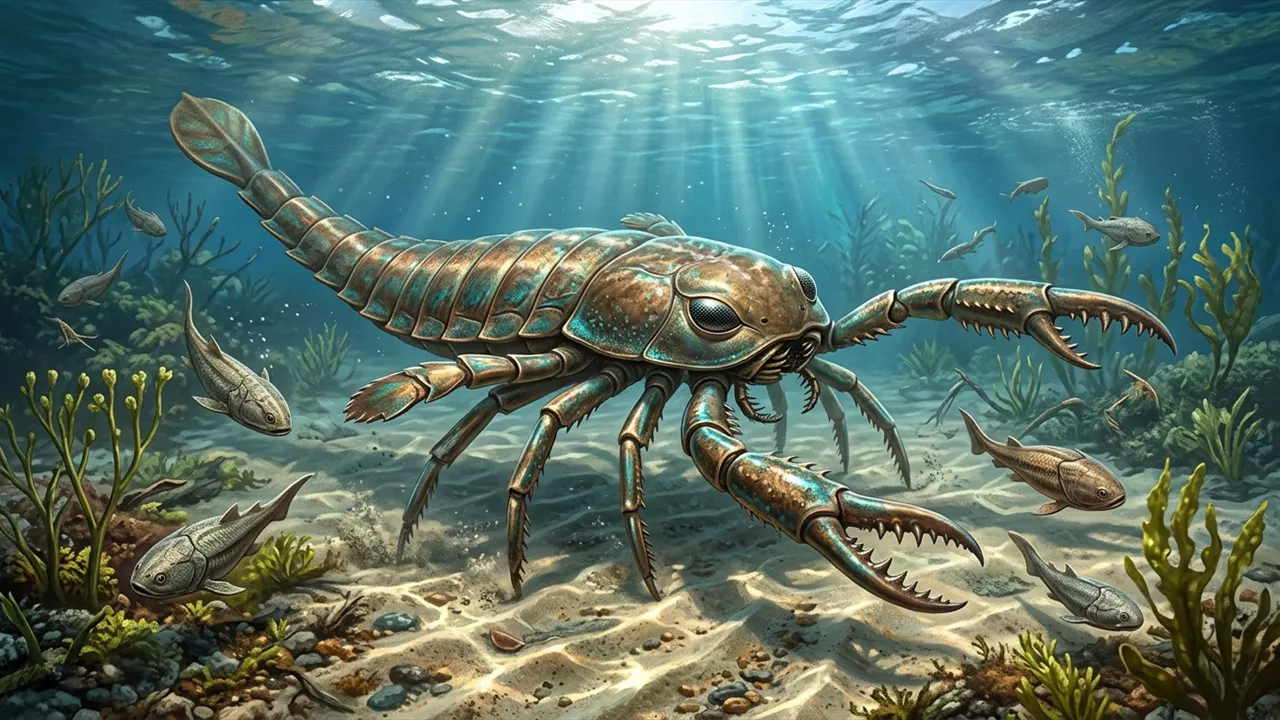
Jaekelopterus: Giant Sea Scorpion
Rewind Earth's geological clock roughly four hundred million years to the Early Devonian Period of the Era, and terrestrial ecosystems barely reached human ankle height. Spore-bearing vascular plants clung to damp shorelines while miniature early arachnids and myriapods colonized muddy riverbanks, leaving the planet's fiercest evolutionary arms race submerged beneath shallow river deltas and each brackish coastal . Dominating those sunlit, sediment-clouded channels was Jaekelopterus rhenaniae (pronounced yay-keh-LOP-ter-us reh-NAY-nee-ee), a giant eurypterid popularly nicknamed a sea scorpion.
Its true proportions stunned researchers in 2007 when paleontologists examining Early Devonian Klerf Formation strata from Rhineland, Germany analyzed a solitary fossilized chelicera—a barbed frontal grasping appendage measuring eighteen inches long all by itself! Applying established biometric scaling ratios from complete eurypterid skeletons revealed that the intact animal stretched between eight and eight point two feet from pincer tips to tail paddle, establishing Jaekelopterus as the largest ever documented in the stone record, surpassing Carboniferous swamp millipedes and modern Japanese spider crabs in body bulk.
Taxonomically, eurypterids were aquatic chelicerates more closely allied to modern horseshoe crabs and arachnids than to true venomous land scorpions. Jaekelopterus carried zero venom glands on its broad, flattened tail telson, which functioned instead as a horizontal hydrodynamic rudder alongside wide, oar-shaped sixth swimming appendages for rapid bursts of speed.
What made Jaekelopterus truly lethal was biomechanical precision: thousands of tightly packed optical facets inside forward-angled compound eyes delivered crisp stereoscopic depth tracking in sunlit shallows, allowing this human-outgrowing ambush hunter to lie half-buried in river silt before snapping serrated raptorial claws shut right through the dermal head shields of early jawless ostracoderms and primitive jawed fishes.
Outsizing an adult human and breaking the all-time arthropod size ceiling, Jaekelopterus combined sharp compound-eye depth perception with eighteen-inch barbed pincers in murky river mouths!
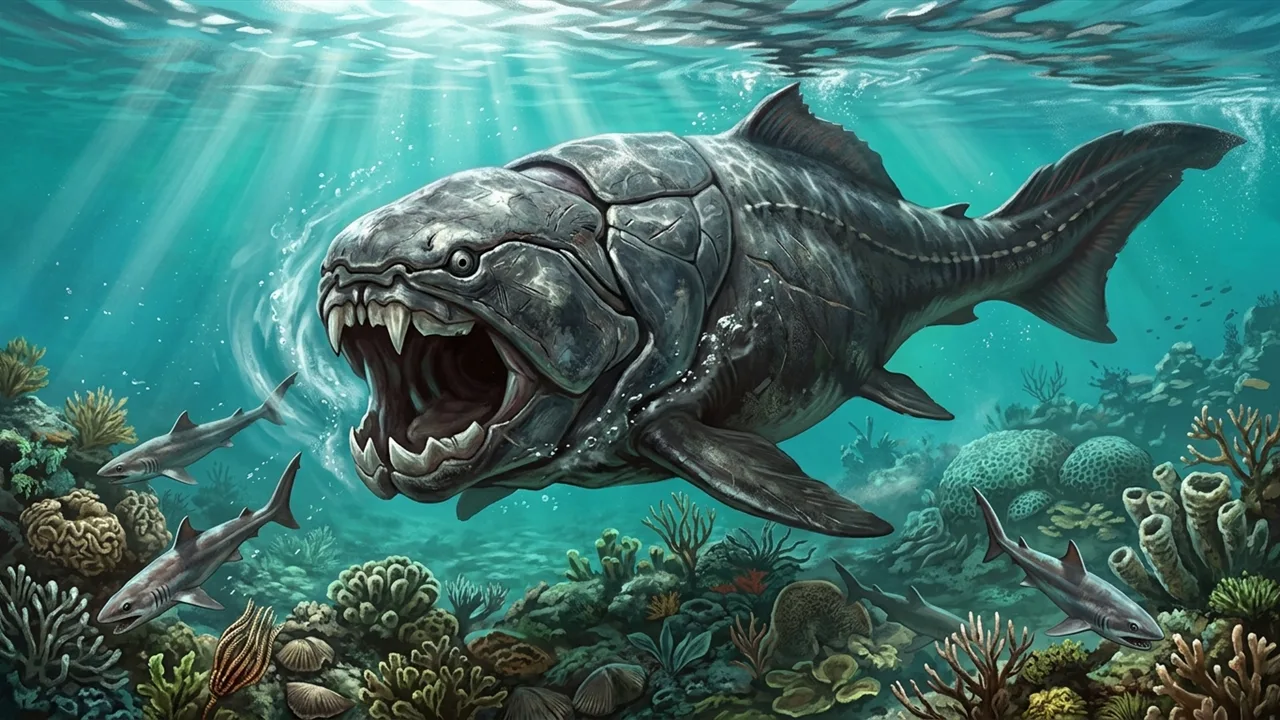
Dunkleosteus: The Armored Guillotine Fish
During the Late Devonian Period (~382 to 358 million years ago), late in the Era, marine vertebrate evolution exploded into such ecological variety that geologists dub the interval the Age of Fishes. Open-water patrols across warm subtropical seas—including the ancient epicontinental seaway preserved in Ohio's dark Cleveland Shale—belonged to Dunkleosteus terrelli (pronounced DUNK-uhl-OSS-tee-us TAIR-uh-lye), an arthrodire classically estimated at twenty to thirty feet long and up to four tons, reigning as one of Earth's earliest vertebrate super-carnivores and marine titans.
Whereas modern sharks build lightweight internal skeletons of flexible cartilage, Dunkleosteus armored its massive cranium and anterior thorax in articulated dermal bone plates nearly two inches thick, hinged at a muscular ball-and-socket neck joint while its unarmored posterior body propelled forward with powerful tail thrusts. Even more remarkable, Dunkleosteus possessed zero true enamel-coated teeth! Instead, two pairs of dense, blade-edged gnathal bone plates grew directly out of its upper and lower jaw margins, shearing tightly past one another with every bite like self-honing industrial steel clippers.
Biomechanical engineering simulations of three-dimensional stone skulls demonstrated why nothing swimming in Late Devonian seas was safe—not even fellow armored placoderms. Driven by a kinetic four-bar skull linkage coordinating cranial roof, thoracic shield, cheek plate, and lower mandible, Dunkleosteus snapped its gape wide open in just twenty milliseconds—one-fiftieth of a second—generating powerful negative suction pressure that vacuumed early sharks and shelled ammonoids straight inward.
An instant later, massive adductor jaw muscles slammed those self-sharpening bone fangs together, concentrating thousands of newtons onto narrow blade tips to punch cleanly through solid dermal bone armor before regurgitating indigestible plate fragments across the muddy seafloor!
Combining a twenty-millisecond suction strike with hydraulic-grade bite pressure focused onto self-sharpening dermal bone blades, Dunkleosteus sheared through early sharks and rival bone shields alike!
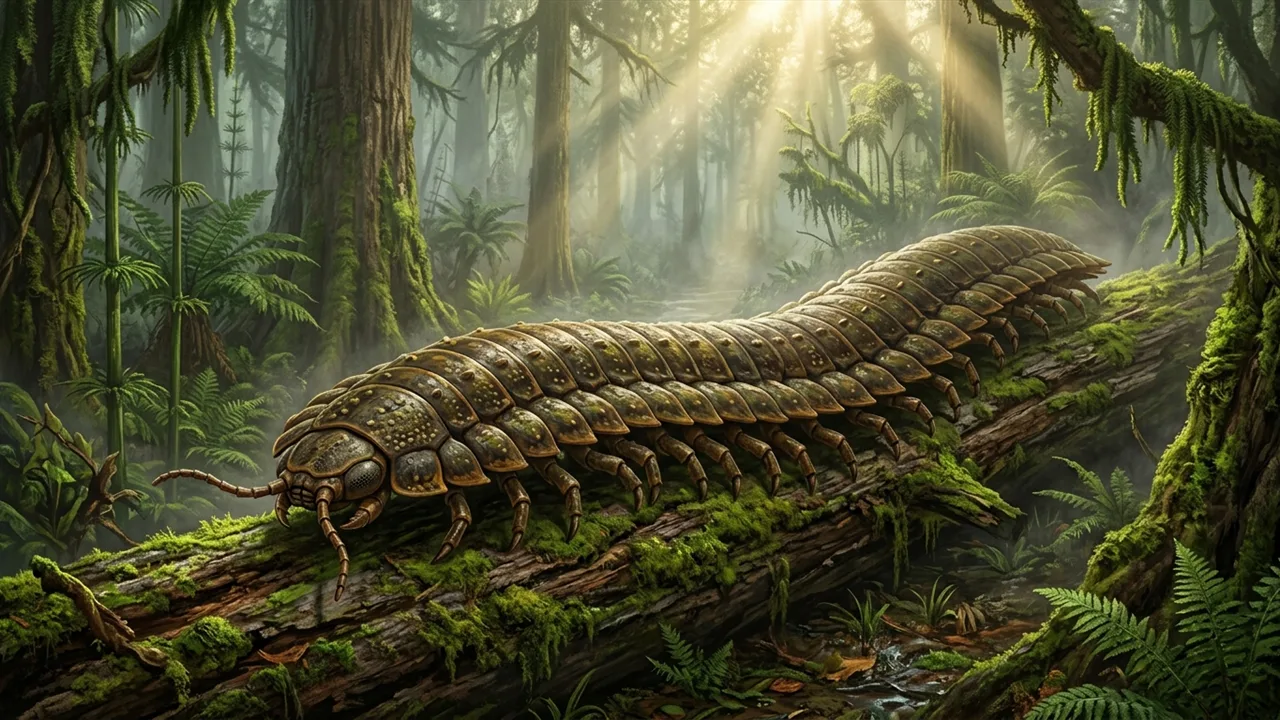
Arthropleura: Car-Sized Swamp Millipede
Roughly 345 to 290 million years ago during the Carboniferous Period of the Era, equatorial Euramerica supported sprawling coal wetlands and seasonal coastal delta woodlands towered over by hundred-foot Lepidodendron scale trees, giant calamite horsetails, and dense seed-fern canopies. Vast quantities of buried plant carbon pushed atmospheric oxygen concentrations past thirty percent, while terrestrial food webs still lacked large, agile vertebrate insectivores—twin ecological conditions that enabled ancient myriapods to achieve staggering proportions in Arthropleura (pronounced AR-throh-PLOOR-uh).
In 2018, coastal cliff erosion along Northumberland in northern England split open a sandstone river-channel boulder preserving a giant molted dorsal carapace segment from an open woodland delta. Scaling those articulated body segments proved adult Arthropleura reached up to eight point five feet in length, twenty-two inches in width—wider than a highway lane stripe—and roughly one hundred ten pounds in mass, cementing its record status as the largest terrestrial and land in Earth's entire stone archive.
Approximately thirty overlapping, trilobed armor plates flared outward over dozens of paired, gripping legs that left parallel, tire-wide trackways called Diplichnites across damp Carboniferous mudflats in Scotland, Germany, and Nova Scotia. Those tough lateral plates deflected attacks from giant crocodile-like labyrinthodont amphibians prowling shallow swamp margins and sunlit stream crossings.
Although nineteenth-century naturalists speculated that Arthropleura wielded venomous fangs, fossilized gut contents, coprolites packed with lycopod spores, and 2024 micro-CT X-ray scans of juvenile specimens from Montceau-les-Mines in France revealed stalked crab-like eyes, leg-like mouthparts, and a high-calorie detritivore diet of decaying woodland litter, woody seeds, and nutrient-dense spores—proving a gentle plant-eater can still inspire unforgettable bug-sized awe!
Even without predatory fangs, a hundred-ten-pound, car-length segmented arthropod rustling out of misty Carboniferous ferns on dozens of clicking legs remains nature's ultimate giant-bug spectacle!
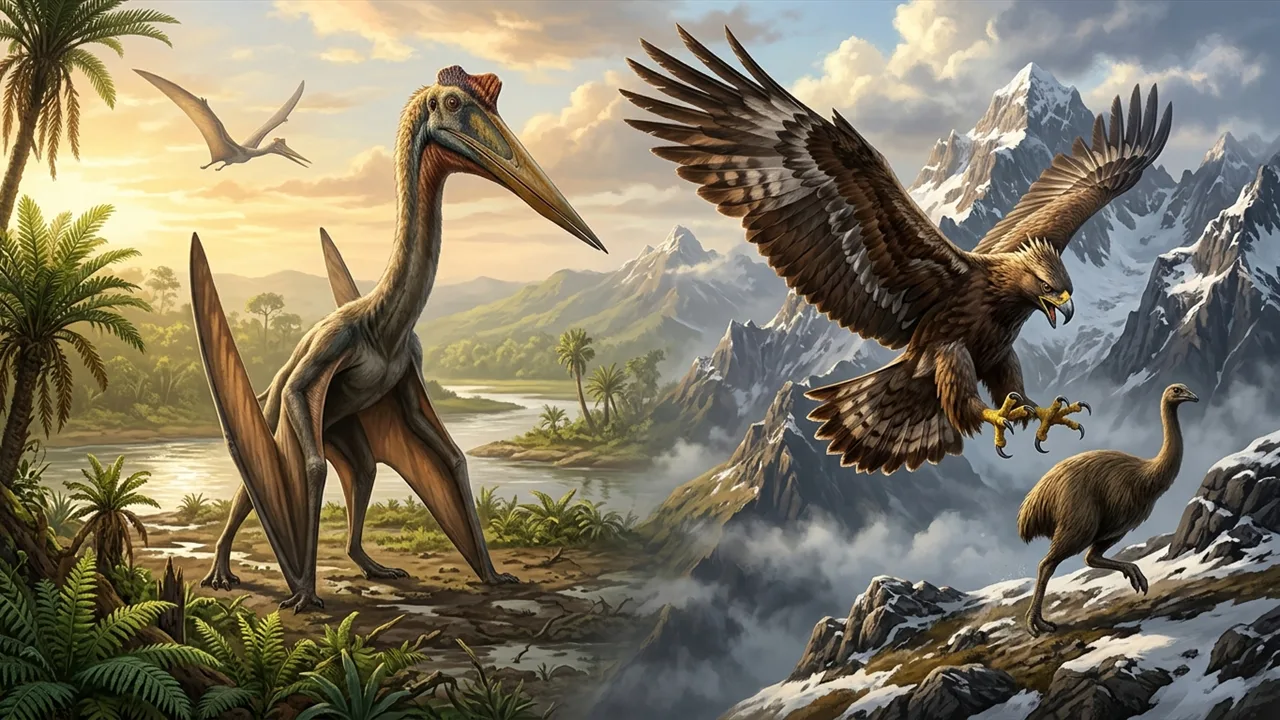
Quetzalcoatlus & Haast's Eagle: Sky Terrors
Even Earth's open skies produced breathtaking hunters across two dramatically different geological epochs. Sixty-eight to sixty-six million years ago above Late Cretaceous floodplains in West Texas soared Quetzalcoatlus northropi (pronounced ket-sahl-koh-AHT-lus nor-THROH-pye), an azhdarchid and the largest volant animal ever discovered, spanning thirty to thirty-six feet from wingtip to wingtip like a light fighter aircraft! Despite standing sixteen to eighteen feet tall on solid ground—matching an adult giraffe—its honeycomb-walled, pneumatic bones kept total body mass near five hundred pounds, enabling a powerful quadrupedal vault that launched it eight feet airborne off hyper-muscular forelimbs.
Once back on land, Quetzalcoatlus transformed seamlessly from effortless continental thermal glider into a fast-striding terrestrial stalker. Tucking its elongated fourth wing-digits neatly beside its flanks, it marched upright on all four limbs across semi-arid floodplains and meandering riverbanks, whipping down an eight-foot, toothless, dagger-pointed beak to impale and swallow human-sized juvenile dinosaurs, small mammals, and lizards whole without chewing!
Nearly sixty-six million years later, isolated mountain forests on New Zealand's South Island lacked native mammalian carnivores, allowing giant flightless moa birds to reach twelve feet tall and five hundred pounds. Evolution answered that open ecological vacuum with Haast's Eagle (Hieraaetus moorei), the heaviest true eagle known to science at roughly thirty-three to thirty-nine pounds and the island's undisputed aerial .
Rather than wide ocean-gliding wings, Haast's Eagle evolved a compact eight-to-ten-foot wingspan tailored for tight woodland maneuvering, plunging from mountain forest canopies at nearly fifty miles per hour to drive three-inch, tiger-claw-sized talons into moa pelvises and necks—persisting until roughly 1400 CE, late enough to live alongside early Polynesian settlers!
Prehistoric skies mastered both extremes of aerial terror: a giraffe-tall pterosaur spearing human-sized prey on foot and a woodland ambush eagle striking birds fifteen times its own body weight!
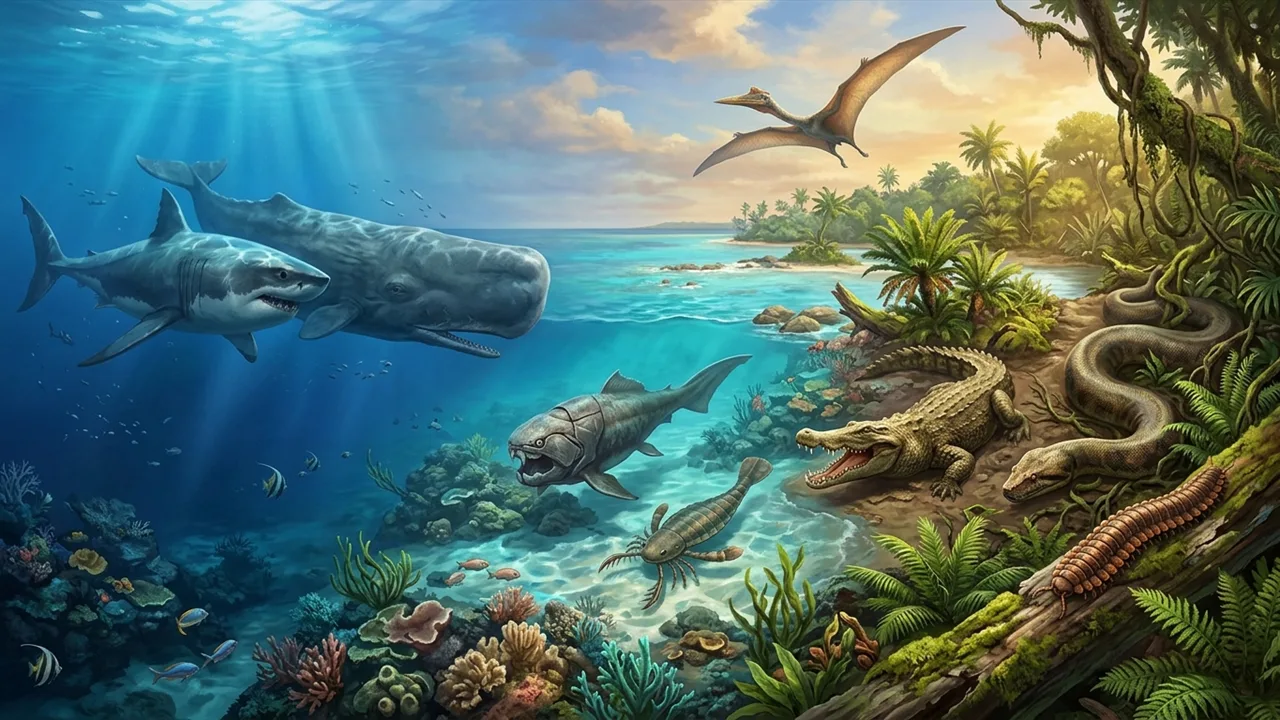
Prehistoric Size & Era Showdown
Surveying more than four hundred million years of evolutionary history—from Early Devonian river deltas in the Era to Late mountain forests—reveals that giant body size emerged repeatedly whenever global climate, atmospheric oxygen, water buoyancy, and prey abundance aligned. Long before the earliest dinosaurs walked on dry land, Paleozoic estuaries, subtropical coral seas, and humid coal swamps forged eight-foot Jaekelopterus, guillotine-jawed Dunkleosteus, and car-length Arthropleura, proving ancient ecosystems already supported complex food webs and formidable dermal armor.
During the Mesozoic Era, sprawling Cretaceous river systems across Africa and North America nourished forty-foot crocodile-relatives like Sarcosuchus and Deinosuchus, while giraffe-tall Quetzalcoatlus claimed the all-time wingspan record overhead on thirty-six-foot wings. Following the end-Cretaceous asteroid extinction sixty-six million years ago, warm Cenozoic greenhouse rainforests, whale-rich Miocene ocean upwellings, and mammal-free Pleistocene islands produced fifty-foot Titanoboa, raptorial Livyatan, sixty-foot Megalodon, and deadly Haast's Eagle.
Comparing all eight chapters side by side uncovers fundamental biomechanical boundaries that govern animal size across Earth's diverse habitats: dense seawater buoyancy and calorie-rich marine mammal blubber permitted Megalodon and Livyatan to approach sixty feet in length and fifty-plus tons in mass, whereas terrestrial arthropods faced strict respiratory and exoskeleton-molting ceilings near eight and a half feet, and giant powered flyers relied on ultralight hollow pneumatic skeletons.
Ultimately, extreme anatomical specialization became every giant 's greatest ecological vulnerability whenever global temperatures cooled, sea levels dropped, or mega-prey populations vanished—leaving mineralized stone bones, serrated teeth, molted shells, and muddy trackways preserved in sedimentary rock for modern paleontologists to measure and compare in the visual showdown table below!
| Creature | Max Size & Scale | Habitat | Geological Era |
|---|---|---|---|
| 1. Megalodon | 60 ft long. |
🌊 Sea | Cenozoic (Miocene–Pliocene, 23–3.6 MYA). |
| 2. Livyatan | 59 ft long. |
🌊 Sea | Cenozoic (Late Miocene, 9.9–8.9 MYA). |
| 3. Titanoboa | 48–50 ft long. |
🌿 Land / Swamp | Cenozoic (Paleocene, 60–58 MYA). |
| 4. Sarcosuchus & Deinosuchus | 40 ft long. |
🌊 River / Estuary | Mesozoic (Cretaceous, 112–73 MYA). |
| 5. Quetzalcoatlus & Haast's Eagle | 36 ft / 10 ft wingspan. |
☁️ Sky | Mesozoic (Cretaceous) & Cenozoic (Pleistocene). |
| 6. Dunkleosteus | 25–30 ft long. |
🌊 Sea | Paleozoic (Late Devonian, 382–358 MYA). |
| 7. Arthropleura | 8.5 ft long. |
🌿 Land / Swamp | Paleozoic (Carboniferous, 345–290 MYA). |
| 8. Jaekelopterus | 8.2 ft long. |
🌊 River / Estuary | Paleozoic (Early Devonian, ~400 MYA). |
Buoyant Cenozoic oceans produced the longest and heaviest predators on Earth, while Paleozoic armor, Mesozoic river stealth, and aerial strike mechanics proved every habitat bred unforgettable titans!