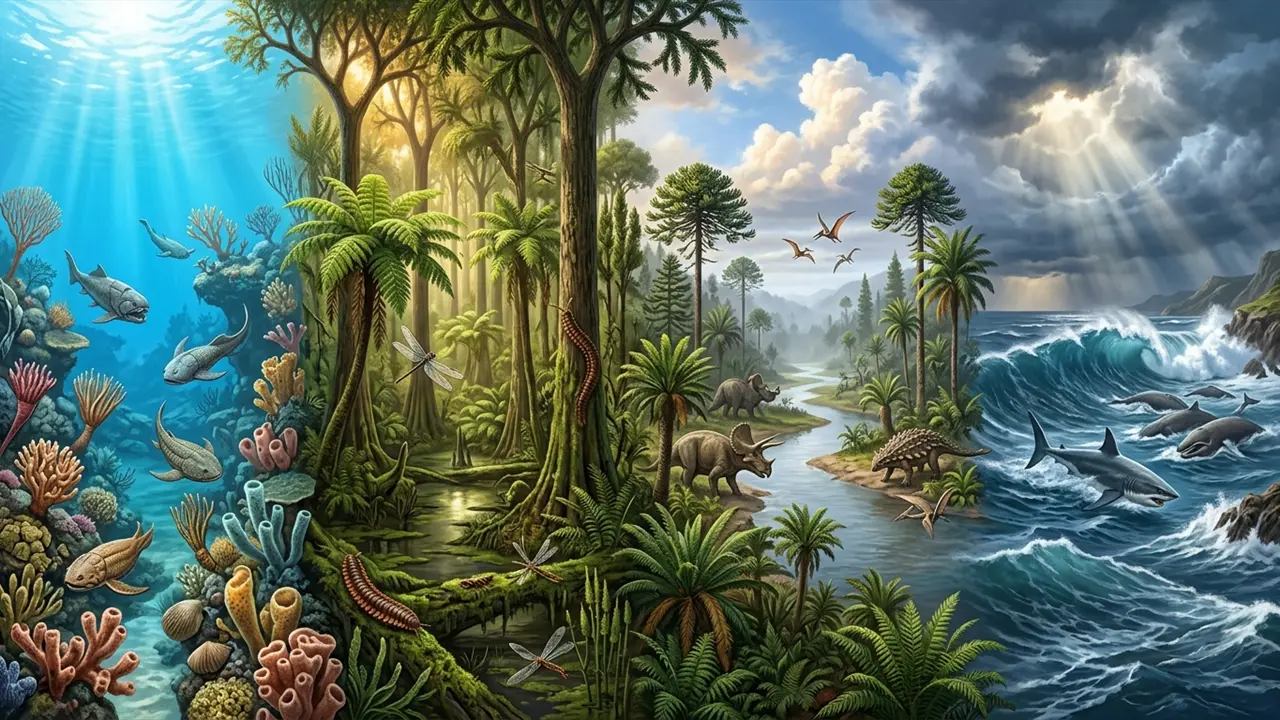
Welcome to Earth's Deadliest Eras
Long before modern coastlines took shape or early humans walked across grassy savannas, Earth hosted a breathtaking succession of prehistoric worlds. Across more than four hundred million years, drifting continents, shifting sea levels, and dramatic swings in oxygen and temperature drove animals to extraordinary extremes. During the ancient Era, strange pioneers conquered water and land alike: eight-foot predatory sea scorpions lurked in shallow deltas, bone-armored guillotine fish ruled open seas, and car-length millipedes glided beneath towering coal-swamp ferns.
Millions of years later, the Mesozoic Era raised reptilian scale even higher. Forty-foot crocodilian cousins ambushed thirsty dinosaurs along muddy floodplains, while pterosaurs as tall as giraffes launched from Late Cretaceous plains on thirty-six-foot wingspans. Even after a catastrophic asteroid impact reshaped life sixty-six million years ago, the Cenozoic Era produced fifty-foot rainforest boas, rival fifty-ton ocean titans, and giant mountain eagles.
Paleontologists reconstruct these vanished ecosystems without guesswork by examining mineralized skeletons, microscopic tooth wear, coprolites, and healed bite punctures preserved in sedimentary rock. Engineering software even tests three-dimensional skull scans to measure bite force and swimming speed! Together, these clues reveal how every ancient mastered its environment across land, sea, and sky. Prepare to journey across deep time and meet the eight scariest prehistoric animals ever uncovered in stone!
Every monster in these pages was shaped by real climate shifts, oxygen levels, and evolutionary arms races—and stone clues let us study their superpowers safely today!
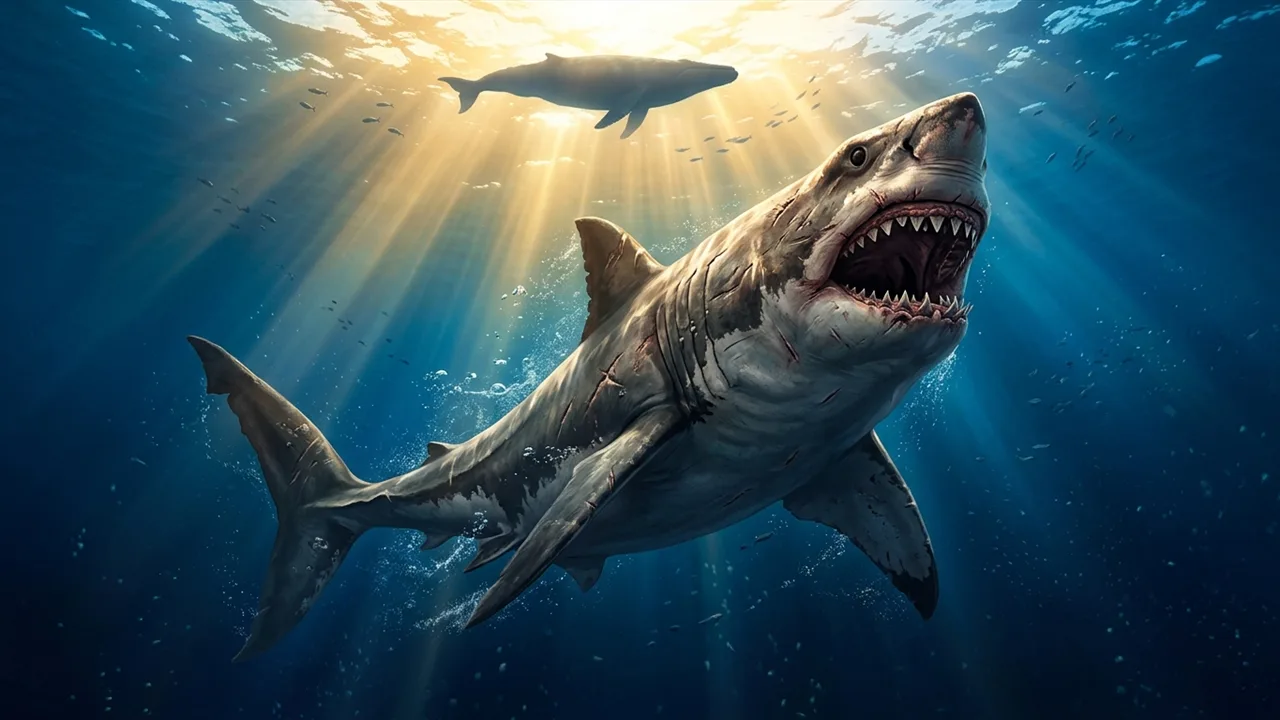
Megalodon: The Sixty-Foot Shark King
For nearly twenty million years during the Miocene and Pliocene Epochs, warm global seas belonged to Otodus megalodon—a megatooth shark built on a scale that defies comparison with living fish. Reaching fifty-nine to sixty feet in length and weighing fifty to sixty-five tons, an adult female Megalodon stretched longer than a city transit bus and weighed roughly ten times as much as today's largest great white sharks. Shallow coastal bays from Panama to South Carolina served as protected nurseries for newborn pups already six feet long!
Because shark skeletons consist of flexible cartilage rather than dense bone, almost the entire body decays before mineralizing. Fortunately, Megalodon shed thousands of enameled teeth during its lifetime, leaving giant triangular blades up to seven inches tall scattered across ancient seafloors. Five conveyor-belt rows held roughly two hundred seventy-six thick, heart-shaped teeth lined with fine notches that sawed cleanly through dense whale blubber and rib bones.
Biomechanical models show its six-and-a-half-foot-wide jaws clamped down with roughly forty thousand pounds of force—the most powerful bite ever calculated for any creature. Launching vertical ambushes from dim water below, this supreme marine crippled baleen whales by crushing tail flukes, flippers, and chests before cooling Pliocene seas and shifting whale migrations ended its twenty-million-year reign around three point six million years ago.
Jaws wide enough to swallow a compact car combined forty thousand pounds of bone-crushing pressure with nearly three hundred seven-inch serrated blades!
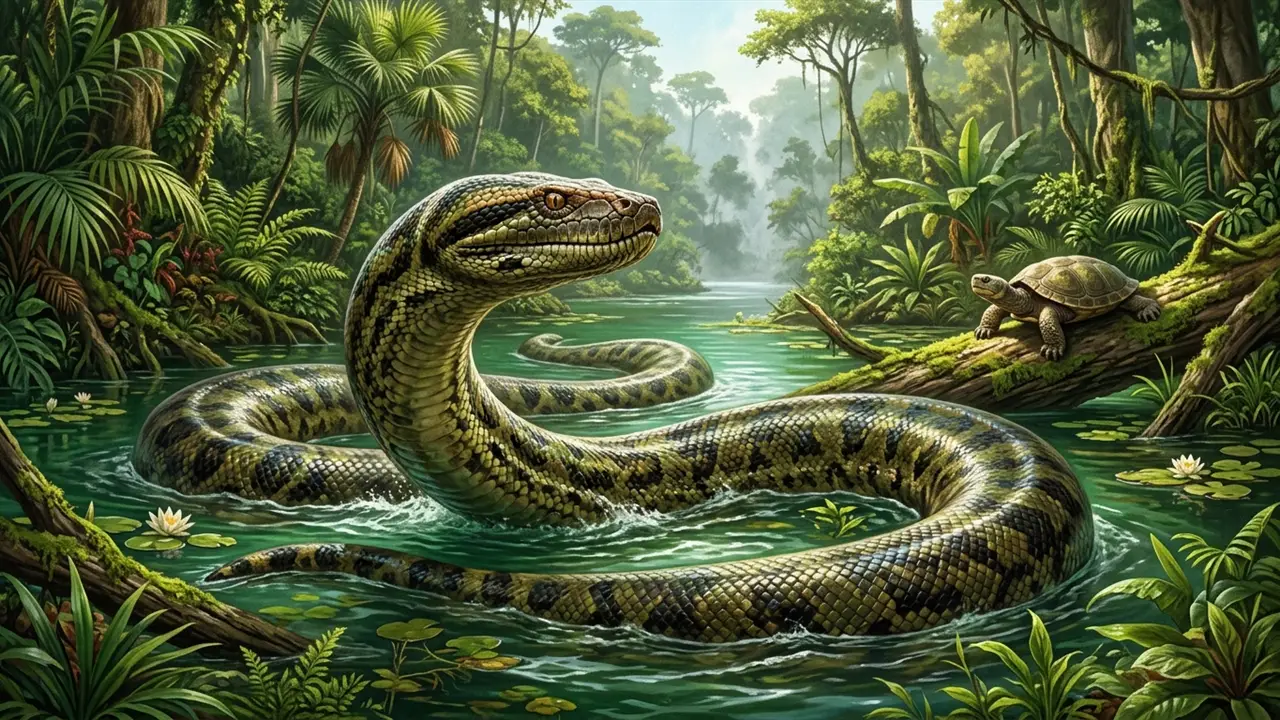
Titanoboa: Monster Snake of the Swamp
Roughly sixty million years ago during the Paleocene Epoch, northern South America recovered from the asteroid impact that ended the dinosaur age by sprouting lush, rain-soaked tropical forests. Year-round greenhouse warmth pushed equatorial temperatures several degrees higher than modern jungles, supercharging the metabolism of cold-blooded reptiles. Inside Colombia's flooded Cerrejón river basins evolved Titanoboa cerrejonensis—the largest snake in Earth's history, stretching forty-two to fifty feet long, measuring nearly three feet thick at its waist, and weighing well over two thousand five hundred pounds!
Moving such enormous mass across dry ground required tremendous effort, so Titanoboa spent most of its life buoyed safely inside murky channels and peat swamps like a colossal green anaconda. Skull bones recovered alongside twenty-eight stone skeletons revealed rows of sharp, backward-curved palatal and jaw teeth adapted for seizing slippery lungfish as well as ambushing heavy swamp reptiles. Prior to its dramatic 2009 announcement by paleontologists working in Colombian open-pit coal mines, no scientist knew snakes could attain school-bus proportions.
Whenever a five-foot Carbonemys river turtle or twelve-foot crocodylomorph drifted near submerged roots, this silent swamp erupted from the water in a split-second lunge. Completely non-venomous, Titanoboa looped thick muscular bands around its quarry and applied lethal , halting blood circulation and crushing rib cages beneath immense hydraulic coil pressure.
Virtually weightless underwater yet heavier than a small car, Titanoboa struck without warning from muddy shallows and crushed armored crocodiles in massive coils!
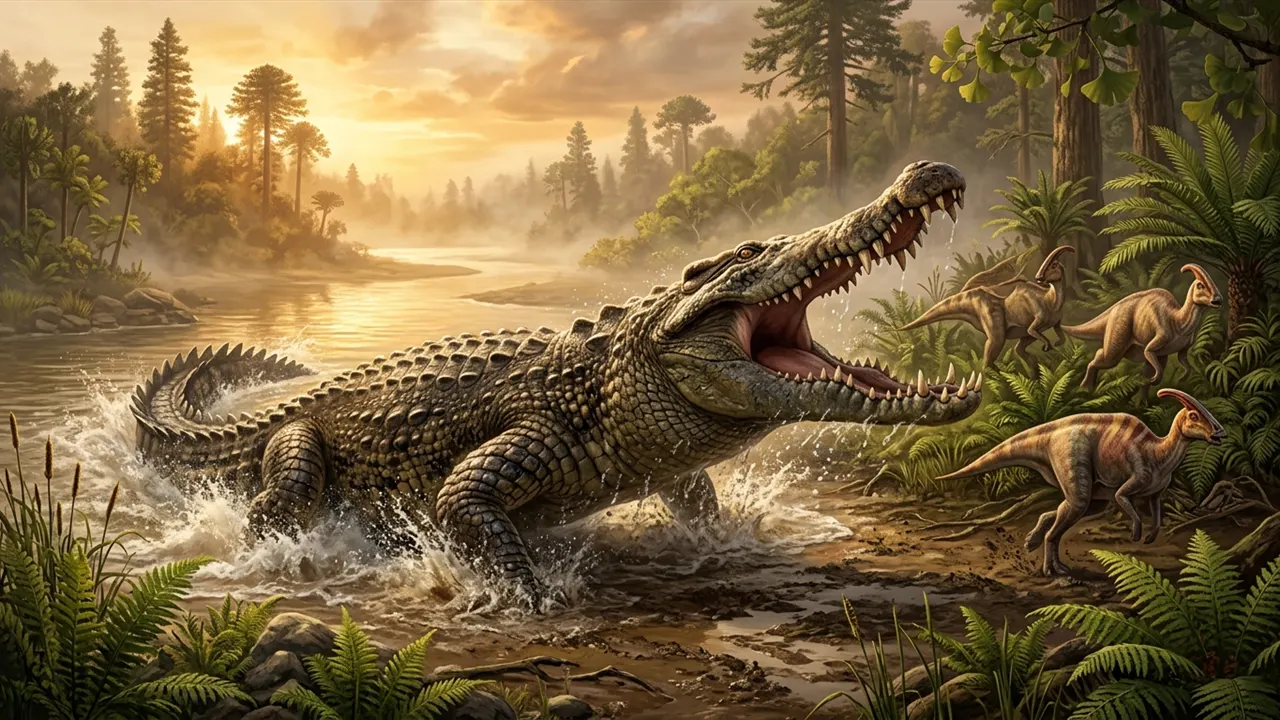
Sarcosuchus & Deinosuchus: The Super-Crocs
Even multi-ton dinosaurs grew cautious whenever thirst forced them down to muddy Cretaceous shorelines. Separated by thirty million years and an ocean, two giant crocodilian cousins independently evolved into armored river monsters nearly twice the length of today's largest saltwater crocodiles. Around one hundred twelve million years ago, Early Cretaceous river basins across North Africa hosted Sarcosuchus imperator, while Late Cretaceous rivers and brackish coastal marshes across North America belonged to Deinosuchus riograndensis. Both titans reached thirty-five to forty feet in length and weighed eight to ten tons!
Though often grouped together as super-crocs, each hunter carried specialized weaponry. Sarcosuchus featured an elongated five-and-a-half-foot skull tipped with a bulbous nasal chamber and over one hundred interlocking conical teeth suited for impaling giant lobe-finned fish and riverside dinosaurs. Broad-snouted Deinosuchus, closer to modern alligators, wielded banana-thick rear teeth and an estimated bite exceeding eighteen thousand pounds of force.
Shielded beneath overlapping rows of bony armor plates, each submerged waited motionless with only raised eyes and nostrils breaking the current. Exploding upward in a wall of spray, they clamped onto drinking duck-billed dinosaurs and twisted into hydro-powered underwater rolls—an ambush proven by punctured dinosaur tail vertebrae! Some dinosaur bones even preserve regrown bone tissue around tooth gouges, showing a lucky few escaped those crushing jaws.
Combining near-invisible submerged stealth with alligator-style jaws outbiting Tyrannosaurus rex, forty-foot super-crocs turned calm riverbanks into dinosaur ambush traps!
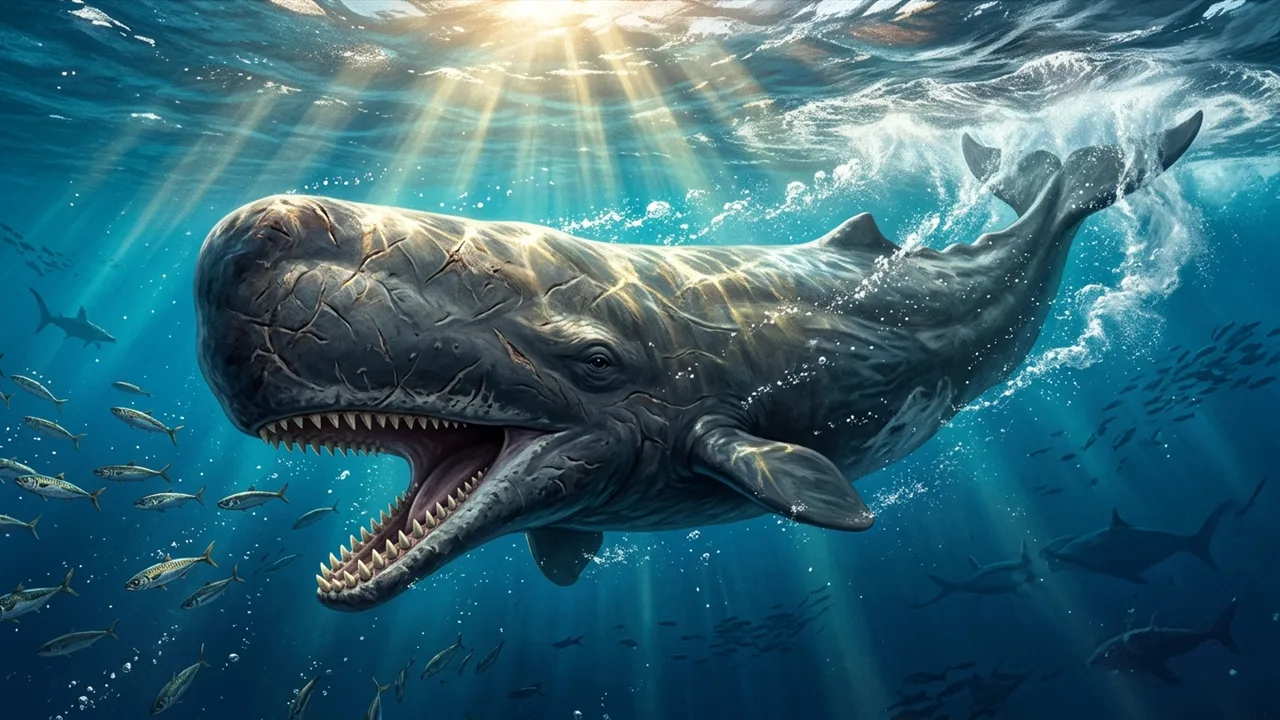
Livyatan: The Whale-Eating Leviathan
Roughly nine to ten million years ago during the Late Miocene Epoch, cool nutrient-rich ocean currents off ancient Peru supported vast herds of seals, dolphins, and medium-sized baleen whales. That marine buffet attracted two rival fifty-ton giants into the exact same waters: the giant shark Megalodon and a ferocious toothed whale named Livyatan melvillei! Unearthed from Peruvian coastal desert rocks in 2008, Livyatan's ten-foot skull revealed a fifty-to-fifty-nine-foot predator unlike any whale swimming on Earth today.
Modern sperm whales dive nearly a mile deep to vacuum up soft-bodied giant squid, carrying modest peg-like teeth only along their narrow lower jaws. Livyatan belonged to an extinct macroraptorial lineage engineered to tear apart massive warm-blooded prey near the sunlit surface. Both its robust upper jaw and muscular lower jaw held thick, interlocking conical teeth measuring up to fourteen point two inches long and nearly five inches across!
Cradled inside a deep basin atop its skull sat a huge wax-filled spermaceti organ that focused powerful sonar clicks through murky ocean water. Armed with mammal endurance, keen social intelligence, acoustic tracking, and record-shattering teeth, this warm-blooded sheared straight through baleen whale blubber and bone—standing fin-to-fin alongside Megalodon at the pinnacle of Miocene seas. When ocean climates cooled and smaller baleen whales vanished, this remarkable killer sperm whale disappeared too.
Armed with sonar targeting and fourteen-inch interlocking teeth in both upper and lower jaws, Livyatan hunted whales across the very same seas ruled by Megalodon!
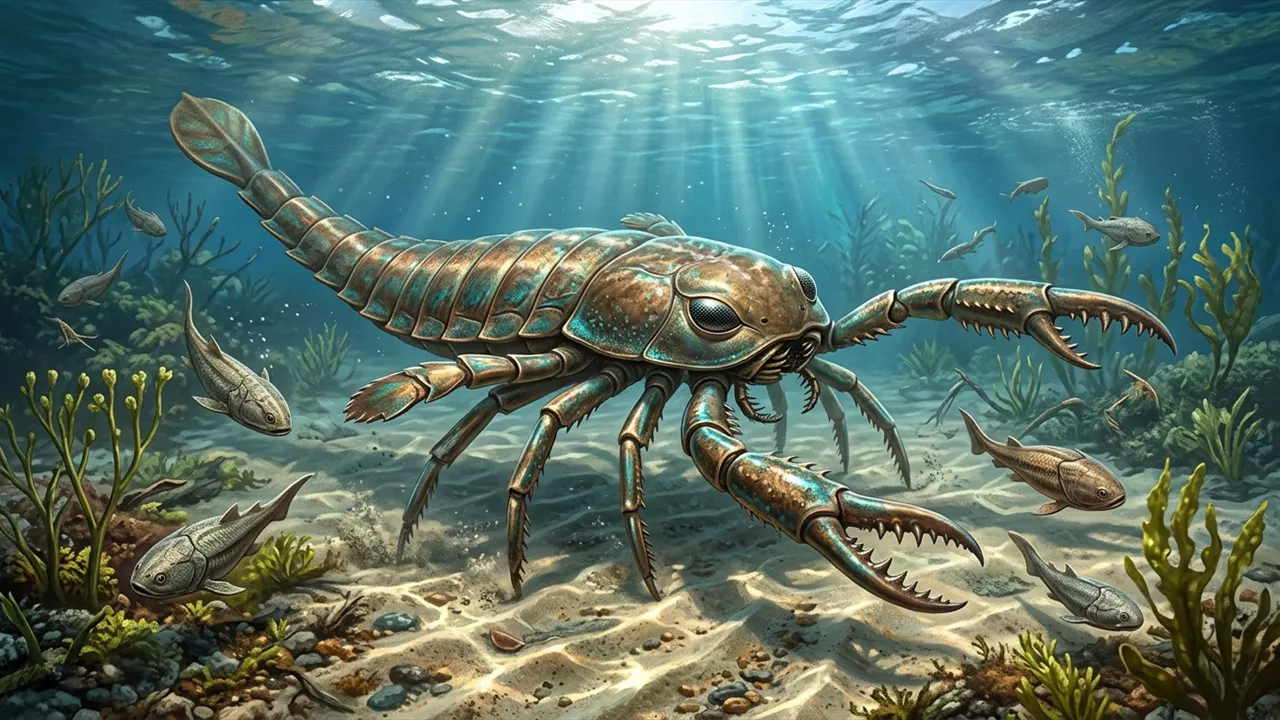
Jaekelopterus: Giant Sea Scorpion
Travel back four hundred million years to the Early Devonian Period of the Era, and planet Earth looks almost like an alien world. Dry continents held only low, leafless vascular plants and tiny creeping bugs, while dramatic life-and-death chases unfolded underwater inside warm river channels and every shallow coastal . Prowling those sunlit, silty currents was Jaekelopterus rhenaniae (pronounced yay-keh-LOP-ter-us reh-NAY-nee-ee), an aquatic hunter known popularly as a giant sea scorpion.
For generations, scientists knew ancient eurypterids could grow big, until hunters excavating Early Devonian rock beds in Rhineland, Germany uncovered a single stone fossil chelicera—a spiked grasping pincer measuring eighteen inches from base to tip! By comparing that massive claw's proportions against complete eurypterid skeletons, paleontologists calculated that its owner stretched roughly eight to eight point two feet long, making Jaekelopterus the largest ever recorded on Earth.
Despite looking like a desert scorpion stretched longer than a professional basketball player, Jaekelopterus belonged to an extinct chelicerate lineage closer to modern horseshoe crabs and arachnids. Its broad tail ended in a flat steering rudder rather than a venomous stinger. Instead of poison, it relied on finely faceted compound eyes with keen depth perception, waiting motionless along muddy riverbeds before snapping serrated, pincer-tipped arms shut around early armored fishes.
Outgrowing every spider, crab, insect, and lobster in Earth's history, this eight-foot freshwater and estuary ambusher seized armored fish in eighteen-inch barbed pincers!
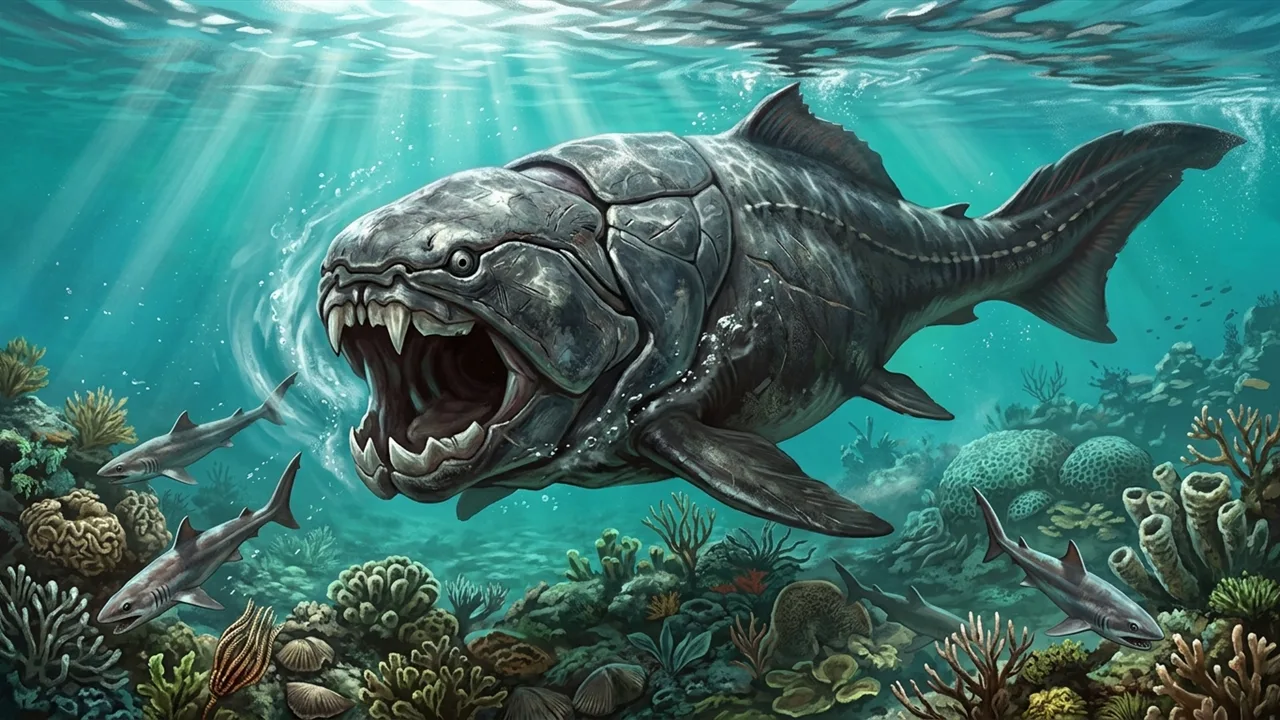
Dunkleosteus: The Armored Guillotine Fish
By the Late Devonian Period—roughly 382 to 358 million years ago in the Era—jawed vertebrates had seized command of warm subtropical seas across the globe. Standing unchallenged atop this Age of Fishes food web was Dunkleosteus terrelli (pronounced DUNK-uhl-OSS-tee-us TAIR-uh-lye), a heavily built reaching twenty to thirty feet in classic length estimates and up to four tons in body mass as an ocean .
Unlike modern sharks or swift bony tuna, the front third of Dunkleosteus was encased in interlocking dermal bone plates nearly two inches thick, while its muscular rear torso remained unarmored and flexible for powerful tail thrusts. Stranger still, Dunkleosteus possessed zero true teeth anywhere in its mouth! Two pairs of dense, fang-shaped gnathal bone plates jutted directly from its upper and lower jaws, sliding tightly past each other with every bite so the heavy bone blades continually sharpened themselves.
When paleontologists modeled three-dimensional stone skulls from Ohio's famous Cleveland Shale, they uncovered an astonishing biomechanical weapon. Driven by a rapid four-bar linkage connecting skull roof, cheek plate, thorax shield, and lower jaw, Dunkleosteus popped its mouth wide open in just twenty milliseconds—generating furious suction that yanked early sharks and shelled ammonoids inward before slamming shut like a hydraulic guillotine capable of shearing solid bone armor in half!
No Devonian swimmer could outreact a twenty-millisecond vacuum strike followed immediately by self-sharpening bone blades concentrating immense pressure onto narrow fang tips!
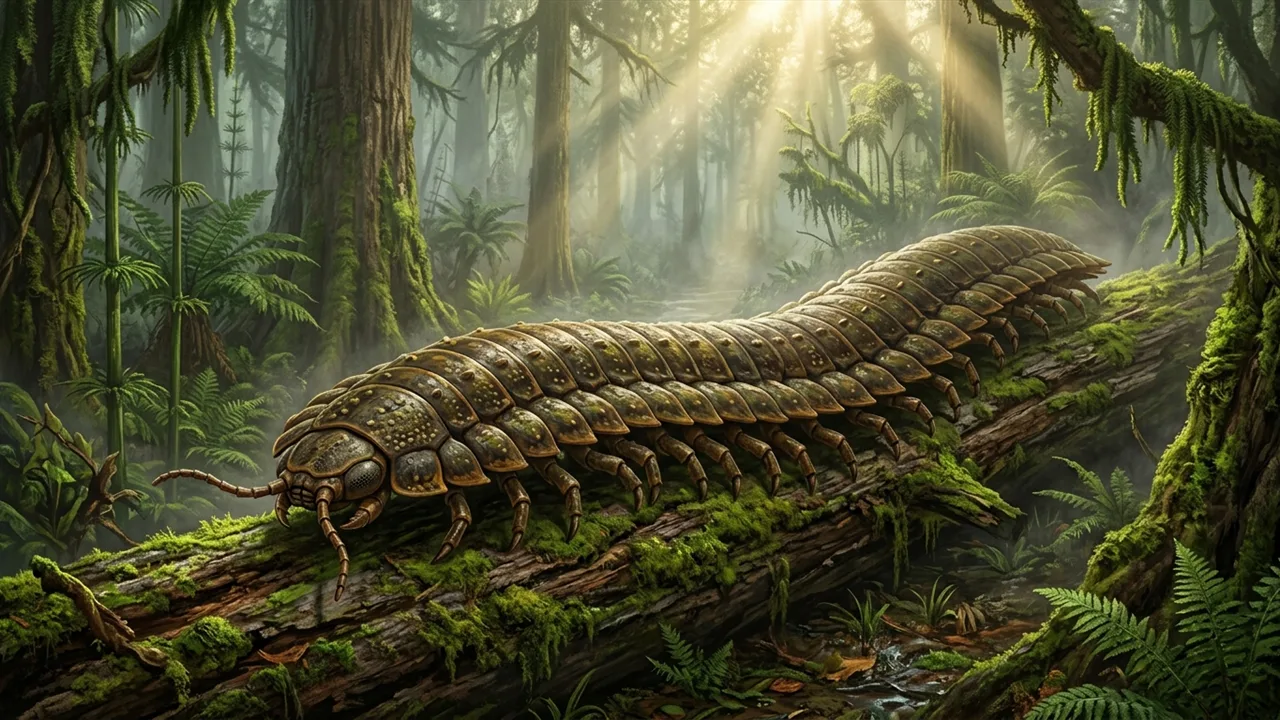
Arthropleura: Car-Sized Swamp Millipede
Around 345 to 290 million years ago during the Carboniferous Period of the Era, vast equatorial wetlands and coastal delta woodlands blanketed what are now Britain, Germany, and eastern North America. Giant club-moss trees over one hundred feet tall and dense fern thickets pumped atmospheric oxygen past thirty percent, while few large land-dwelling vertebrates yet existed to hunt big invertebrates. Through that shady, humid understory rustled Arthropleura (pronounced AR-throh-PLOOR-uh)—a millipede relative built on the scale of a compact family car!
In 2018, a fallen sandstone block on a Northumberland beach in northern England revealed a massive molted shell segment proving adult Arthropleura reached roughly eight and a half feet long, nearly twenty-two inches wide, and around one hundred ten pounds in weight. That remarkable stone confirmed Arthropleura as the largest land and terrestrial ever to walk on Earth, protected across its broad back by roughly thirty overlapping segmented armor plates.
Beneath those wide side flanges marched dozens of jointed legs that left parallel, tire-wide trackways across wet swamp mud and sandy stream banks. Although early textbooks once imagined a venomous hunter, fossilized gut contents and spore-packed droppings show Arthropleura peacefully munched rotting club-moss bark, seeds, and fern spores—yet meeting a hundred-pound armored bug in dim swamp mist remains unforgettable!
Even as a gentle forest detritivore, an eight-and-a-half-foot, twenty-two-inch-wide armored myriapod gliding across damp leaves on dozens of legs is history's ultimate creepy-crawly giant!
Quetzalcoatlus & Haast's Eagle: Sky Terrors
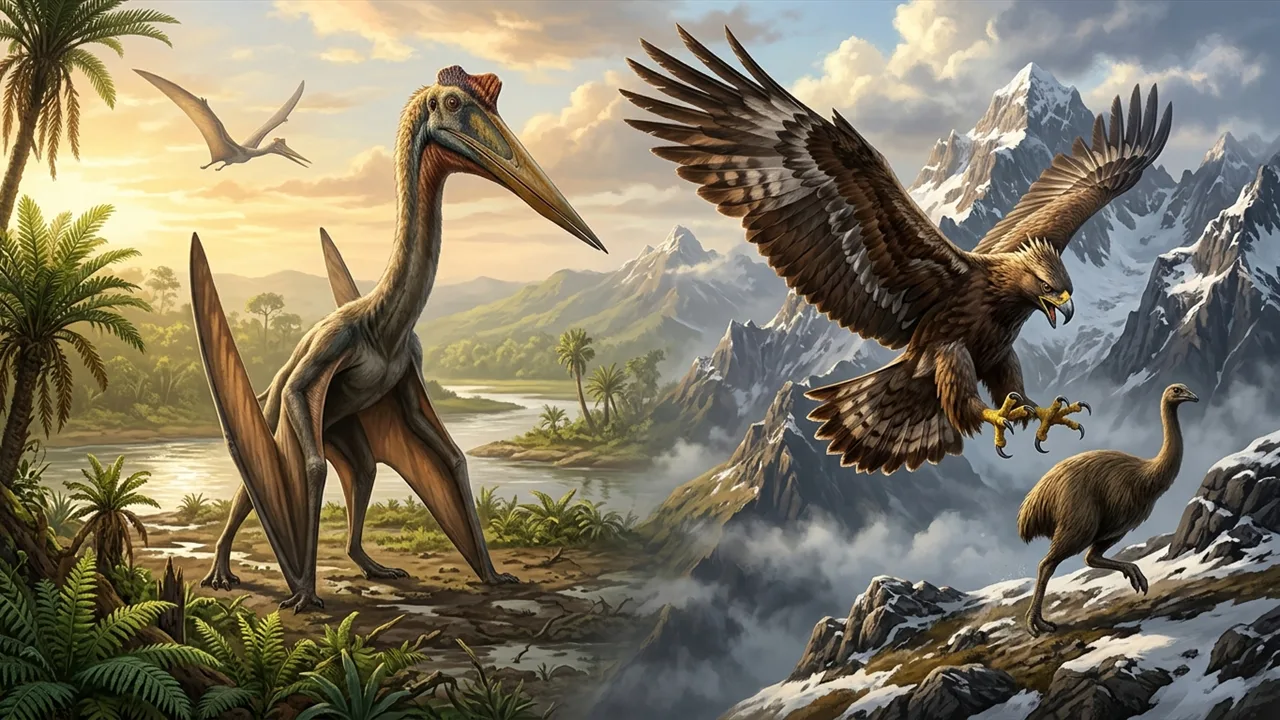
Not even open skies offered safe refuge when prehistoric giants spread their wings across two wildly different chapters of Earth history. Sixty-eight to sixty-six million years ago above Late Cretaceous floodplains in West Texas towered Quetzalcoatlus northropi (pronounced ket-sahl-koh-AHT-lus nor-THROH-pye), an azhdarchid boasting a thirty-to-thirty-six-foot wingspan as wide as a small fighter jet! Kept surprisingly light at roughly five hundred pounds by hollow, air-sac-filled bones, it pole-vaulted eight feet skyward off muscular forelimbs before soaring effortlessly across continents.
Paradoxically, Quetzalcoatlus became even deadlier right after touching down on solid ground. Folding its elongated fourth wing-fingers neatly beside its flanks, it stalked upright on all four limbs at a giraffe-matching height of sixteen to eighteen feet—peering high over floodplain shrubs and whipping down its eight-foot, stork-like spear beak to impale and gulp down human-sized juvenile dinosaurs, small mammals, and lizards whole without chewing!
Fast-forward millions of years to the Ice Age of South Island, New Zealand, where zero native land mammals existed to hunt giant flightless moa birds. Evolution filled that empty predatory role with Haast's Eagle (Hieraaetus moorei), a thirty-five-pound feathered whose compact eight-to-ten-foot wings let it twist rapidly between mountain forest trees at fifty miles per hour, driving tiger-claw-sized talons into five-hundred-pound moa!
Prehistoric skies perfected two opposite nightmares: a giraffe-tall flying reptile stalking floodplains on foot and a high-speed woodland ambush eagle tackling prey fifteen times its weight!
Prehistoric Size & Era Showdown
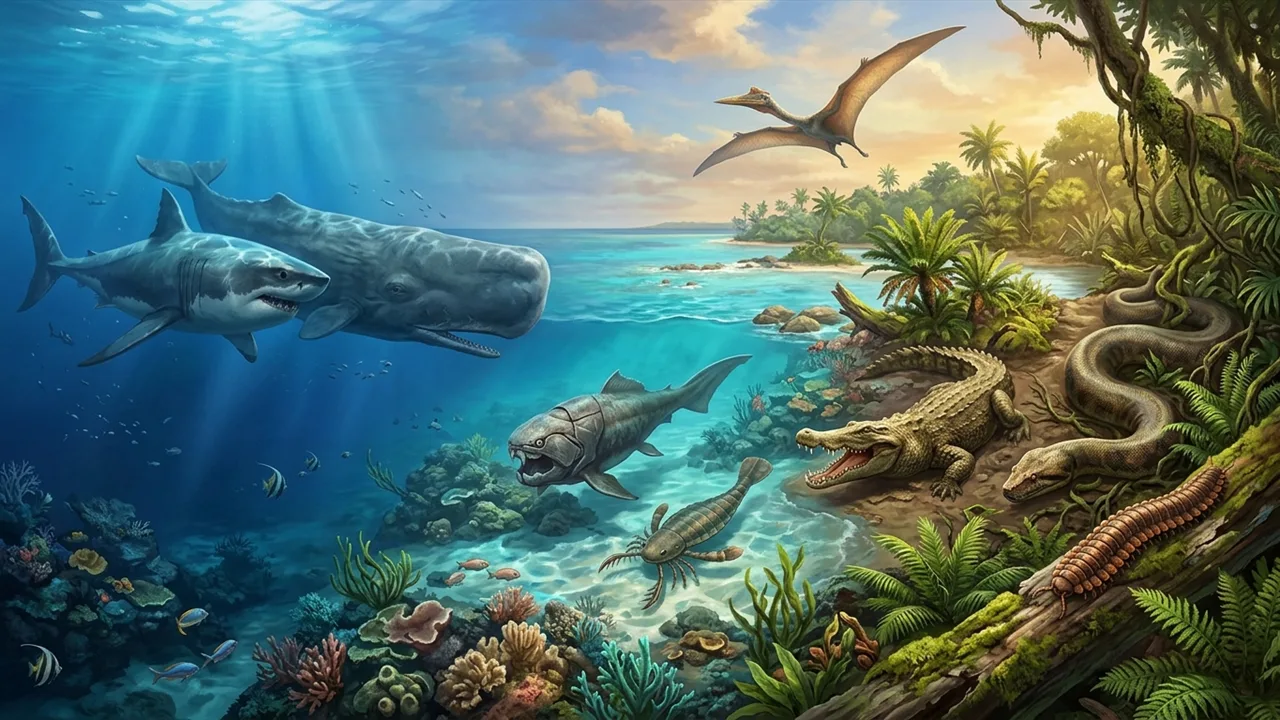
Stepping back to survey more than four hundred million years of deep geological history reveals how Earth's shifting environments sculpted distinct breeds of prehistoric giants across water, land, and sky. During the ancient Era, shallow brackish river mouths, subtropical coral seas, and oxygen-rich coal forests gave rise to eight-foot Jaekelopterus, guillotine-jawed Dunkleosteus, and car-length Arthropleura more than fifty million years before the earliest dinosaur ever hatched on dry land.
Across the Mesozoic Era, sprawling Cretaceous river deltas nourished dinosaur-snatching Super-Crocs like Sarcosuchus and Deinosuchus, while giraffe-tall Quetzalcoatlus patrolled sunny floodplains from above on thirty-six-foot fighter-jet wings. After the end-Cretaceous asteroid impact reshaped global ecosystems sixty-six million years ago, steamy Cenozoic greenhouse swamps, whale-filled Miocene oceans, and isolated mountain islands fueled fifty-foot Titanoboa, raptorial Livyatan, sixty-foot Megalodon, and giant Haast's Eagle.
Comparing all eight chapters side by side highlights two crucial biological principles: dense saltwater buoyancy and calorie-rich whale blubber allowed marine vertebrates to reach fifty to sixty-five tons, whereas molted outer exoskeletons capped terrestrial arthropods near eight and a half feet. Yet extreme size also made every specialized vulnerable whenever global climates cooled or food webs collapsed, leaving stone bones, teeth, and tracks ranked in the visual scale chart below!
| Creature | Max Size & Scale | Habitat | Geological Era |
|---|---|---|---|
| 1. Megalodon | 60 ft long. |
🌊 Sea | Cenozoic (Miocene–Pliocene, 23–3.6 MYA). |
| 2. Livyatan | 59 ft long. |
🌊 Sea | Cenozoic (Late Miocene, 9.9–8.9 MYA). |
| 3. Titanoboa | 48–50 ft long. |
🌿 Land / Swamp | Cenozoic (Paleocene, 60–58 MYA). |
| 4. Sarcosuchus & Deinosuchus | 40 ft long. |
🌊 River / Estuary | Mesozoic (Cretaceous, 112–73 MYA). |
| 5. Quetzalcoatlus & Haast's Eagle | 36 ft / 10 ft wingspan. |
☁️ Sky | Mesozoic (Cretaceous) & Cenozoic (Pleistocene). |
| 6. Dunkleosteus | 25–30 ft long. |
🌊 Sea | Paleozoic (Late Devonian, 382–358 MYA). |
| 7. Arthropleura | 8.5 ft long. |
🌿 Land / Swamp | Paleozoic (Carboniferous, 345–290 MYA). |
| 8. Jaekelopterus | 8.2 ft long. |
🌊 River / Estuary | Paleozoic (Early Devonian, ~400 MYA). |
Megalodon and Livyatan dominate overall length and tonnage in buoyant seas, Titanoboa and Super-Crocs rule swamps and rivers, and Quetzalcoatlus claims the all-time wingspan crown!