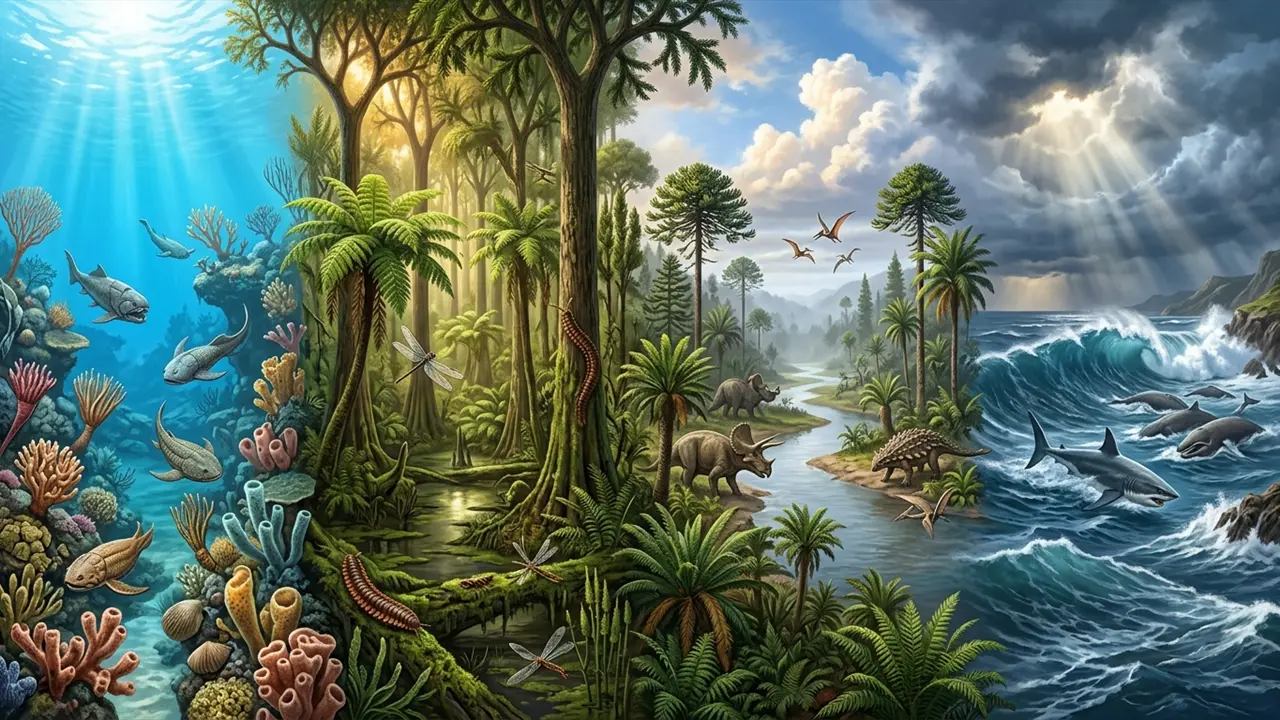
Welcome to Earth's Deadliest Eras
Earth's modern lions, sharks, and crocodiles are impressive hunters, yet they look almost modest beside the titans of deep time. Over the past four hundred million years, shifting continents, warm oceans, and oxygen-rich forests produced giant animals that stretch human imagination. During the ancient Era, long before a single dinosaur hatched, eight-foot sea scorpions and guillotine-jawed armored fish ruled shallow waters while car-sized millipedes rustled across coal swamps.
Next came the Mesozoic Era, when forty-foot super-crocs waited beneath dinosaur rivers and giraffe-tall flying reptiles shadowed open plains. Even after an asteroid ended the dinosaur age, the Cenozoic Era unleashed fifty-foot rainforest snakes, sixty-foot sharks, and whale-eating sperm whales!
How can paleontologists measure creatures that vanished millions of years ago? Every mineralized skull, tooth scar, and backbone acts like a puzzle piece locked in stone. By testing jaw leverage and studying ancient rock layers, researchers discover exactly how each prehistoric ruled land, sea, or sky.
Across eight thrilling chapters, stone clues reveal how shifting climates and food webs built Earth's greatest real-life monsters—and why changing worlds eventually ended their reign!
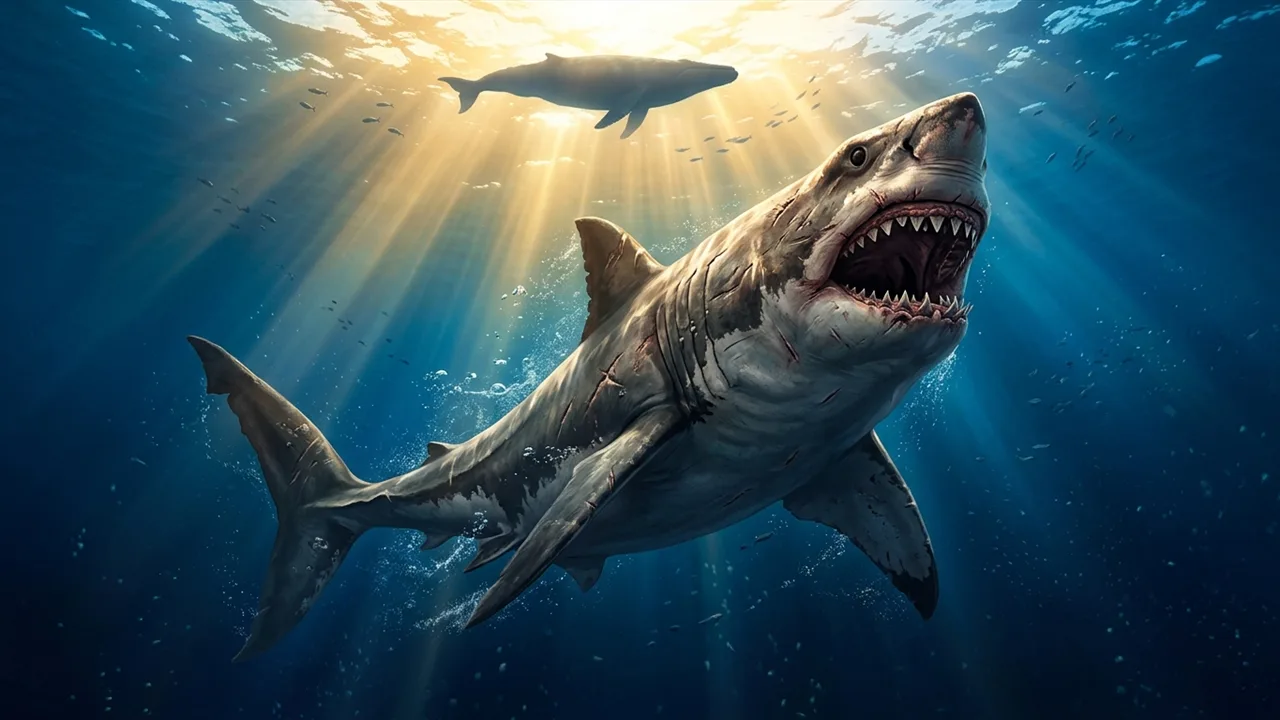
Megalodon: The Sixty-Foot Shark King
From twenty-three million to roughly three point six million years ago, no ocean swimmer anywhere on Earth was completely safe from Otodus megalodon. Reaching fifty-nine to sixty feet in length and weighing up to sixty-five tons, this colossal mackerel shark grew three times longer than today's largest great white sharks. Its muscular torpedo body patrolled warm oceans around the globe.
Megalodon's hinged jaws spanned nearly seven feet wide and held about two hundred seventy-six thick, triangular teeth arranged in five conveyor-belt rows. Each seven-inch tooth featured razor-sharp edges engineered to slice dense blubber and saw straight through solid whale bone. Computer models estimate its bite reached roughly forty thousand pounds of force—more than triple the bite of Tyrannosaurus rex!
Rather than chasing small fish, this marine ambushed medium-sized baleen whales from below, smashing flippers and rib cages first. Because shark cartilage dissolves quickly after death, paleontologists reconstruct Megalodon from rare vertebrae and thousands of triangular teeth.
Charging upward from dark ocean depths, Megalodon delivered a forty-thousand-pound bite strong enough to crush a whale's chest in a single impact!
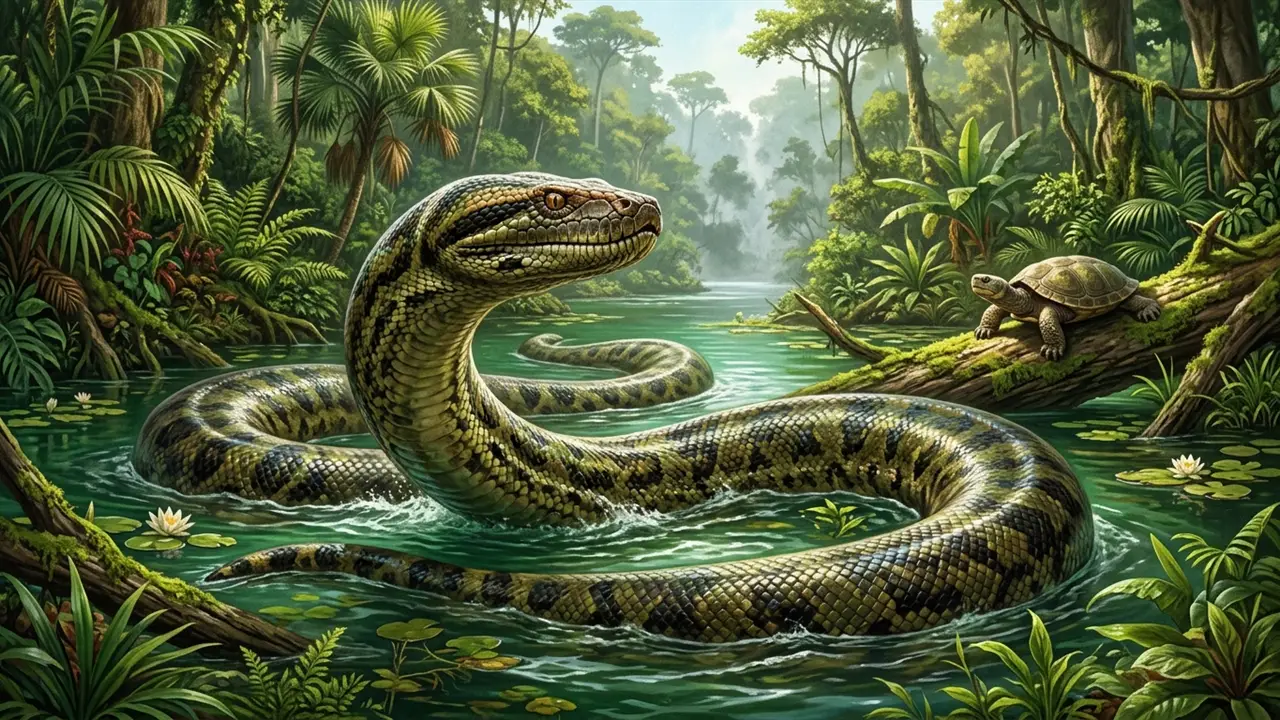
Titanoboa: Monster Snake of the Swamp
After an asteroid impact ended the age of non-avian dinosaurs sixty-six million years ago, lush tropical rainforests spread across northern South America during the Paleocene Epoch. Year-round greenhouse heat allowed cold-blooded reptiles to reach record sizes. Inside Colombia's soggy Cerrejón river basins slithered Titanoboa cerrejonensis, a snake stretching forty-two to fifty feet long and weighing well over two thousand five hundred pounds!
At nearly three feet wide across its muscular middle, Titanoboa moved slowly on dry mudbanks yet glided effortlessly through murky swamp channels. Acting much like a giant modern anaconda, this semi-aquatic waited underwater until five-foot shelled turtles, giant lungfish, or twelve-foot crocodiles drifted within striking range.
Titanoboa possessed zero venom fangs. Instead, it lunged with rows of backward-curved teeth and wrapped victims inside heavy coils, using fatal to stop blood flow and breathing. In 2009, coal miners and paleontologists unearthed twenty-eight giant snakes preserved as dark stone vertebrae.
Longer than a school bus and camouflaged in tea-colored swamp water, Titanoboa crushed armored crocodiles and giant river turtles inside inescapable coils!
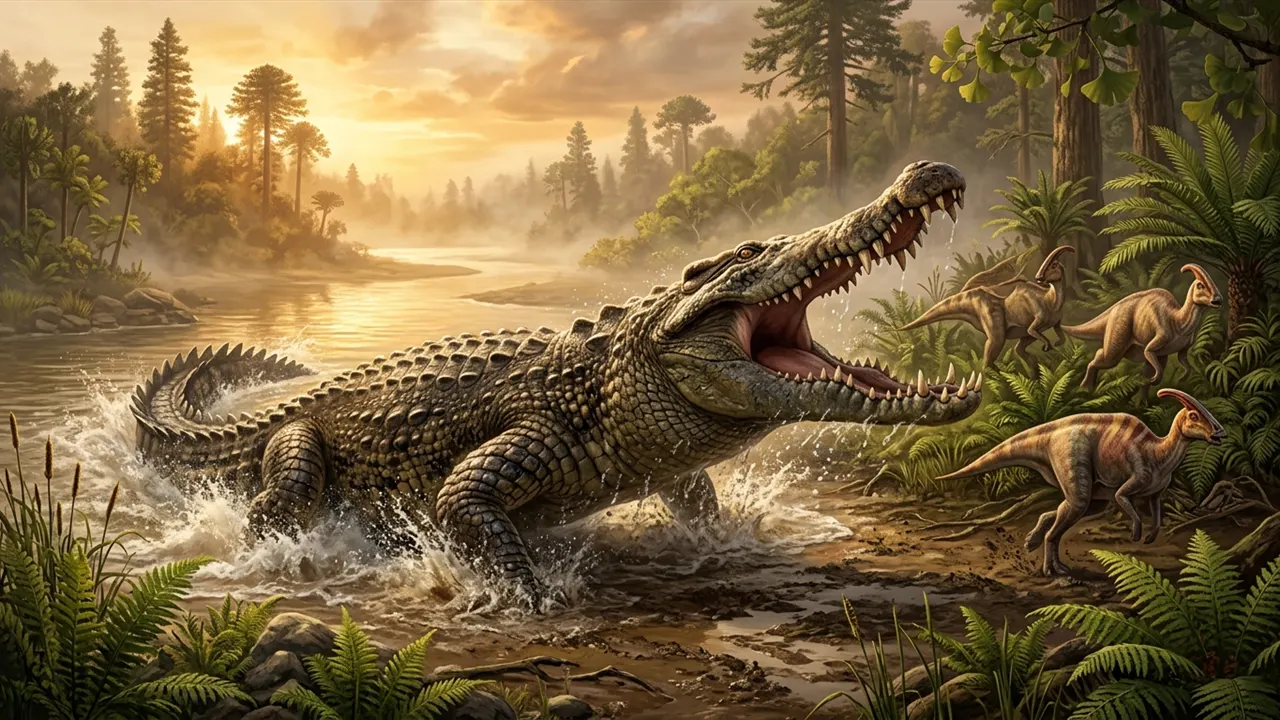
Sarcosuchus & Deinosuchus: The Super-Crocs
Dinosaurs ruled Cretaceous continents, yet stepping down to muddy waterholes brought them face-to-face with armored giants twice as long as modern Nile crocodiles. Around one hundred twelve million years ago, North African rivers sheltered Sarcosuchus imperator. Roughly thirty million years later, coastal rivers and tidal channels across North America belonged to Deinosuchus riograndensis. Both giants stretched thirty-five to forty feet long and tipped the scales at eight to ten tons!
Covered in thick bony armor plates called osteoderms, these patient hunters drifted just beneath cloudy water with only raised eyes and nostrils breaking the surface. Sarcosuchus seized giant river fish and young dinosaurs in narrow five-and-a-half-foot jaws, while broader-snouted Deinosuchus wielded crushing bite pressure exceeding eighteen thousand pounds.
Once locked onto a drinking dinosaur's leg or snout, each waterway spun violently underwater in a signature crocodile roll. Punctured and healed duck-billed dinosaur bones prove these dramatic shoreline ambushes truly happened!
Nearly invisible until the final yard, forty-foot super-crocs exploded out of calm Cretaceous rivers to drag multi-ton dinosaurs beneath the current!
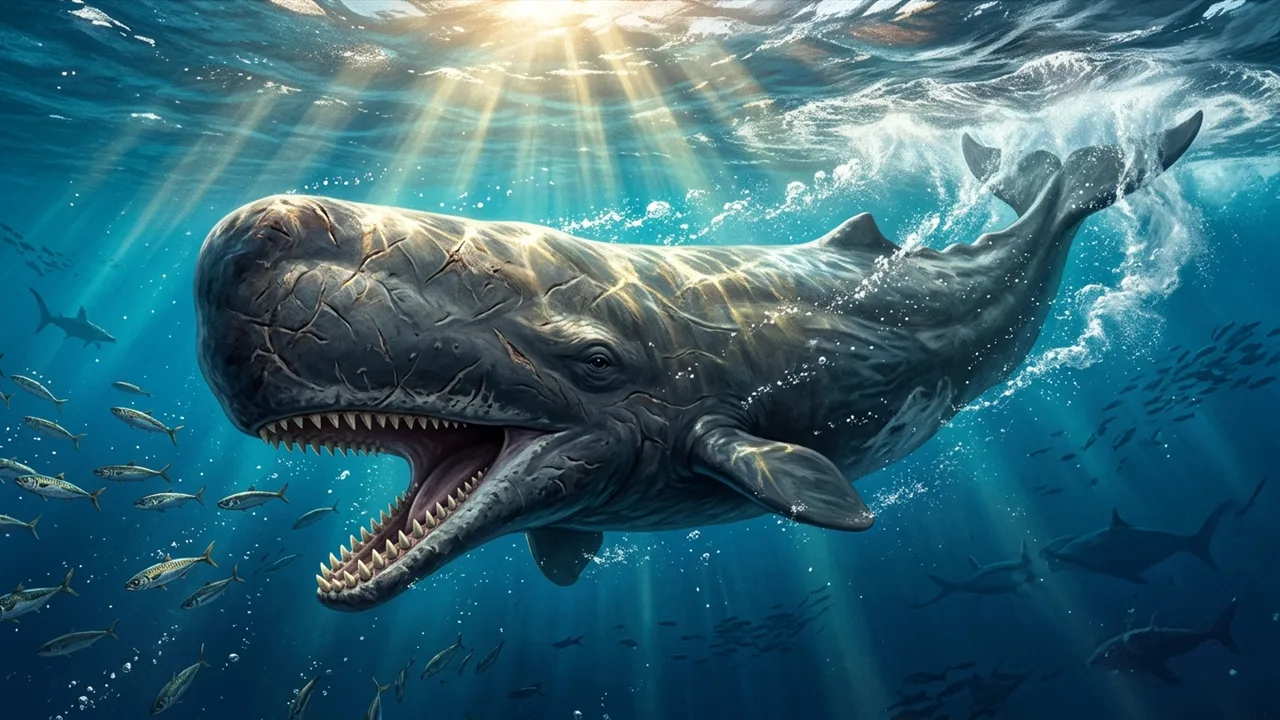
Livyatan: The Whale-Eating Leviathan
Imagine diving into cool Late Miocene seas off ancient Peru nine million years ago, only to realize Megalodon was not the sole fifty-ton giant patrolling the waves! Sharing the exact same oceans and whale prey was Livyatan melvillei, a fierce prehistoric sperm whale measuring fifty to fifty-nine feet long. Discovered in coastal desert cliffs in 2008, its ten-foot skull stunned marine scientists around the world.
Today's deep-diving sperm whales carry modest teeth only in their narrow lower jaws and suck in soft deep-sea squid. Livyatan hunted completely differently! Both its heavy upper jaw and massive lower jaw held interlocking conical teeth up to fourteen inches long and nearly five inches thick—the largest biting teeth of any animal ever discovered.
Inside a giant bowl atop its skull sat a wax-filled organ that beamed rapid clicks through dark water. Guided by pinpoint sonar and mammal intelligence, this warm-blooded ambushed twenty-five-foot baleen whales whenever they surfaced for air.
Combining sonar tracking, warm-blooded stamina, and foot-long interlocking teeth in both jaws, Livyatan tore through whales across Megalodon's own hunting grounds!
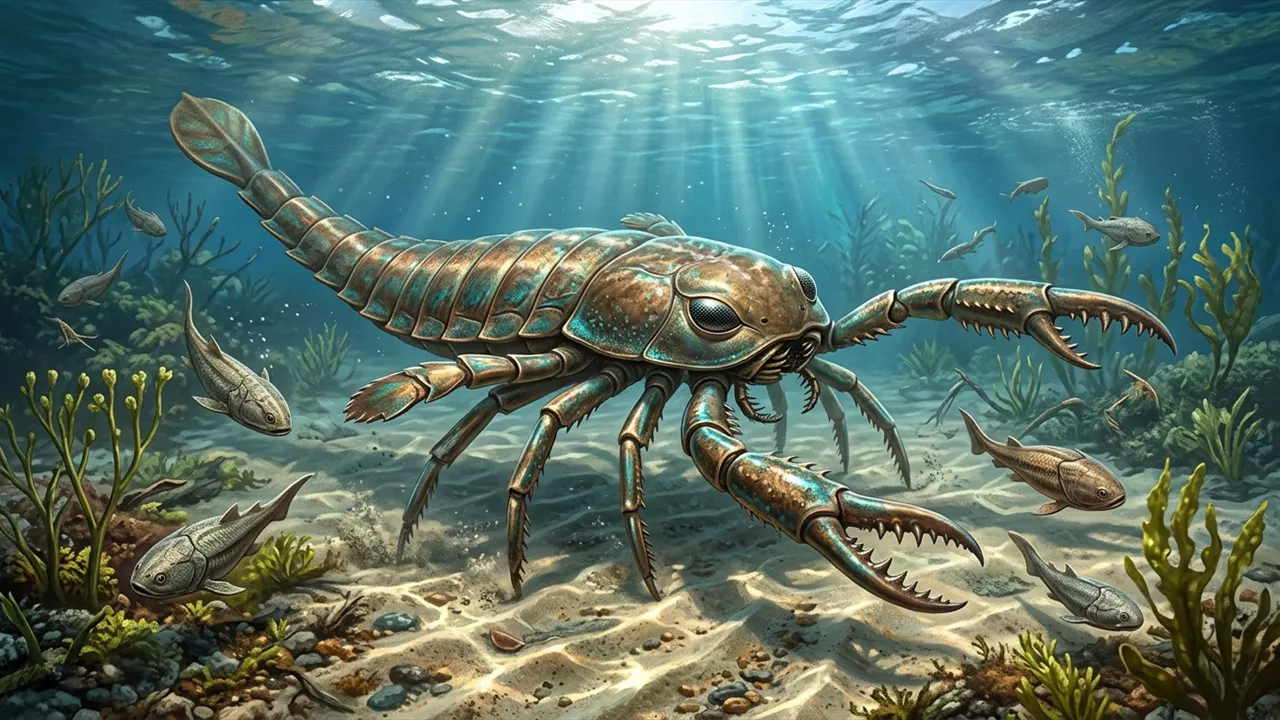
Jaekelopterus: Giant Sea Scorpion
Nearly four hundred million years ago—more than one hundred fifty million years before the earliest dinosaurs—the Early Devonian Period of the Era belonged to strange armored swimmers. Along shallow river deltas and each brackish coastal , murky water hid Jaekelopterus (pronounced yay-keh-LOP-ter-us), a monster sea scorpion longer than a tall adult human!
Paleontologists uncovered its true size in Germany when they split open Early Devonian rock layers and found an eighteen-inch stone pincer. Scaling up carefully from that single barbed weapon revealed a total body length of more than eight feet, crowning Jaekelopterus the largest ever discovered in Earth's entire history.
Despite its spooky nickname, Jaekelopterus was an aquatic cousin of modern horseshoe crabs, and its wide flat tail worked as a steering paddle rather than a venom stinger. It never needed poison anyway: large compound eyes tracked movement through dim river currents while long, spike-lined front claws shot forward to slice and crush early jawless fishes.
Hiding in shallow river mouths where land animals later took their first steps, an eight-foot armored arthropod lunged out of muddy water with eighteen-inch barbed pincers!
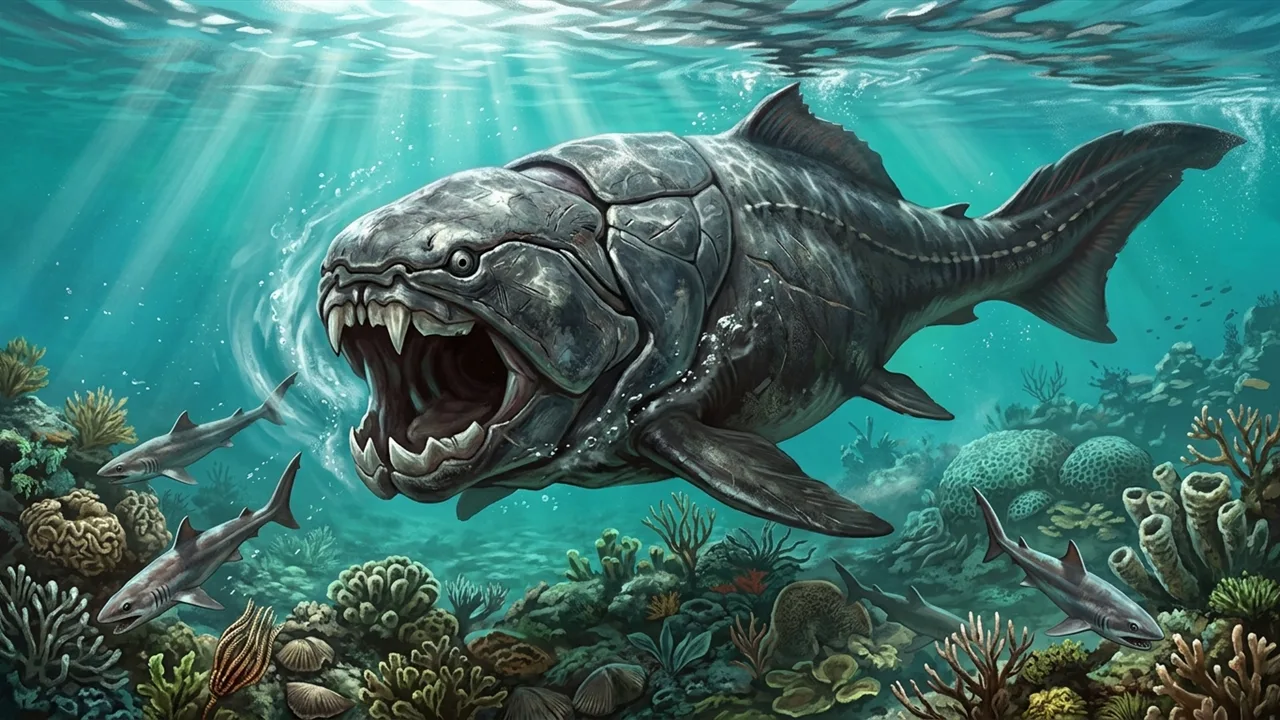
Dunkleosteus: The Armored Guillotine Fish
Twenty million years after Jaekelopterus prowled rivers, the Late Devonian Period earned its famous scientific nickname, the Age of Fishes. Out in warm subtropical seas patrolled Dunkleosteus (pronounced DUNK-uhl-OSS-tee-us), a twenty-to-thirty-foot that weighed up to four tons and reigned over ancient reefs as the ocean's undisputed .
Thick interlocking plates of solid dermal bone shielded its massive skull and chest like an armored submarine hull, yet inside its mouth sat zero true teeth! Instead, two pairs of fang-tipped bony jaw blades rubbed tightly against one another every time Dunkleosteus bit down, grinding their edges razor-sharp like self-honing metal shears.
Biomechanics studies of stone skulls unearthed in Ohio show that Dunkleosteus used a special four-bar hinge linking its head, neck, and lower jaw. In just twenty milliseconds—one-fiftieth of a second—its mouth snapped wide open, creating an unstoppable suction rush that pulled early sharks and shelled ammonoids straight onto its guillotine blades!
Combining lightning-fast twenty-millisecond suction with thousands of pounds of bite pressure focused onto razor-thin bone blades, Dunkleosteus sheared cleanly through rival armor!
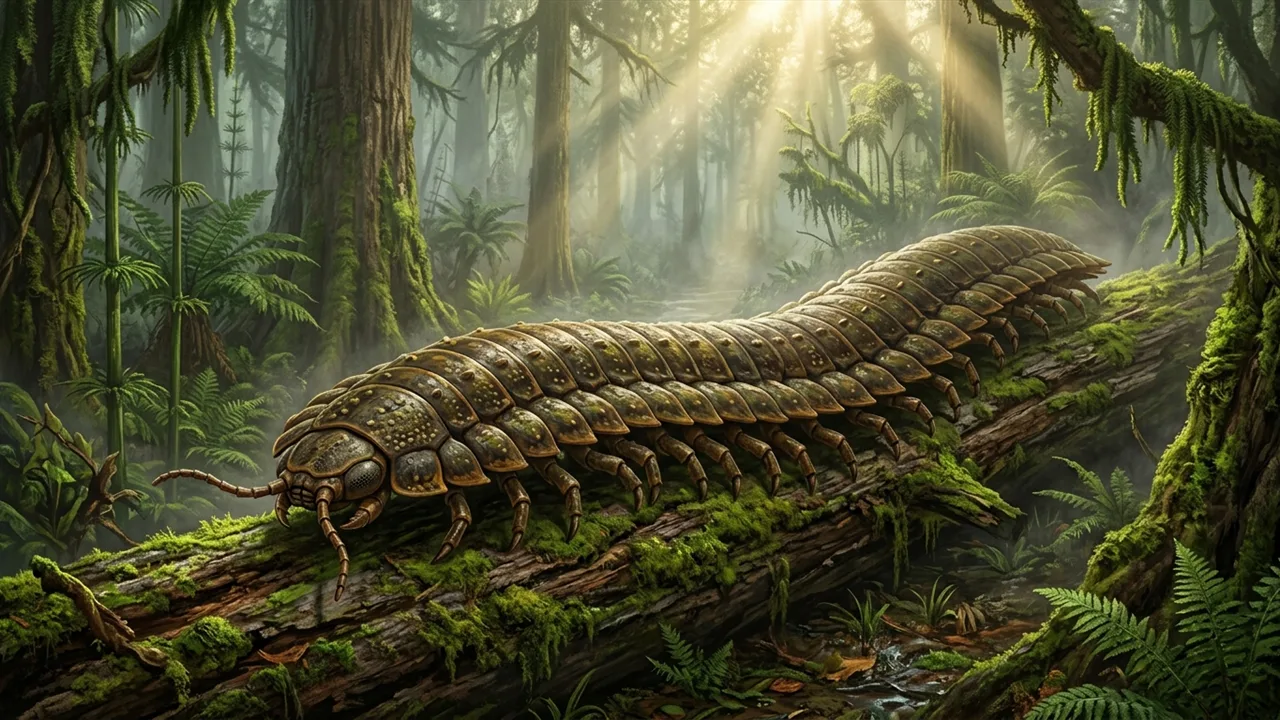
Arthropleura: Car-Sized Swamp Millipede
Step out of Devonian seas and into the steamy, moss-draped coal swamps of the Carboniferous Period, late in the Era. Towering scale trees, giant horsetails, and shady tree ferns released huge amounts of fresh oxygen into Earth's atmosphere—helping produce Arthropleura (pronounced AR-throh-PLOOR-uh), a swamp millipede as long as a compact family car!
Measuring up to eight and a half feet long, nearly two feet wide, and roughly one hundred ten pounds, Arthropleura stands unchallenged as the largest land and terrestrial ever discovered. Around thirty overlapping segmented plates curved neatly over dozens of jointed legs, shielding its wide body from hungry, crocodile-sized swamp amphibians.
For decades, scientists wondered whether this giant bug hunted meat. However, stone trackways preserved in Britain and tiny plant spores packed inside fossilized droppings proved Arthropleura was a peaceful detritivore that munched decaying club-moss logs and seeds! Still, picturing a hundred-pound armored bug rustling beside your boots is pure nightmare fuel.
Harmless diet or not, encountering an eight-and-a-half-foot segmented arthropod wider than a car tire skittering through misty swamp ferns would freeze any explorer in place!
Quetzalcoatlus & Haast's Eagle: Sky Terrors
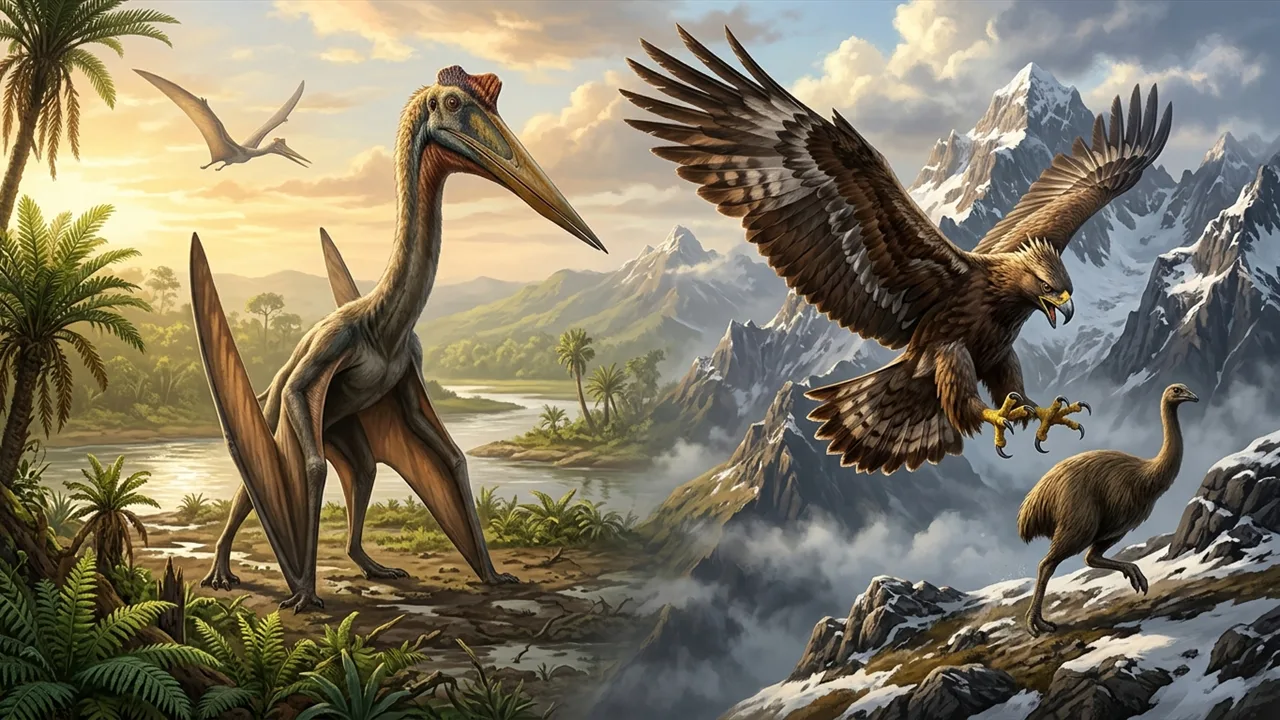
Prehistoric danger also plunged straight down from the clouds across two very different eras! Sixty-seven million years ago in Late Cretaceous Texas lived Quetzalcoatlus (pronounced ket-sahl-koh-AHT-lus), the largest flying animal ever known. With hollow air-filled bones and a thirty-six-foot wingspan rivaling a small fighter jet, this giant vaulted eight feet upward off muscular forelimbs to catch rising warm winds.
Even scarier was how Quetzalcoatlus hunted right after landing on solid ground. Folding its leathery wings upright beside its body, it stood sixteen to eighteen feet tall—eye to eye with a modern giraffe—and strode rapidly on all four limbs across open floodplains, using its eight-foot toothless beak like giant chopsticks to spear and swallow human-sized young dinosaurs whole!
Millions of years later, in New Zealand, dense mountain forests sheltered Haast's Eagle, the heaviest true eagle ever discovered. Functioning as the island's top , it tucked broad ten-foot wings to weave swiftly between forest trees at fifty miles per hour, slamming tiger-sized talons into flightless moa weighing five hundred pounds!
Neither open floodplains nor thick forest canopies were safe when giraffe-tall pterosaurs stalked on four limbs and thirty-five-pound eagles struck prey fifteen times their weight!
Prehistoric Size & Era Showdown
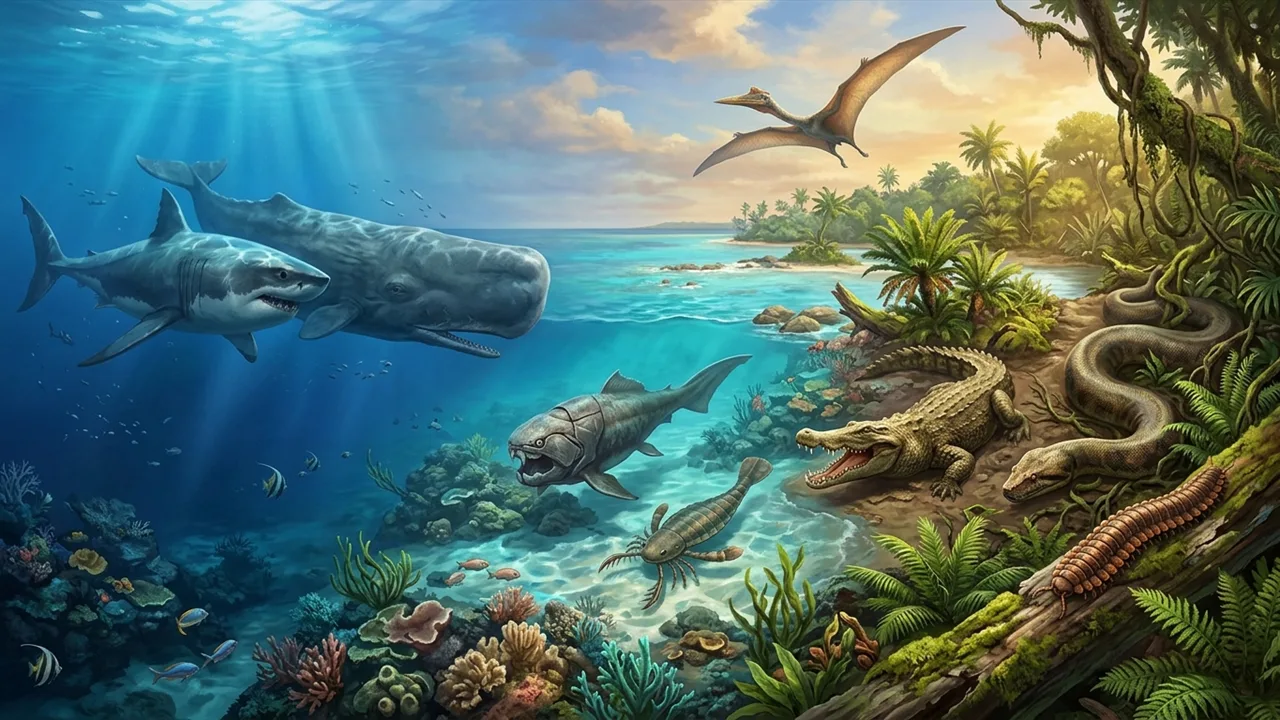
Journeying across more than four hundred million years of deep time reveals that no single geological era held a monopoly on prehistoric giants. Ancient river mouths, subtropical seas, and misty coal forests forged armored pioneers like eight-foot Jaekelopterus, guillotine-jawed Dunkleosteus, and car-sized Arthropleura long before dinosaurs appeared. Later, Mesozoic rivers and skies unleashed dinosaur-ambushing Super-Crocs and giraffe-tall Quetzalcoatlus.
After non-avian dinosaurs vanished sixty-six million years ago, warm Cenozoic swamps, deep oceans, and isolated islands produced fifty-foot Titanoboa, whale-eating Livyatan, sixty-foot Megalodon, and bone-crushing Haast's Eagle. Notice a clear biological pattern: ocean buoyancy and blubber-rich whales let marine vertebrates grow longest and heaviest, while molted outer shells kept land arthropods much smaller.
Every giant depended on stable habitats and abundant prey, so cooling climates and shifting food webs eventually ended each titan's reign. Using stone clues dug from rock layers around the globe, paleontologists ranked all eight chapters in the showdown chart below—compare their maximum lengths, wingspans, habitats, and eras side by side!
| Creature | Max Size & Scale | Habitat | Geological Era |
|---|---|---|---|
| 1. Megalodon | 60 ft long. |
🌊 Sea | Cenozoic (Miocene–Pliocene, 23–3.6 MYA). |
| 2. Livyatan | 59 ft long. |
🌊 Sea | Cenozoic (Late Miocene, 9.9–8.9 MYA). |
| 3. Titanoboa | 48–50 ft long. |
🌿 Land / Swamp | Cenozoic (Paleocene, 60–58 MYA). |
| 4. Sarcosuchus & Deinosuchus | 40 ft long. |
🌊 River / Estuary | Mesozoic (Cretaceous, 112–73 MYA). |
| 5. Quetzalcoatlus & Haast's Eagle | 36 ft / 10 ft wingspan. |
☁️ Sky | Mesozoic (Cretaceous) & Cenozoic (Pleistocene). |
| 6. Dunkleosteus | 25–30 ft long. |
🌊 Sea | Paleozoic (Late Devonian, 382–358 MYA). |
| 7. Arthropleura | 8.5 ft long. |
🌿 Land / Swamp | Paleozoic (Carboniferous, 345–290 MYA). |
| 8. Jaekelopterus | 8.2 ft long. |
🌊 River / Estuary | Paleozoic (Early Devonian, ~400 MYA). |
From eight-foot armored river bugs to sixty-foot whale-hunting sharks, evolution repeatedly built ultimate specialists—until changing Earth environments rewrote the rules of survival!