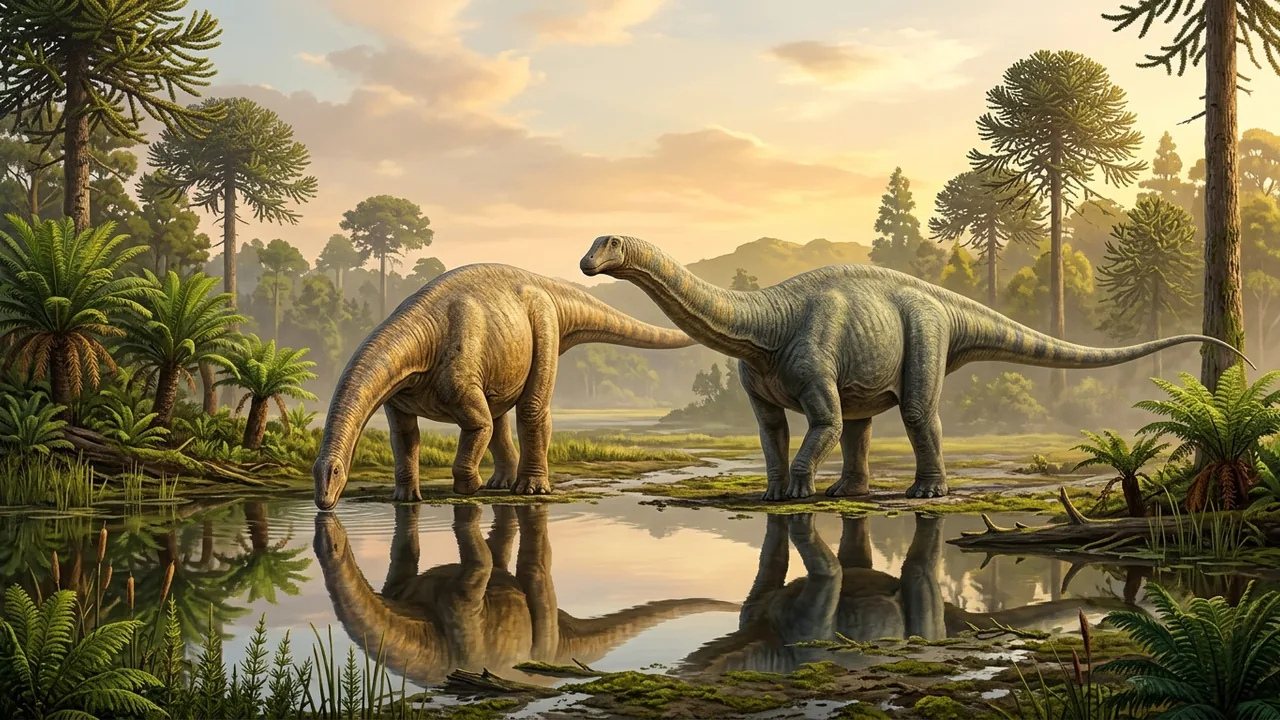
Meet the Legend: Heavyweight Champion of Diplodocids
Within the Upper Jurassic Morrison ecosystem, Apatosaurus represents the pinnacle of muscular robustness inside the whip-tailed family Diplodocidae. When Yale paleontologist Othniel Charles Marsh described holotype specimen YPM 1860 from foothills outside Morrison, Colorado, in 1877, he coined the name 'deceptive lizard' because its V-shaped caudal chevrons bore a startling superficial resemblance to those of marine mosasaurs.
Measuring twenty-one to twenty-three meters in length while tipping volumetric mass estimates between eighteen and twenty-five metric tons—with giant Oklahoma specimen OMNH 1670 potentially exceeding thirty tons—Apatosaurus outweighed comparably long Diplodocus by more than fifty percent!
Together with its resurrected sister genus Brontosaurus, Apatosaurus anchors the brawny subfamily , distinguished by heavily reinforced appendicular limb bones and astonishingly wide cervical vertebrae. Despite that stocky, barrel-chested silhouette, internal computed tomography confirms extensive postcranial skeletal hollowed its presacral column, allowing pulmonary air sacs to trim tons of dead bone weight.
Quantitative comparisons of humeral and femoral shaft circumferences reveal safety factors engineered to support immense forequarter musculature without sacrificing terrestrial mobility across seasonal river basins. Histological thin sections drilled from cortical limb walls further demonstrate rapid juvenile bone growth followed by dense structural remodeling as adults approached maximum body mass.
Consequently, Apatosaurus combined the long axial reach and caudal bullwhip of diplodocids with the sheer structural mass, wide stance, and forequarter power of a living siege engine across Late Jurassic North America, commanding floodplain trails wherever perennial rivers sustained evergreen woodlands and broad riverside fern meadows.
Lost World Habitat: Upper Morrison Gallery Corridors
High-precision argon-argon radiometric dates and regional place Apatosaurus ajax and Apatosaurus louisae predominantly within the upper Brushy Basin Member of the Morrison Formation, spanning roughly 152 to 150 million years ago during the late Kimmeridgian and early Tithonian stages. Fluvial sandstone channel belts, overbank mudstones, and paleosol carbonate horizons across Colorado, Utah, Wyoming, and Oklahoma record a warm, seasonally semi-arid alluvial plain dissected by snowmelt- and monsoon-fed rivers.
Along those perennial waterways thrived lush riparian gallery forests composed of Araucariaceae and Cheirolepidiaceae conifers, Ginkgoales, tree ferns, horsetail marshes, and dense understories of tough bennettitalean and cycadalean gymnosperms. Stable carbon and oxygen isotope profiles extracted from tooth enamel suggest members of favored wetter, more wooded riparian and lakeshore habitats than savanna-cruising Diplodocus, partitioning floodplain flora cleanly among sympatric sauropods.
Narrow-to-intermediate-gauge trackways impressed into point-bar silts confirm herds walked fully upright across firm substrates and shallow river crossings rather than buoying themselves in deep lakes.
Sharing these shaded gallery oases were plated Stegosaurus, camptosaurid ornithopods, goniopholidid crocodylomorphs, lungfish, freshwater unionid clams, and stealthy theropods stalking woodland edges at dusk.
Seasonal water-table fluctuations preserved deep sauropod footprint basins lined with ostracod shells and calcified aquatic plants, demonstrating how migrating Apatosaurus herds actively engineered floodplain micro-wetlands that sustained amphibians, fishes, crayfish, turtles, and aquatic insects throughout sunny dry intervals between summer monsoon rains across four western states where colorful badlands expose those ancient river deposits for geologists studying Mesozoic climates and ecosystems today across western North America.
What's on the Prehistoric Menu?
Sustaining twenty-plus metric tons of active sauropod biomass demanded ingesting hundreds of kilograms of fibrous gymnosperms and pteridophytes daily without wasting a single minute on oral mastication. Equipped with an elongated diplodocoid skull featuring slightly broader premaxillary and maxillary arches than square-snouted Diplodocus, Apatosaurus deployed procumbent cylindrical peg teeth to nip and strip tough cycad fronds, Equisetum stems, ferns, and low-to-mid-level conifer shoots up to five meters high.
For decades, museum displays asserted that sauropods pulverized coarse foliage inside an avian-style muscular gizzard loaded with swallowed river cobbles—each stone termed a . Taphonomic and experimental tumbling studies led by Oliver Wings scrutinized that claim rigorously: verified in-situ stone clusters occur in vanishingly few sauropod skeletons, lack consistent gizzard-polish microtexture, and represent less than 0.03 percent of body mass—orders of magnitude too small to function as a mechanical gastric mill!
Instead, unchewed plant boluses entered an immense, multi-meter hindgut vat where symbiotic cellulolytic bacteria and ciliates conducted prolonged anaerobic over seventy-two to ninety-six hours.
Extended gut retention time—enabled purely by colossal torso volume—allowed Apatosaurus to extract rich volatile fatty acids from recalcitrant Mesozoic evergreens while keeping its skull extraordinarily light.
Continuous tooth-replacement batteries inside the premaxilla and dentary supplied fresh enamel crowns every single month, preventing gritty floodplain horsetails, coarse cycad petioles, and tough woody shoots from wearing down its harvesting apparatus across decades of active riverside browsing along shady woodland channels and lush lakeside fern glades year after year.
Superpowers, Senses & Anatomy
No anatomical region proclaims the brawn of more dramatically than the cervical series of Apatosaurus louisae. Beneath fifteen deeply pleurocoelous neck centra hung extraordinarily thick, laterally flaring cervical ribs anchored by stout parapophyseal and diapophyseal struts, expanding the lower neck into a broad, muscular triangle reinforced with rugose ventral bone bosses!
Above the neural canal, deeply bifurcated neural spines cradled a massive elastic ligament cable, while invasive avian-style air-sac diverticula generated intricate camerate that removed more than half of internal vertebral bone mass and vented excess digestive heat.
In 2015, biomechanical analyses by Mike Taylor, Matt Wedel, and Darren Naish highlighted that Apatosaurus's wide, thick-walled cervical ribs and massive epaxial-hypaxial muscle scars far exceeded simple foraging requirements, supporting an intraspecific 'neck-bashing' hypothesis analogous to combat in bull giraffes or elephant seals!
Down below, robust humeri and femora with thick cortical walls supported tubular metacarpal colonnades cushioned by elastic plantar pads. Each forefoot bore a single enlarged, medially curved pollex ungual on digit one, pairing rock-steady graviportal support with potent close-quarters striking power.
Engineering stress models indicate those reinforced ventral cervical struts absorbed steep bending and torsional loads without buckling, allowing mature adults to swing their muscular necks vigorously during rival contests or predator encounters while keeping delicate cervical blood vessels, spinal nerves, and respiratory airways completely shielded inside sturdy bony channels throughout energetic movements across soft floodplain ground during every dry or wet season of the year.
Flight vs. Fight Arena: Siege Engine of the Floodplain
Navigating shaded Morrison gallery forests brought Apatosaurus face to face with specialized ambush carnivores—including horn-snouted Ceratosaurus nasicornis, pack-hunting Allosaurus fragilis, and riparian giant Torvosaurus tanneri! Like all sauropods, life began perilously: buried clutches of spherical, porous-shelled eggs produced multi-kilogram hatchlings that relied on cryptic understory cover and rapid vascularized bone deposition to race out of predator jaw range.
Once mature at twenty to twenty-five metric tons, however, adult Apatosaurus occupied the ultimate Team Fight fortress! Outweighing a one-ton Ceratosaurus more than twentyfold, its columnar limbs traded running speed for unyielding stability while deploying formidable weapons at both ends of its twenty-two-meter body.
Posteriorly, an eighty-vertebra caudal whip tapered down to slender biconvex rods capable of sweeping fourteen-meter defensive arcs at velocities exceeding thirty meters per second (~70+ mph). Anteriorly, cervical allowed surprisingly brisk pivots of its heavily muscled neck, delivering bone-shattering ventrolateral slams alongside downward slashes from its stout pollex thumb claws!
Confronted by coordinated herds of twenty-ton titans around dusk watering holes, gallery-forest theropods prudently restricted attacks to isolated juveniles or infirm stragglers.
Paleopathological surveys across Morrison quarries corroborate this ecological standoff: while shed theropod teeth frequently accompany scavenged drought carcasses on ancient sandbars, healed predatory bite trauma is virtually nonexistent on healthy adult apatosaurine limb and rib elements, proving sheer body mass and muscular weaponry discouraged direct assaults throughout adult life across western river valleys and open seasonal wetlands where multi-generational herds gathered safely under shady conifer canopies.
Fossil Detective Secrets: Quarry Sandbars & True Skulls
Modern scientific mastery of Apatosaurus owes an enduring debt to August 17, 1909, when Carnegie Museum paleontologist Earl Douglass discovered eight articulated caudal vertebrae protruding from tilted Morrison Formation sandstone in northeastern Utah. Excavating into that fluvial channel deposit uncovered CM 3018—the spectacular holotype skeleton of Apatosaurus louisae—and established what became Dinosaur National Monument in 1915.
Only four meters from CM 3018's neck lay an elongated, peg-toothed diplodocoid skull (CM 11162), which Douglass rightly argued belonged to his giant sauropod; yet prevailing assumptions forged by Marsh led museums for nearly seven decades to leave CM 3018 headless or crown it with a boxy Camarasaurus skull! In 1978, meticulous quarry-map and cervical-condyle articulation checks by John McIntosh and David Berman vindicated Douglass, uniting Apatosaurus with its true low-slung skull in 1979.
Subsequent taphonomic work scrutinized polished quartz pebbles in the quarry to distinguish genuine digestive clasts from fluvial bedload gravel, while Emanuel Tschopp's 2015 phylogenetic monograph confirmed Apatosaurus and Brontosaurus represent distinct sister genera within .
Today, Utah's enclosed Quarry Exhibit Hall preserves over 1,500 bones in original river sandstone, inviting students to read Jurassic forensic clues firsthand.
Modern laser surface scanning, digital photogrammetry, and synchrotron microtomography of Douglass's historic quarry blocks continue revealing microscopic bone growth rings, internal pneumatic resorption textures, and subtle enamel wear facets more than a full century after their initial discovery high on those sunlit Utah ridges overlooking the winding Green River valley in eastern Utah.